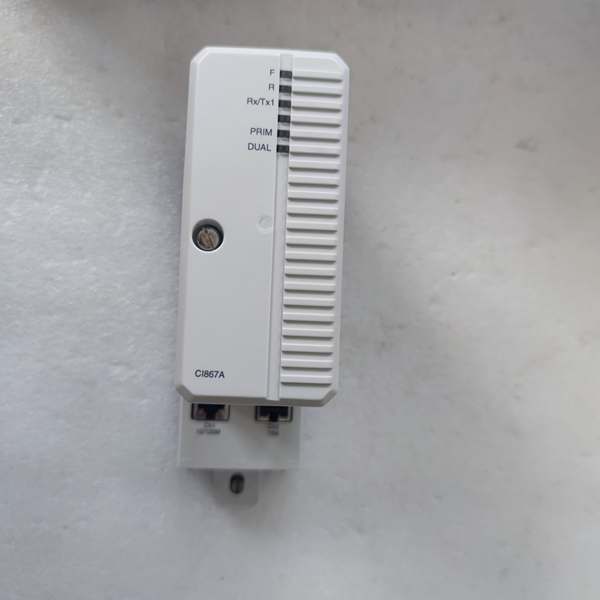
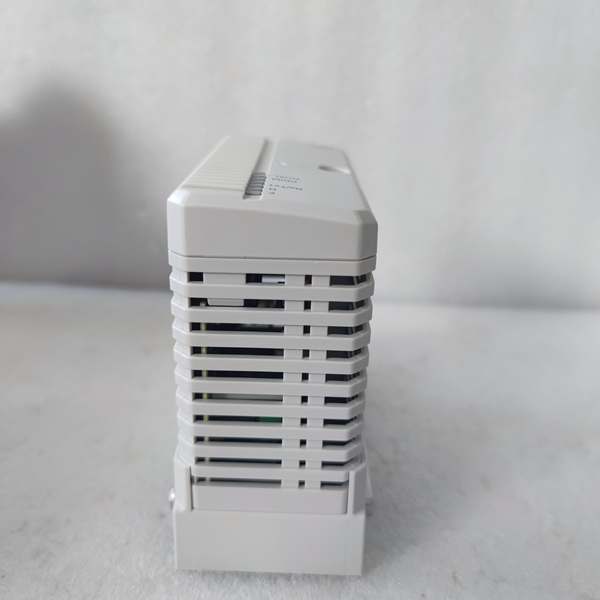
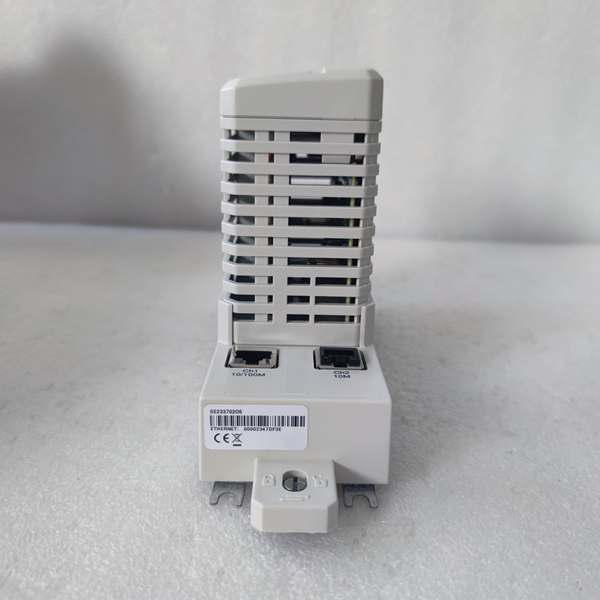
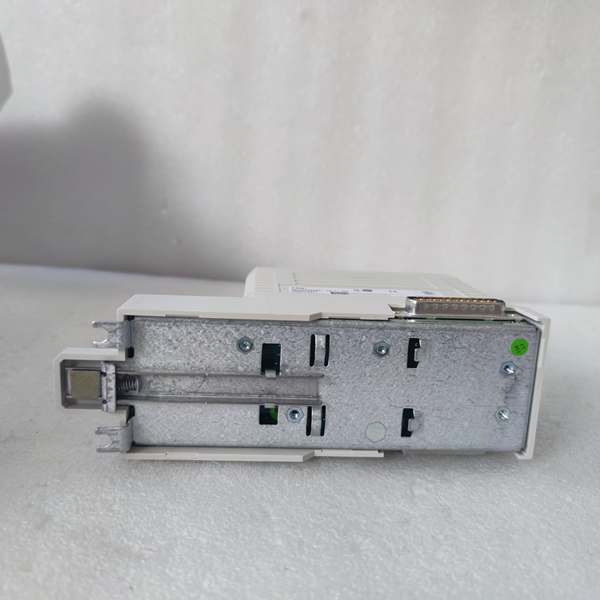
Description
Key Technical Specifications
-
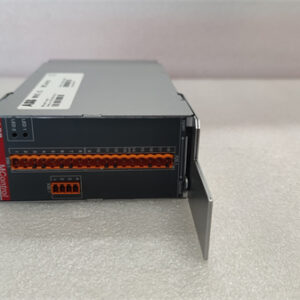
Model Number: CI615 3BHT300024R1
-
Manufacturer: ABB
-
Number of Channels: 8 (independent, software-configurable)
-
Input Type: 4-20mA (2/4-wire), RTD (PT100, 2/3/4-wire), 0-10V DC
-
Resolution: 16-bit ADC (65536 steps)
-
Accuracy: ±0.1% of reading (4-20mA/0-10V), ±0.2% of reading (RTD)
-
Electrical Isolation: 1500Vrms (channel-to-channel, channel-to-bus)
-
Power Supply: 24V DC (±10%, drawn from Symphony Plus I/O rack backplane)
-
Operating Temperature: -25°C to +60°C
-
Storage Temperature: -40°C to +85°C
-
Signal Filtering: Configurable low-pass filter (0.1-10Hz)
-
Communication Interface: S800 I/O bus (proprietary high-speed serial)
-
Protection Rating: IP20 (panel-mount, finger-safe terminals)
- Weight: 0.25kg

Field Application & Problem Solved
In the field, analog signal acquisition is a headache when dealing with noisy environments, mixed sensor types, and long cable runs. Older 4-channel modules force technicians to stack units, creating clutter and increasing wiring errors. This 8-channel module solves that by consolidating inputs—whether 4-20mA from a pressure transmitter, PT100 RTD from a reactor thermometer, or 0-10V from a level sensor—into one compact unit. You’ll find it in chemical plants monitoring distillation column pressures, power plants tracking boiler feedwater temperature, or wastewater facilities measuring tank levels. Its core value is twofold: 1500Vrms isolation kills EMI from VFDs or motors (a constant battle in paper mills), and 0.1% accuracy catches subtle process drifts—like a 0.5°C rise in a reactor that precedes catalyst degradation. Built-in diagnostics (open-circuit, sensor drift) also flag failing transmitters before they skew control loops. For example, in a refinery’s hydrotreater, it detected a drifting temperature sensor early, preventing a $50k batch loss.
Installation & Maintenance Pitfalls (Expert Tips)
-
Mismatched Sensor Wiring: Rookies often confuse 2-wire vs. 4-wire 4-20mA loops. 2-wire sensors share power/ground with the signal; 4-wire have separate pairs. Wire incorrectly, and you’ll get noise or no reading. Label each sensor type on the schematic.
-
Skipping Filter Configuration: The module’s low-pass filter (0.1-10Hz) is disabled by default. In vibrating environments (e.g., compressor skids), enable a 1-2Hz filter to block high-frequency noise. Test with a scope to avoid over-filtering.
-
Ignoring RTD Lead Resistance: 3/4-wire RTDs cancel lead resistance, but 2-wire setups require compensating for cable length. For 100ft runs, use 4-wire RTDs—otherwise, expect 0.5-1% error.
-
Poor Shield Grounding: Shielded twisted-pair is a must, but grounding at both ends creates loops. Ground shields only at the I/O rack(not the sensor end) to avoid induced currents.
-
Forgetting Calibration Checks: Even with 0.1% accuracy, calibrate annually with a Fluke 754. Compare module readings to a calibrated simulator—drift beyond 0.2% means the ADC needs service.
Technical Deep Dive & Overview
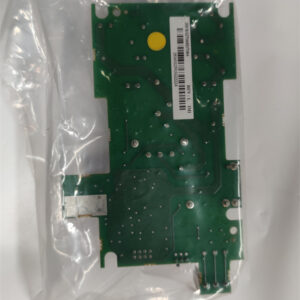
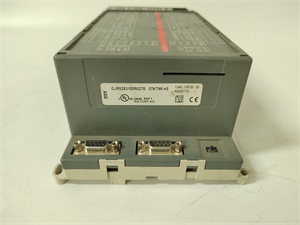
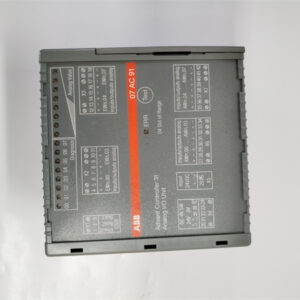
The CI615 3BHT300024R1 is an 8-channel analog input module for ABB’s Symphony Plus DCS. It acts as a front-end signal conditioner: raw inputs (4-20mA, RTD, 0-10V) are filtered, amplified, and converted via a 16-bit ADC. Each channel is software-configurable—set it for 2-wire 4-20mA, 3-wire PT100, etc.—with cold-junction compensation for RTDs. The 1500Vrms isolation between channels and the S800 bus prevents ground loops, critical in plants with mixed AC/DC systems. Internally, a dedicated DSP handles linearization (e.g., RTD curves) and error checking (open circuits, overrange). Processed data (scaled to engineering units) is sent to the Symphony Plus controller (HS-series) via the backplane bus, with cycle times as low as 10ms. Hot-swappable with redundant power, it allows replacement without shutting down the DCS. In short, it’s a rugged signal coprocessor that turns messy field voltages into clean data—built to survive the noise and grime of real-world plants.