Description
Key Technical Specifications
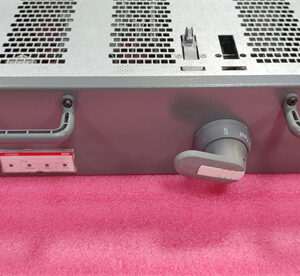
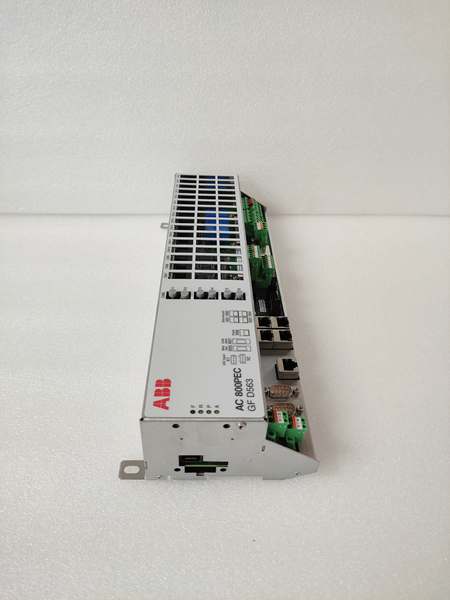
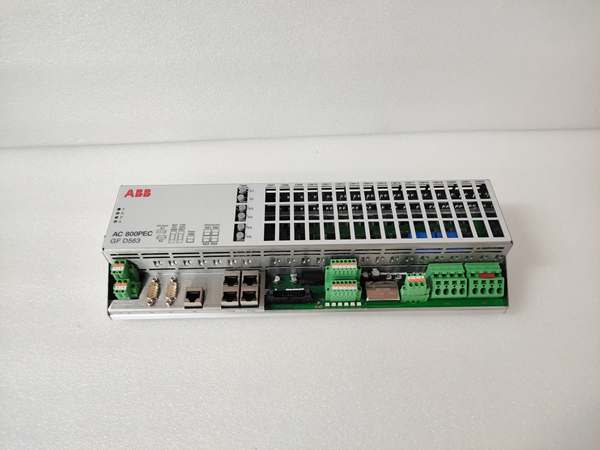
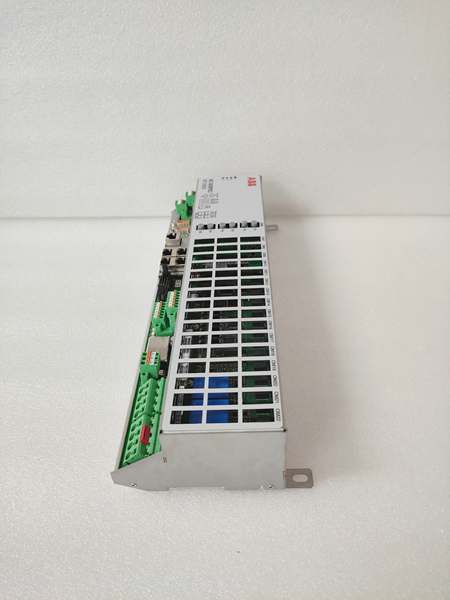
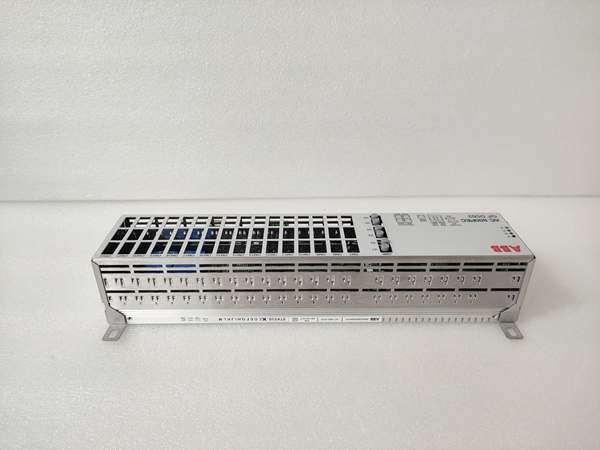
- Model Number: ABB GFD563A101 3BHE046836R0101
- Manufacturer: ABB
- Device Type: Three-phase full-wave rectifier module (field diode assembly)
- Rated Current: 600A (continuous), 1200A (peak surge)
- Rated Voltage: 1200V DC (reverse voltage rating)
- Diode Configuration: 6 x high-power silicon diodes (3-phase bridge)
- Operating Temperature: -40°C to 125°C (-40°F to 257°F)
- Storage Temperature: -55°C to 150°C (-67°F to 302°F)
- Isolation: 2.5kV AC (module-to-ground, 1-minute withstand)
- Thermal Resistance: 0.08°C/W (junction-to-heatsink)
- Mounting: Direct heatsink mounting (compatible with ABB excitation skid)
- Cooling Requirement: Forced air (6 m/s) or liquid cooling (depending on application)
- Weight: 4.2 kg (9.26 lbs)
- Connector Type: Heavy-duty busbar terminals (M12 studs)

GFD563A101 3BHE046836R0101
Field Application & Problem Solved
In power generation—gas turbine plants, combined-cycle facilities, and industrial cogeneration systems—generator field excitation is the backbone of reliable power output. The challenge? Turbine generators require stable, high-current DC power to energize the rotor field, but standard rectifier modules fail under the extreme thermal and electrical stress of turbine operation. They overheat during peak loads, suffer diode degradation from voltage spikes, or lack the ruggedness to withstand vibration in turbine enclosures. The ABB GFD563A101 solves these critical issues with high-current capacity, thermal resilience, and a robust design tailored to turbine environments.
You’ll exclusively find this module in ABB SGT-800 gas turbines and compatible excitation systems, where it converts three-phase AC from the exciter generator into DC power for the main generator’s rotor field. It’s also used in retrofits of older ABB turbine systems (e.g., SGT-700 upgrades), replacing obsolete rectifier modules that struggle with modern load demands. In combined-cycle plants, it operates in tandem with ABB’s UNITROL excitation controllers, ensuring precise field current regulation—critical for maintaining grid frequency and voltage stability. Offshore platform turbines rely on it for its wide temperature range (-40°C to 125°C), which withstands harsh marine environments.
Its core value is uncompromising reliability under extreme conditions. The 600A continuous current rating handles peak load surges (up to 1200A) without thermal shutdown, a common failure point in lower-rated modules. The rugged diode assembly resists voltage transients from grid fluctuations or turbine load changes, preventing catastrophic diode failure that would take the generator offline. For plant operators, this means minimal unplanned downtime—critical in power generation, where a single turbine outage can cost hundreds of thousands in lost revenue.
Installation & Maintenance Pitfalls (Expert Tips)
- Heatsink Contact Is Non-Negotiable (Poor Thermal Transfer = Premature Failure): The module dissipates massive heat (up to 5kW at full load), so rookies often skip proper heatsink preparation. The mating surface of the heatsink must be flat (max 0.1mm warp) and cleaned with isopropyl alcohol to remove oil or debris. Use the supplied thermal grease (ABB part number 3M 5502) and torque the mounting bolts to 25 Nm—too loose, and air gaps cause overheating; too tight, and the module’s base plate warps, breaking diode connections.
- Busbar Torque & Alignment (Loose Connections = Arcing): The module uses M12 busbar studs, and under-torquing is a fatal mistake. Rookies often hand-tighten busbars, leading to high-resistance connections that arc during high-current operation. Use a calibrated torque wrench set to 45 Nm for copper busbars (50 Nm for aluminum) and ensure busbars are aligned parallel to the module’s terminals—misalignment creates mechanical stress that fractures studs over time.
- Ignoring Cooling System Verification (Overheating Is Silent): The module requires forced air (6 m/s) or liquid cooling, but rookies often assume the cooling system is functional without testing. Before commissioning, verify airflow with a pitot tube (measure at the heatsink inlet) or check liquid cooling flow rate (minimum 10 L/min). Blocked air filters or restricted coolant lines cause the module’s internal temperature to spike—diode degradation accelerates at temperatures above 125°C, cutting the module’s lifespan by 50%.
- Skipping Pre-Commissioning Diode Testing (Hidden Faults = Startup Failures): New modules can have latent diode defects, but rookies often skip diode continuity checks. Use a digital multimeter (DMM) in diode mode to test each of the 6 diodes: forward bias should read 0.6-0.7V, reverse bias should show “OL” (open loop). A shorted diode (0V reverse bias) or open diode (OL forward bias) will cause three-phase rectifier imbalance, leading to unstable field current and generator vibration on startup.
GFD563A101 3BHE046836R0101
Technical Deep Dive & Overview
The ABB GFD563A101 3BHE046836R0101 is a high-power rectifier module designed specifically for generator field excitation in ABB’s SGT-800 gas turbine series. It functions as the critical interface between the exciter generator (which produces three-phase AC) and the main generator’s rotor field (which requires stable DC). The module’s core is a three-phase full-wave bridge configuration of 6 high-power silicon diodes—each rated for 600A and 1200V DC—selected for their low forward voltage drop (0.7V typical) and high surge current tolerance.
The module’s base plate is machined from aluminum alloy for optimal thermal conductivity, transferring heat from the diodes to the external heatsink. Internal busbars are copper-plated to minimize resistance and reduce power loss (typically <1% at full load). The 2.5kV AC isolation rating ensures safe operation alongside high-voltage turbine components, while the ruggedized housing (IP54-rated) protects against dust and moisture in turbine enclosures.
Communication with the turbine’s UNITROL excitation controller is indirect—via temperature sensors embedded in the module’s base plate. If the temperature exceeds 125°C, a signal is sent to the controller to reduce field current or trigger an alarm, preventing thermal damage. The module’s diodes are also protected by internal fuses (integrated into the busbar assembly) that trip within 10ms of a short circuit, isolating the fault to a single diode and preventing cascading failure.
Built for the harshest power generation environments, the module withstands vibration (up to 10g at 10-2000Hz) and thermal cycling (-40°C to 125°C), a result of ABB’s rigorous testing to turbine industry standards (ISO 8528). Its hot-swappable design (when used with ABB’s excitation skid) allows replacement without shutting down the entire turbine—though this requires following strict lockout-tagout procedures to avoid exposure to high voltage. The module’s long design life (15 years typical) aligns with the turbine’s service interval, reducing maintenance frequency and lifecycle costs.