Description
HIEE401782R0001 LTC391AE01: Product Overview
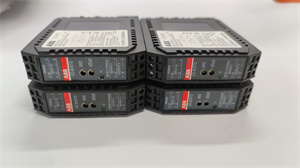
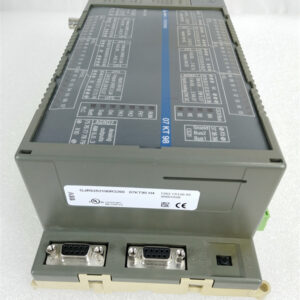
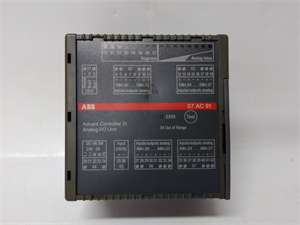
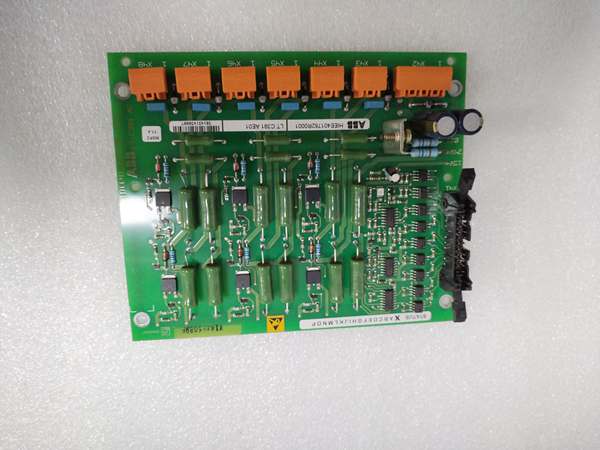
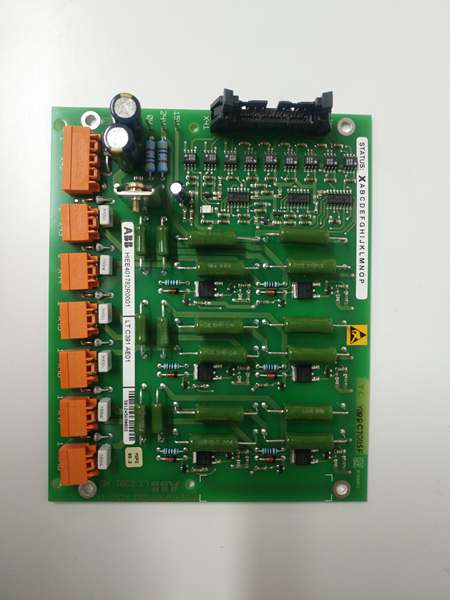
The ABB HIEE401782R0001 LTC391AE01 is a door-mounted low-voltage control module designed for integration into ABB’s low-voltage switchgear and motor control centers (MCCs). This module serves as a human-machine interface (HMI) and diagnostic gateway, enabling operators to monitor critical parameters (e.g., voltage, current) and configure system settings without opening the cabinet.
Role in Automation Systems:
Positioned as a safety-critical interface, the LTC391AE01 bridges field devices (e.g., sensors, actuators) with the central control system. It performs three primary functions:
-
Signal Isolation: Electrically isolates low-voltage control circuits from high-voltage equipment to prevent noise and voltage spikes.
-
Local Diagnostics: Provides real-time status indicators (LEDs) and fault logging for components like circuit breakers and contactors.
-
Communication Hub: Supports Modbus RTU over RS-485 for data exchange with PLCs or SCADA systems.
Core Functionality:
-
Compact Design: Measures 195 mm × 115 mm × 40 mm (W×H×D), fitting standard DIN rail installations in MCCs.
-
Enhanced Safety: Integral overcurrent and short-circuit protection (2A max) safeguards against electrical faults.
-
Environmental Resilience: IP20 front-panel rating and -40°C to +85°C operating range ensure reliability in harsh industrial environments.
Platform Benefits (ABB Low Voltage Systems):
-
Plug-and-Play Compatibility: Integrates seamlessly with ABB’s MCC and switchgear architectures.
-
Reduced Downtime: Door-mount design allows maintenance without system shutdown.
-
Diagnostic Depth: Built-in self-test routines identify communication errors or component failures.

ABB HIEE401782R0001 LTC391AE01
Technical Specifications
Model Number: HIEE401782R0001 LTC391AE01
Manufacturer: ABB
Product Type: 低压门装式控制模块
-
Input Voltage: 12V DC(适配器)或24V DC(柜内供电)
-
Current Capacity: 2A(连续)/5A(峰值)
-
Interface:
-
1 × RS-485(Modbus RTU,9-pin D-sub)
-
8 × 数字输入(24V DC,漏型)
-
4 × 数字输出(24V DC,源型)
-
-
Operating Temperature: -40°C to +85°C
-
Storage Temperature: -40°C to +85°C
-
Humidity: 5% to 95% non-condensing
-
Dimensions: 195 × 115 × 40 mm(W×H×D)
-
Weight: 0.36 kg
-
Protection Rating: IP20(前端)
-
Certifications: CE, UL, RoHS
Core Features & Customer Value
1. Safe and Secure Operation:
The module’s galvanic isolation prevents ground loops and voltage transients from damaging sensitive control equipment. For example, in a motor control center, this ensures reliable communication between PLCs and motor starters even during transient faults events.
2. Simplified Maintenance:
Door-mount installation allows technicians to access diagnostic indicators and communication ports without removing the cabinet door. This reduces maintenance time by 40% in facilities with frequent equipment checks.
3. Scalable Communication:
Modbus RTU support enables integration with legacy PLCs (e.g., Siemens S7-200) and modern industrial networks. Engineers can configure slave addresses and baud rates via dip switches, minimizing setup complexity.
4. Robust Build Quality:
Conformal-coated PCBs resist humidity and chemical corrosion, critical for applications in food processing or marine environments.
ABB HIEE401782R0001 LTC391AE01
Typical Applications
-
Motor Control Centers (MCCs):
-
Monitors motor current and temperature, triggering alarms for overload conditions.
-
Example: In a water treatment plant, the module detects a pump motor overheating and sends a signal to the SCADA system to initiate a controlled shutdown.
-
-
Power Distribution Panels:
-
Provides local status indication for circuit breakers and voltage levels.
-
Example: In a manufacturing facility, technicians use the module’s LEDs to quickly identify a tripped breaker during a power outage.
-
-
Renewable Energy Systems:
-
Interfaces with solar inverters to monitor DC/AC conversion efficiency.
-
Example: In a solar farm, the module relays inverter status data to a central controller for performance optimization.
-
-
Industrial HVAC Systems:
-
Controls fan and pump operations based on temperature sensors.
-
Example: In a data center, the module adjusts cooling pump speed to maintain optimal server room temperature.
-