Description
Key Technical Specifications
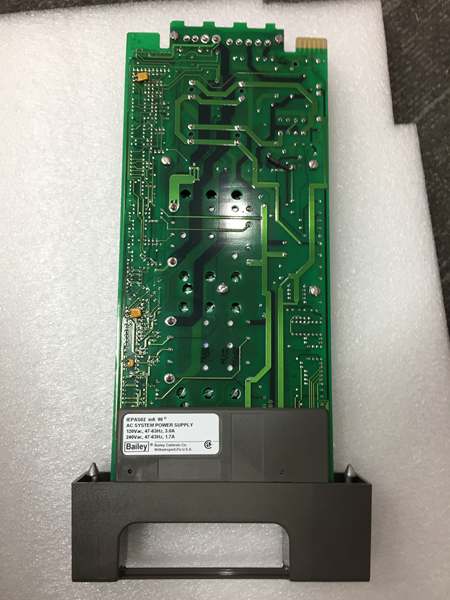
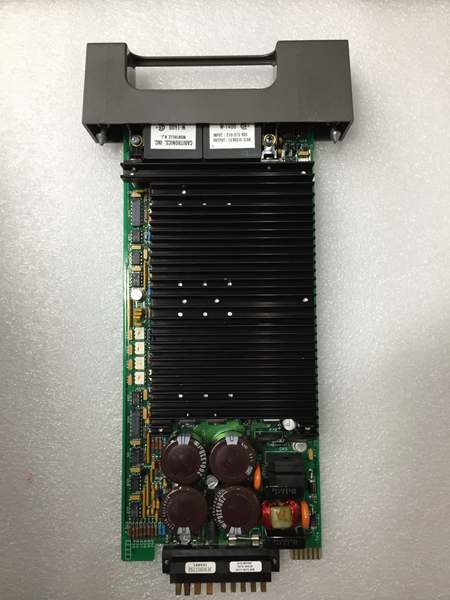
Model Number: ABB IEPAS02
Manufacturer: ABB
Input Type: Universal (4-20mA current, RTD [Pt100/Pt1000], 0-10V DC voltage)
Number of Channels: 2 (individually isolated)
Supply Voltage: 24V DC ±10% (from AC 800M I/O rack backplane)
Input Range (Current): 4-20mA (2-wire/4-wire, loop-powered compatible)
Input Range (RTD): Pt100 (0-200°C), Pt1000 (0-400°C)
Input Range (Voltage): 0-10V DC, ±10V DC (software-selectable)
Accuracy: ±0.1% of full scale (current/voltage), ±0.2% of full scale (RTD)
Operating Temperature: -25°C to 70°C (-13°F to 158°F)
Isolation: 1kV AC (channel-to-channel, channel-to-backplane)
Diagnostics: Open circuit, short circuit, overrange/underrange detection
Mounting: AC 800M I/O rack (compatible with PM850/PM860/PM861/PM865 CPUs)
Power Consumption: 0.8W (standby), 1.2W (full load)
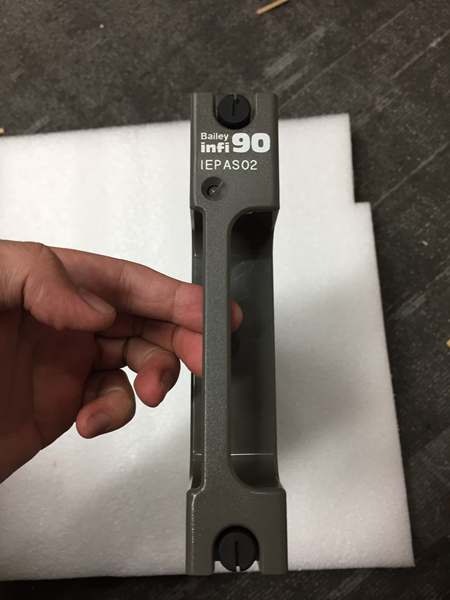
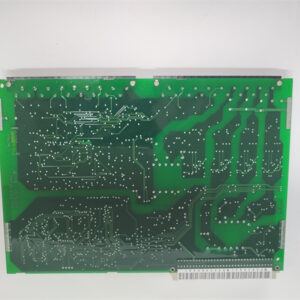
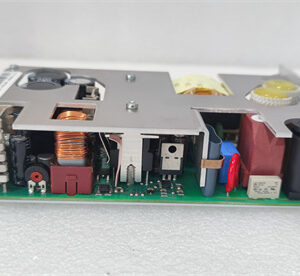
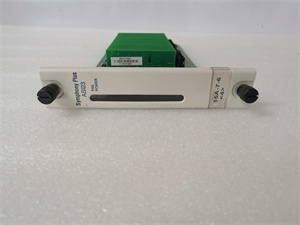
ABB IEPAS02
Connector Type: Spring-cage terminal block (4 terminals per channel)
Field Application & Problem Solved
In process industries—chemical plants, oil refineries, and water treatment facilities—accurate measurement of continuous variables (temperature, pressure, flow, level) is critical for process control and safety. The challenge? Many analog input modules force users to choose between current, RTD, or voltage inputs, requiring multiple modules for mixed-sensor setups. Others lack robust isolation, leading to noise-induced inaccuracies, or fail to provide actionable diagnostics—leaving technicians guessing when a sensor or wire fails. The ABB IEPAS02 solves these issues with universal input compatibility, channel isolation, and comprehensive diagnostics.
You’ll typically find this module in applications like monitoring reactor temperature via Pt100 RTDs in chemical plants, measuring pipeline pressure with 4-20mA transmitters in refineries, or tracking water level with 0-10V sensors in treatment facilities. It’s a linchpin in AC 800M-based systems, where it consolidates inputs from different sensor types into a single module—reducing rack space and wiring complexity. In power plant steam turbine control, it’s used to measure bearing temperature (RTD) and lubricating oil pressure (4-20mA), applications where precision (±0.1% full scale) prevents equipment overheating or mechanical failure.
Its core value is flexibility and reliability. The universal input eliminates the need to stock multiple module types, simplifying inventory and reducing installation time. Channel isolation blocks noise from high-voltage equipment (e.g., motors, transformers) that plagues non-isolated modules, ensuring consistent accuracy. Built-in diagnostics (open circuit, overrange) immediately flag issues like broken sensor wires or faulty transmitters, allowing technicians to resolve problems before they cause process drift or shutdowns. For plant operators, this translates to lower maintenance costs, fewer unplanned outages, and tighter process control.
Installation & Maintenance Pitfalls (Expert Tips)
Incorrect Input Type Configuration (Software Mismatch = Bad Data): The IEPAS02’s universal inputs require software configuration in Control Builder M—rookies often forget to set the channel to match the sensor type (e.g., RTD instead of 4-20mA). This leads to nonsensical readings (e.g., 1000°C for a pressure transmitter) or no data at all. After wiring, double-check that each channel’s input type, range, and sensor model (Pt100 vs. Pt1000) are configured exactly to the sensor’s specifications.
Poor RTD Wiring (3-Wire vs. 2-Wire Mix-Ups): For RTD sensors, the module supports 2-wire, 3-wire, and 4-wire configurations—but 3-wire is the most common (and most often miswired). Rookies often swap the sense and excitation wires, leading to temperature offset errors. Follow ABB’s wiring diagram: connect the RTD’s two excitation wires to the module’s “+” and “-” terminals, and the sense wire to the “S” terminal. For 3-wire setups, ensure the sense wire is the same gauge and length as the excitation wires to eliminate lead resistance errors.
Ignoring Loop Power for 2-Wire Transmitters: The IEPAS02 provides loop power (24V DC) for 2-wire 4-20mA transmitters, but rookies sometimes connect external power to these sensors—creating a voltage conflict that damages the module or transmitter. Check if your transmitter is 2-wire (loop-powered) or 4-wire (requires external power). For 2-wire units, use the module’s internal loop power (no external supply needed); for 4-wire, disable loop power in software and connect the transmitter’s power separately.
Cable Routing Near High-Voltage Lines (Noise = Inaccuracy): Analog signals are sensitive to electromagnetic interference (EMI), but rookies often run sensor cables parallel to high-voltage power lines (3-phase, 480V). This induces noise, causing fluctuating readings that mimic process variations. Keep sensor cables at least 50cm away from power lines, use shielded twisted-pair (STP) cable, and ground the shield at the module end only (single-point grounding) to prevent ground loops. For long runs (over 100 meters), use twisted-pair with a drain wire for extra noise protection.
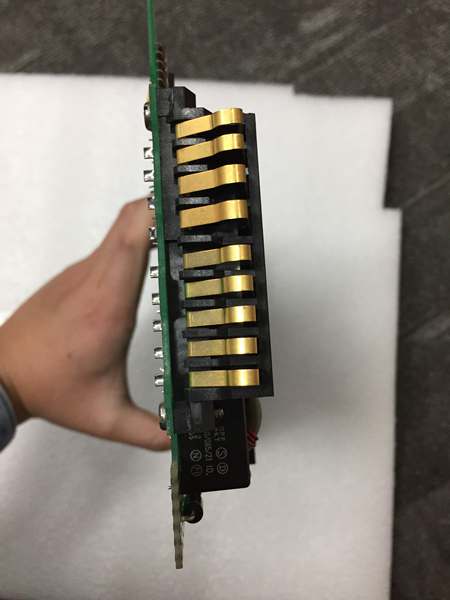
ABB IEPAS02
Technical Deep Dive & Overview
The ABB IEPAS02 is a universal analog input module engineered for ABB’s AC 800M controller series, a cornerstone of industrial process control. It acts as a bridge between analog field sensors and the controller’s CPU, converting continuous physical variables (temperature, pressure) into digital values the CPU can process for closed-loop control or monitoring. Its defining design is dual-channel versatility—each channel can be independently configured for current, RTD, or voltage inputs, eliminating the need for specialized modules.
The module draws 24V DC power from the AC 800M I/O rack’s backplane, with dedicated power paths for each channel to support loop-powered 2-wire transmitters. Each channel features 1kV AC isolation from the others and the backplane, a critical safeguard in noisy industrial environments. Isolation prevents ground loops and fault propagation—if one channel shorts, the other remains operational, avoiding total module failure.
Communication with the AC 800M CPU occurs via the rack’s high-speed backplane bus, which prioritizes real-time analog data transfer with minimal latency. The module’s precision comes from 16-bit analog-to-digital (A/D) conversion, combined with built-in linearization for RTD sensors (compensating for non-linear resistance-temperature characteristics). Diagnostics are implemented via current and voltage monitoring: an open circuit (e.g., broken RTD wire) is detected when input current drops below 1mA, while overrange/underrange faults trigger when signals exceed the configured input range.
Built for harsh conditions, the IEPAS02 withstands extreme temperatures (-25°C to 70°C), vibration (up to 5g), and humidity (10-95% non-condensing)—ideal for refineries, chemical plants, and offshore platforms. Its compact 1-slot design maximizes I/O density, and hot-swappable capability (with compatible racks) allows module replacement without shutting down the control system. The spring-cage terminals simplify wiring and reduce installation time, while the module’s self-calibration feature (triggered via software) eliminates the need for manual calibration, reducing maintenance overhead.