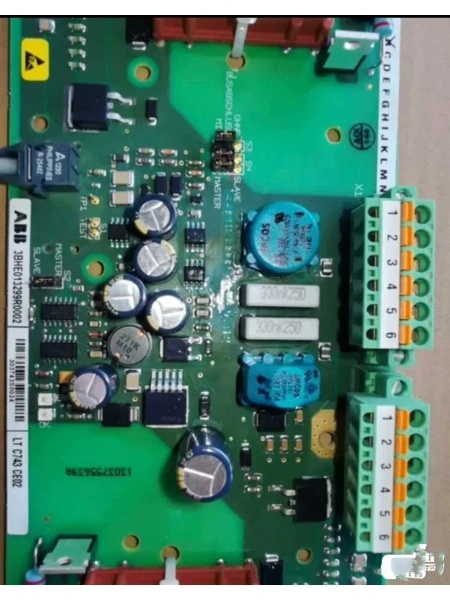
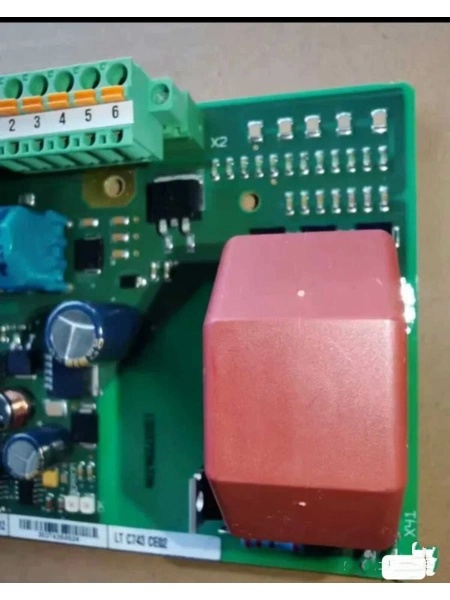
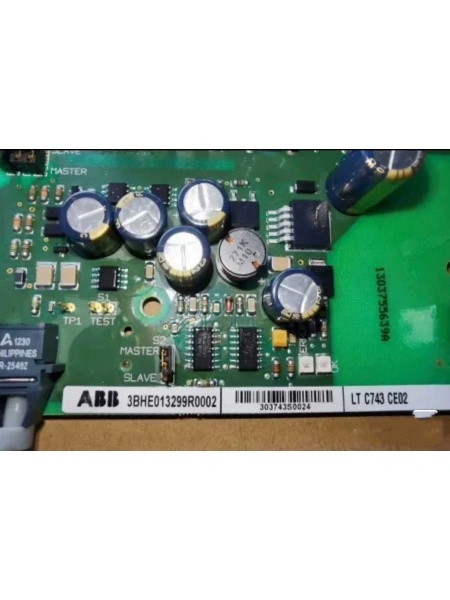
Description
System Architecture & Operational Principle
The ABB LTC743CE 3BHE013299R0002 is a Control and Communication Board (CCB) designed for Level 1 (Device) or Level 2 (Control) of the Purdue Model, depending on the application. It resides within the ACS880 VFD’s control cabinet and acts as the interface between the drive’s main control unit (MCU) and external systems.
Upstream Communication: Receives command signals (e.g., speed setpoints, start/stop commands) from higher-level control systems (PLCs, DCS, or SCADA) via industrial protocols (e.g., Modbus TCP/IP, PROFIBUS DP). The board converts these signals to electrical commands for the MCU.
Downstream Communication: Transmits real-time data from the VFD (e.g., motor speed, current, fault codes) back to the control system using the same protocols. It also interfaces with field devices (e.g., sensors, actuators) to collect input signals (e.g., temperature, pressure) for VFD adjustment.
The CCB’s modular design is a key advantage: it allows for easy replacement without disassembling the entire VFD, minimizing downtime. The board also includes built-in diagnostics to detect communication errors or hardware faults, sending alerts to the control system for proactive maintenance.
Core Technical Specifications
-
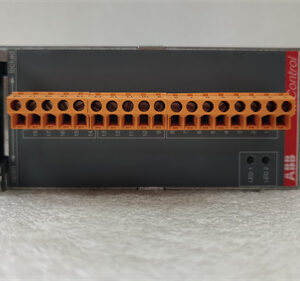
Physical Interface: Connects to ACS880 MCU via proprietary backplane; field I/O via terminal blocks.
-
Signal Type: Analog (4-20 mA, 0-10 V) and digital (24V DC) inputs/outputs.
-
Communication Protocols: Modbus TCP/IP, PROFIBUS DP, CANopen (via optional adapters).
-
Operating Temperature: -20°C to +60°C (industrial grade).
-
Power Supply: 24V DC (from VFD’s internal power supply).
-
Dimensions: 120 mm (W) x 80 mm (H) x 247 mm (D).
-
Weight: 1.12 kg (2.47 lbs).
-
Certifications: CE, UL, RoHS.

ABB LTC743CE 3BHE013299R0002
Customer Value & Operational Benefits
Minimized Downtime
The CCB’s modular design allows for hot-swappable replacement—if the board fails, it can be swapped out without shutting down the VFD. This reduces unplanned downtime by up to 50% compared to replacing the entire drive.
Seamless Integration
Supports multiple industrial protocols (Modbus TCP/IP, PROFIBUS DP), making it compatible with a wide range of control systems (ABB, Siemens, Allen-Bradley). This eliminates the need for protocol converters, reducing installation time and costs.
Proactive Maintenance
Built-in diagnostics detect communication errors or hardware faults early, sending alerts to the control system. This allows engineers to address issues before they escalate into costly failures—critical for mission-critical applications like motor control in manufacturing.
Space-Saving Design
The compact form factor (120x80x247 mm) fits easily into crowded VFD cabinets, making it ideal for retrofits or new installations where space is limited.
Field Engineer’s Notes (From the Trenches)
When installing the LTC743CE 3BHE013299R0002, always verify the backplane connection—loose pins can cause intermittent communication faults. I once spent hours troubleshooting a “no communication” error only to find a bent pin in the backplane connector. Use a magnifying glass to inspect the pins before plugging in the board.Another gotcha: label the field I/O wires before disconnecting them. The CCB has multiple terminal blocks for analog and digital signals—mixing them up can lead to incorrect VFD operation (e.g., a temperature sensor input being treated as a speed command). Use a permanent marker to label each wire with its function (e.g., “Motor Current” or “Start Command”).If the board’s status LED (green) is blinking rapidly, check the VFD’s power supply—a low voltage input can cause the CCB to malfunction. Use a multimeter to measure the 24V DC supply at the board’s power terminals; it should be within 10% of 24V.
Real-World Applications
-
Motor Control in Automotive Manufacturing:The CCB connects an ACS880 VFD to a PLC, enabling precise speed control of a robotic welding line. It transmits real-time motor current data to the PLC, which adjusts the weld speed based on sensor feedback—critical for maintaining weld quality.
-
Pump Station Monitoring in Water Treatment:Used to connect an ACS880 VFD (controlling a water pump) to a SCADA system. The CCB sends pump status (e.g., on/off, flow rate) to the SCADA system, allowing operators to respond quickly to issues like low pressure or pump failure.
ABB LTC743CE 3BHE013299R0002
High-Frequency Troubleshooting FAQ
Q: What are the common LED indicators on the ABB LTC743CE 3BHE013299R0002, and what do they mean?
A: The board has two LEDs:
-
Power (Green): On when the board is receiving 24V DC power from the VFD.
-
Status (Yellow): Blinks when data is being transmitted/received via Modbus or PROFIBUS. If it stays solid, there’s a communication error (e.g., no connection to the PLC).
Q: Can the ABB LTC743CE 3BHE013299R0002 be used with non-ACS880 VFDs?
A: No, the CCB is specifically designed for ABB ACS880 series VFDs. It relies on the ACS880’s proprietary backplane and communication protocol to function. For non-ACS880 VFDs, use an ABB-compatible CCB (e.g., LTC743CE01 for ACS580).
Q: How do I replace the ABB LTC743CE 3BHE013299R0002?
A: Follow these steps:
-
Power Down: Turn off the ACS880 VFD and disconnect it from the power supply.
-
Remove Cover: Unscrew the VFD’s front cover to access the CCB.
-
Disconnect Wires: Label and disconnect the field I/O wires from the CCB’s terminal blocks.
-
Remove Board: Unscrew the CCB from the backplane (use a Phillips screwdriver).
-
Install New Board: Secure the new CCB to the backplane and reconnect the wires (ensure correct polarity).
-
Power Up: Turn on the VFD and verify the CCB’s operation (check the status LED).
Q: Why is the ABB LTC743CE 3BHE013299R0002 not communicating with the PLC?
A: Check three things first:
-
Protocol Settings: Ensure the CCB and PLC are configured for the same protocol (e.g., Modbus TCP/IP).
-
Cable Connection: Verify the Ethernet cable is securely connected to the CCB and PLC (use a CAT5e cable for best results).
-
IP Address: Confirm the CCB’s IP address matches the PLC’s configuration (check the VFD’s parameter settings).
Commercial Availability & Pricing
Please note: The listed price is not the actual final price. It is for reference only and is subject to appropriate negotiation based on current market conditions, quantity, and availability.