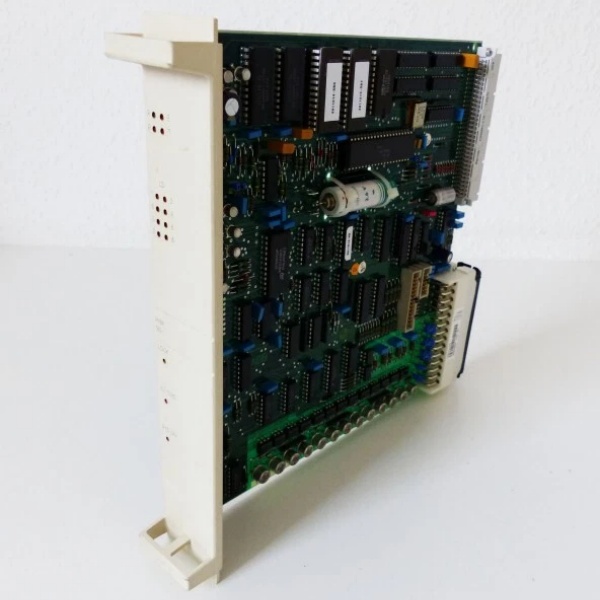
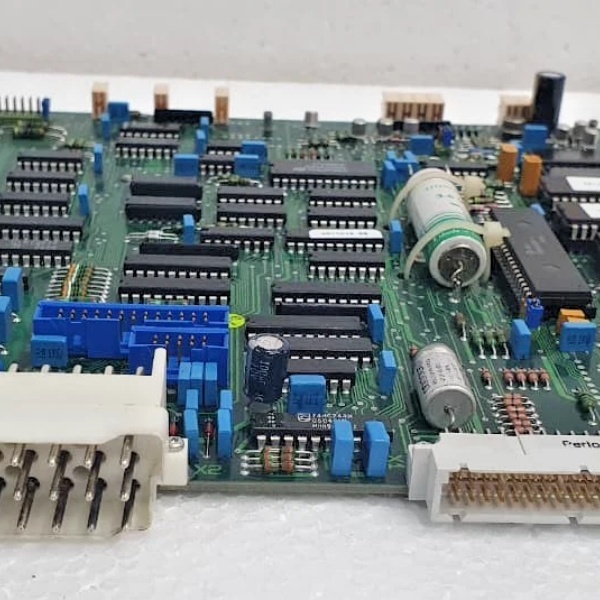
Description
PFBK165: Product Overview
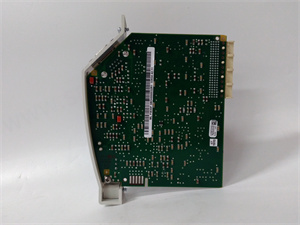
The ABB PFBK165 (part number: 3BSE000470R1) is a specialized signal processing board designed for ABB’s Millmate series of roll force and strip tension measurement systems. These systems are critical in cold rolling mills, metal forming facilities, and other industrial processes where precise control of roll force and strip tension is essential for product quality and equipment longevity.
Role in Automation Systems:
Positioned as the “brain” of the Millmate measurement system, the PFBK165 performs three primary functions:
-
Signal Acquisition: Receives analog signals from Millmate transducers (e.g., strain gauge-based roll force sensors, load cells) and converts them into digital data for processing.
-
Signal Conditioning: Filters and amplifies raw transducer signals to eliminate noise and ensure accuracy, even in electrically harsh mill environments.
-
Communication: Transmits processed data to ABB’s DCS (Distributed Control System) or PLC (Programmable Logic Controller) via Ethernet or RS-232, enabling real-time monitoring and control of roll force and strip tension.
Core Functionality:
-
Real-Time Processing: The 200 MIPS processor handles high-speed signal processing, ensuring that roll force and tension data is updated in real time (typically within 1–5 ms).
-
Transducer Compatibility: Supports all Millmate transducers, including those used in cold rolling mills, hot rolling mills, and metal forming presses.
-
Hot-Swappable Design: Allows for replacement without shutting down the system, minimizing downtime during maintenance—critical for 24/7 mill operations.
Platform Benefits (Millmate Series):
The PFBK165 leverages ABB’s Millmate platform, which is renowned for:
-
Precision: Measures roll force with an accuracy of ±0.5% of full scale, ensuring consistent product thickness and quality.
-
Reliability: Industrial-grade components and a rugged design withstand vibration, temperature fluctuations, and electrical noise in mill environments.
-
Integration: Seamlessly integrates with ABB’s DCS (e.g., AC 800M) and PLC systems, reducing setup time and effort.

ABB PFBK165
Technical Specifications
Model Number: PFBK165 (3BSE000470R1)
Manufacturer: ABB
Product Type: Signal Processing Board
-
Processor: 200 MIPS (16-bit or 32-bit, inferred from MIPS rating)
-
Operating Voltage: 24 V DC (±10% tolerance)
-
Communication Interfaces:
-
1× Ethernet port (10/100 Mbps, RJ45)
-
1× RS-232 port (serial, DB9)
-
-
Signal Inputs: Supports 4–20 mA analog signals (from Millmate transducers)
-
Signal Outputs: 0–10 V DC (conditioned analog output for external devices)
-
Operating Temperature: -20°C to +55°C (-4°F to 131°F)
-
Storage Temperature: -40°C to +85°C (-40°F to 185°F)
-
Humidity: 5–95% non-condensing
-
Dimensions (W×H×D): 140 mm × 58.5 mm × 86.1 mm (5.51 in × 2.30 in × 3.39 in)
-
Weight: 0.52 kg (1.15 lbs)
-
Certifications: CE, UL (inferred from ABB industrial product standards)
Core Features & Customer Value
1. High-Precision Signal Processing:
The PFBK165’s 200 MIPS processor and advanced signal conditioning algorithms ensure that roll force and strip tension data is accurate to within ±0.5% of full scale. For example, in a cold rolling mill, this precision allows operators to maintain consistent strip thickness (e.g., ±0.01 mm), reducing scrap and improving product quality.
2. Real-Time Data Transmission:
With Ethernet and RS-232 interfaces, the PFBK165 transmits processed data to the DCS/PLC in real time. This enables immediate adjustments to roll force or tension—critical for preventing strip breakage or equipment damage in high-speed mills.
3. Rugged Reliability:
The board’s industrial-grade design (e.g., conformal coating, vibration-resistant components) ensures reliable operation in harsh mill environments. For instance, in a steel mill with high temperatures and electrical noise, the PFBK165 maintains signal integrity, reducing downtime and maintenance costs.
4. Easy Integration:
The PFBK165 is designed to work seamlessly with ABB’s Millmate transducers and DCS/PLC systems. This plug-and-play compatibility reduces setup time and eliminates the need for custom wiring, saving time and money during installation.
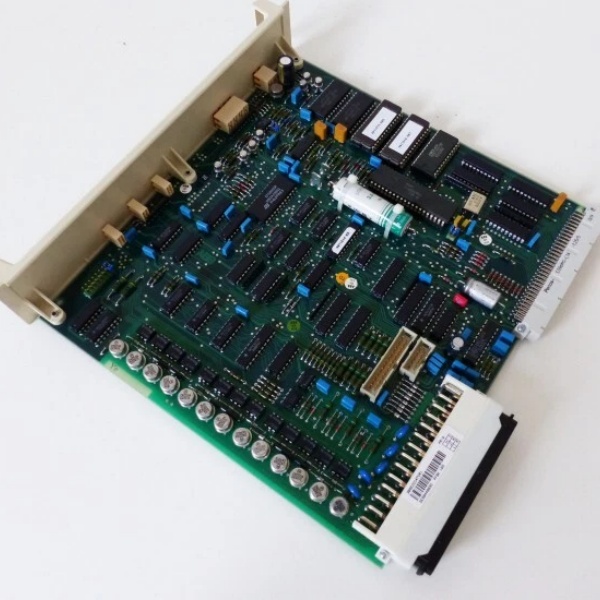
ABB PFBK165
Typical Applications
The ABB PFBK165 is widely used in industries requiring precise roll force and strip tension control:
-
Cold Rolling Mills:
-
Measures roll force in cold rolling mills to maintain consistent strip thickness.
-
Example: In a aluminum cold rolling mill, the PFBK165 processes signals from roll force sensors to adjust the gap between rolls, ensuring that the final product meets thickness specifications.
-
-
Metal Forming Facilities:
-
Controls strip tension in metal forming presses (e.g., stamping, bending) to prevent wrinkles or tears.
-
Example: In a automotive metal forming plant, the PFBK165 monitors strip tension during the stamping of car body panels, ensuring that the panels are formed correctly without defects.
-
-
Wire and Cable Manufacturing:
-
Measures tension in wire drawing machines to maintain consistent wire diameter.
-
Example: In a wire manufacturing facility, the PFBK165 processes signals from tension sensors to adjust the speed of the drawing machine, ensuring that the wire diameter is consistent throughout the process.
-