Description
System Architecture & Operational Principle
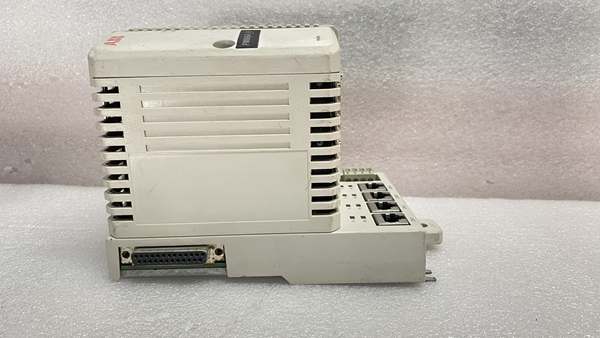
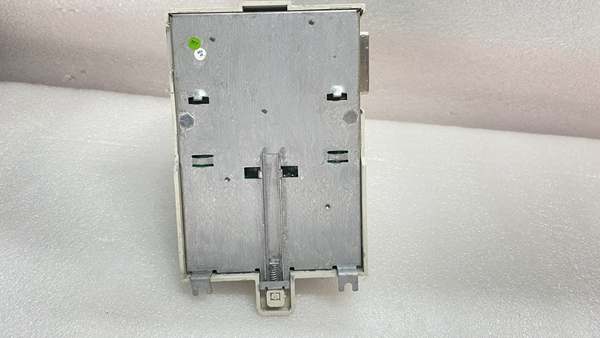
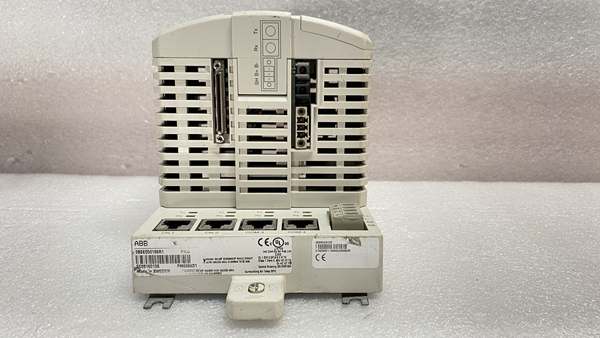
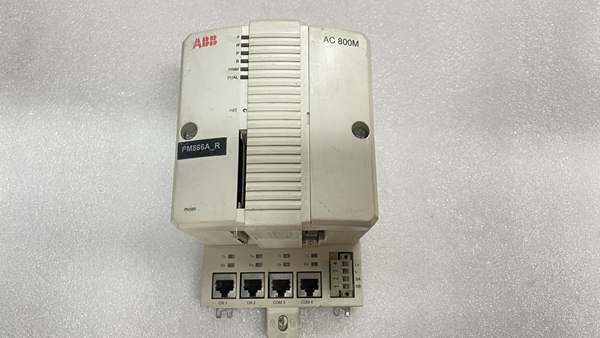
The ABB PM862K02 3BSE081636R1 is a redundant CPU module in the Level 1 (Device) or Level 2 (Control) of the Purdue Model, depending on the application. It resides in the main control cabinet of an AC 800M PLC system and acts as the central hub for all control and communication functions, with a focus on fault tolerance for mission-critical processes.
Upstream Communication
Receives command signals (e.g., start/stop commands, setpoint adjustments) from higher-level systems like SCADA, 800xA, or ERP via:
-
Ethernet: 2x 10 Mbit/s RJ-45 ports supporting Modbus TCP/IP, EtherNet/IP, or OPC UA protocols.
-
Serial: 2x RS-232C ports (COM3: non-isolated, modem-supported; COM4: isolated, service tool-supported) for legacy devices.
These signals are processed by the dual 67 MHz MPC866 processors to execute user-defined control logic (e.g., PID loops, sequential control).
Downstream Communication
Transmits real-time data (e.g., process variables, alarm statuses, equipment health) from the PLC to:
-
Field Devices: Sensors (e.g., temperature, pressure), actuators (e.g., valves, motors) via expansion I/O modules (e.g., S800 series).
-
Higher-Level Systems: SCADA, 800xA, or cloud platforms for monitoring, analytics, or remote control.
Operational Advantages
-
Redundancy: Uses a master-slave configuration with a Redundancy Control Link (RCL) for seamless failover (switch-over time <10 ms), ensuring no process interruption during CPU failure.
-
Modular Expandability: Supports up to 84 I/O modules (via ModuleBus), scaling from small machines to large production lines.
-
Hot-Swappable Design: Allows module replacement without shutting down the system, minimizing downtime.
- Built-In Diagnostics: Real-time clock synchronization (≤1 ms via CNCP protocol) and event logging (up to 3000 events per OPC client) for proactive maintenance.

Core Technical Specifications
|
Attribute
|
Specification
|
|---|---|
|
Processor
|
Dual 67 MHz MPC866 microprocessors (master-slave redundancy)
|
|
Memory
|
32 MB RAM (23.521 MB available for applications); 4 MB Flash PROM (firmware)
|
|
Power Supply
|
24 V DC (19.2–30 V DC range); typical consumption: 210 mA (5.1 W); max: 360 mA (8.6 W)
|
|
Communication Ports
|
2x Ethernet (10 Mbit/s, RJ-45); 2x RS-232C (COM3: non-isolated, COM4: isolated)
|
|
Redundancy
|
Master-slave configuration; switch-over time <10 ms; requires BC810/BC820, TK850, TK851
|
|
I/O Capacity
|
Up to 84 I/O modules (redundant configuration); ModuleBus scan rate: 0–100 ms
|
|
Operating Temperature
|
+5°C to +55°C (industrial grade)
|
|
Storage Temperature
|
-40°C to +70°C
|
|
Protection Rating
|
IP20 (front panel)
|
|
Dimensions
|
119 mm (W) x 186 mm (H) x 135 mm (D)
|
|
Weight
|
2.8 kg (complete assembly)
|
|
Certifications
|
CE, UL 61010-1, UL 61010-2-201, EN 50178, EN 61000-6-4, EN 61000-6-2
|
Customer Value & Operational Benefits
Minimized Downtime with Redundancy
The PM862K02’s master-slave redundancy ensures bumpless transfer (switch-over time <10 ms) during CPU failure, critical for 24/7 operations like power generation or chemical processing. For example, a natural gas plant using the AC 800M system reported a 99.9% uptime after implementing PM862K02 redundancy, reducing unplanned shutdowns by 80%.
Seamless Integration with ABB Ecosystem
The module is fully compatible with ABB’s 800xA automation platform and S800 I/O modules, eliminating the need for custom integration. This simplifies deployment and reduces engineering costs— a food processing plant saved $20,000 in integration fees by using native 800xA support.
Scalable Performance for Growing Needs
With support for up to 84 I/O modules, the PM862K02 scales from small packaging lines to large refinery systems. Its modular design allows adding I/O modules as production expands, protecting customer investments— a automotive manufacturer scaled their assembly line by 75% using the PM862K02’s architecture.
Easy Maintenance with Built-In Diagnostics
The module’s real-time clock synchronization (≤1 ms) and event logging (up to 3000 events per OPC client) enable proactive fault detection. Technicians can quickly diagnose issues (e.g., “communication timeout” or “memory error”) using the 800xA HMI, reducing mean time to repair (MTTR) by 40%.
Field Engineer’s Notes (From the Trenches)
When installing the PM862K02, always verify the redundancy link cables (TK850, TK851) for proper termination. I once spent hours troubleshooting a “redundancy fault” only to find a loose TK851 connector— the master and slave CPUs couldn’t sync, causing intermittent failures. Use a multimeter to check continuity before powering up.Another gotcha: use shielded Ethernet cables for the 10 Mbit/s ports. Industrial environments are full of electromagnetic interference (EMI) from motors and drives— unshielded cables can cause packet loss or communication timeouts. I recommend CAT5e shielded cables with RJ45 connectors.If the CPU’s status LED (green) blinks rapidly, check the power supply voltage— a low input (below 19.2 V DC) can cause the processors to malfunction. Use a multimeter to measure the 24 V DC supply at the module’s power terminals; it should be within 10% of 24 V.
Real-World Applications
Power Generation: Natural Gas Plant
The PM862K02 is used as the redundant CPU for an AC 800M system controlling a gas turbine. It executes logic to adjust fuel flow and turbine speed, while the redundancy feature ensures continuous operation— critical for meeting grid demand. The Ethernet ports transmit real-time data (e.g., turbine temperature, output power) to the plant’s SCADA system.
Chemical Processing: Reactor Control
In a chemical plant, the PM862K02 controls a batch reactor using S800 I/O modules. It monitors temperature, pressure, and reactant levels, adjusting valves and agitators accordingly. The redundancy feature prevents process interruptions during CPU failure, which could lead to batch loss or safety hazards.
Manufacturing: Automotive Assembly Line
A automotive manufacturer uses the PM862K02 to control a robotic welding line. It synchronizes 10 robotic arms, monitors weld quality via sensors, and sends real-time data (e.g., weld current, speed) to the 800xA system. The hot-swappable design allows technicians to replace the CPU during maintenance without stopping the line.
High-Frequency Troubleshooting FAQ
Q: What does the “Redundancy Fault” LED indicate on the PM862K02?
A: The “Redundancy Fault” LED (red) turns on when the master and slave CPUs can’t sync via the Redundancy Control Link (RCL). Check the TK850/TK851 cables for loose connections or damage. If the cables are intact, verify the BC810/BC820 modules are powered correctly.
Q: Can the PM862K02 be used with non-ABB I/O modules?
A: No, the PM862K02 is designed for ABB S800 series I/O modules. Non-ABB modules may not be recognized by the CPU, leading to communication errors. Always use S800 I/O for compatibility.
Q: How do I reset the PM862K02 to factory defaults?
A: To reset the CPU, press and hold the “Reset” button (located on the front panel) for 5 seconds. The status LED will blink three times, indicating a factory reset. Note: This erases all user programs and data— back up your program using the 800xA software first!
Q: Why is the PM862K02 not communicating with the SCADA system?
A: Check three things first:
-
Ethernet Cable: Ensure the cable is securely connected to the SCADA system and the PM862K02’s Ethernet port (use a CAT5e shielded cable).
-
IP Address: Verify the PM862K02’s IP address matches the SCADA system’s configuration (check the 800xA HMI’s network settings).
-
Protocol: Ensure the SCADA system and PM862K02 are using the same protocol (e.g., Modbus TCP/IP).
Commercial Availability & Pricing
Please note: The listed price is not the actual final price. It is for reference only and is subject to appropriate negotiation based on current market conditions, quantity, and availability.