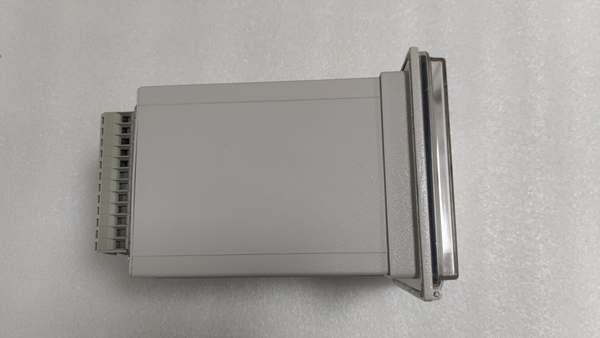
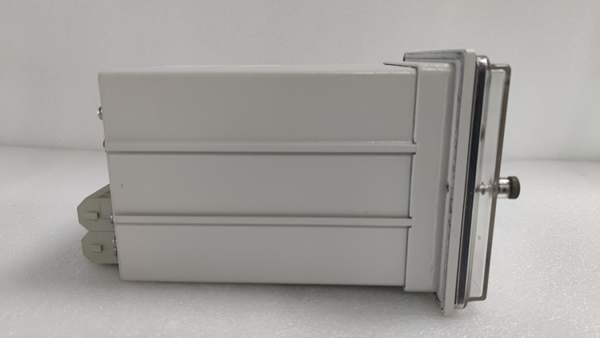
Description
SPAU140C: Product Overview
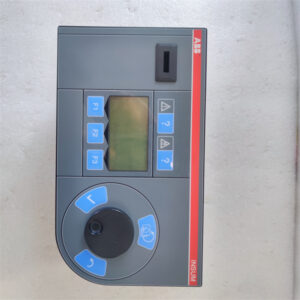
The ABB SPAU140C is a digital synchro-check relay designed for power system synchronization applications. Positioned as a protective device in distribution networks, it ensures two power sources (e.g., grid and generator, or adjacent busbars) are synchronized in voltage, frequency, and phase before permitting circuit breaker closure. This prevents equipment damage from inrush currents, mechanical stress, and grid instability, critical in power generation, transmission, and industrial facilities.
In automation systems, the SPAU140C acts as a decision-making interface between control logic and circuit breakers. It continuously monitors synchronization parameters (ΔU, Δf, Δφ) and only issues a closing permissive when all user-defined limits are met. Core functionality includes dual operating modes (instruction/continuous), adjustable sync thresholds, and self-diagnostic alerts.
The relay belongs to ABB’s legacy power protection portfolio, leveraging decades of field experience. Platform benefits include proven reliability in global utility and industrial projects, compatibility with ABB circuit breakers (e.g., VD4, HD4) and control systems (e.g., 800xA), and modular design for straightforward maintenance.

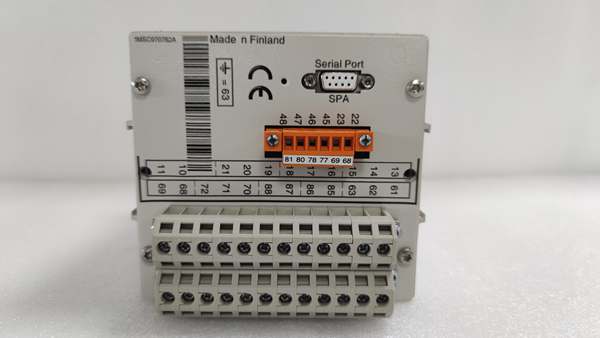
ABB SPAU140C
Technical Specifications
-
Model Number: SPAU140C
-
Manufacturer: ABB
-
Product Type: Digital Synchro-Check Relay
-
Input Voltage: 100V/110V (rated)
-
Frequency Range: 45–65 Hz
-
Synchronization Accuracy: ±0.2° electrical angle
-
Response Time: <20 ms (permissive to closing signal)
-
Output Contacts: 2 SPST (250V AC/DC, 5A continuous; 30A make/break for 0.5s)
-
Power Supply: 24V DC (±10%) or 110–250V AC/DC (optional)
-
Operating Temperature: -20°C to +60°C (-4°F to 140°F)
-
Storage Temperature: -40°C to +85°C (-40°F to 185°F)
-
Humidity: 5–95% non-condensing
-
Dimensions (W×H×D): 140 mm × 110 mm × 25 mm (5.51 in × 4.33 in × 0.98 in)
-
Weight: 0.3 kg (0.66 lbs)
-
Certifications: CE, UL (inferred from ABB industrial standards)
Core Features & Customer Value
Precision Synchronization Verification: The SPAU140C’s ±0.2° phase angle accuracy and tight voltage/frequency thresholds ensure breakers close only when sources are truly synchronized. For a power plant generator connecting to the grid, this prevents winding damage from non-synchronous currents, extending asset life.
Flexible Operating Modes: Instruction mode (manual sync check) and continuous mode (automatic reclosing) adapt to diverse workflows. In a substation with frequent feeder switching, continuous mode enables seamless power transfer, while instruction mode supports maintenance outages.
Self-Diagnostic Alerts: Built-in hardware/software checks detect sensor faults or parameter drift, triggering alarms via LED indicators. This proactive monitoring reduces unexpected failures—for example, alerting technicians to a voltage sensor drift before a critical sync event.
Compact, Serviceable Design: The relay’s small footprint (140x110x25 mm) fits crowded control panels, and front-panel access simplifies terminal connections. Hot-swappable components (where supported) minimize downtime during repairs, critical for 24/7 operations like hospitals or data centers.
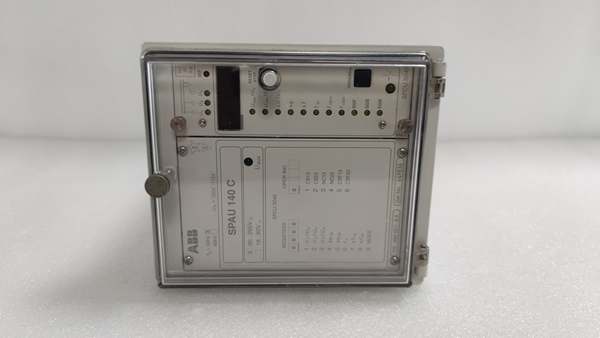
ABB SPAU140C
Typical Applications
The SPAU140C is deployed in scenarios requiring precise power source synchronization:
-
Power Generation Plants: Synchronizes standby generators with the grid during outages, ensuring smooth transition without voltage sags. In a hospital, it verifies generator-grid sync before transfer, protecting MRI machines from surges.
-
Transmission Substations: Controls breaker closure for tie-lines connecting adjacent grids, maintaining frequency stability during load transfers. For example, in a regional grid interconnection, it prevents desynchronization during peak demand shifts.
-
Industrial Cogeneration: Synchronizes on-site gas turbines with the utility grid, allowing surplus power export. In a paper mill, it enables seamless switching between self-generation and grid power, optimizing energy costs.