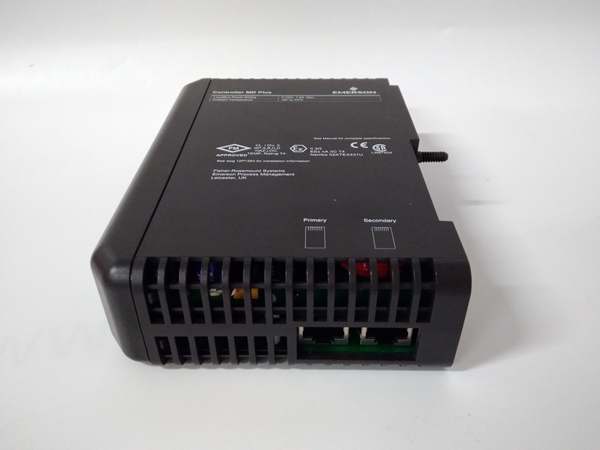
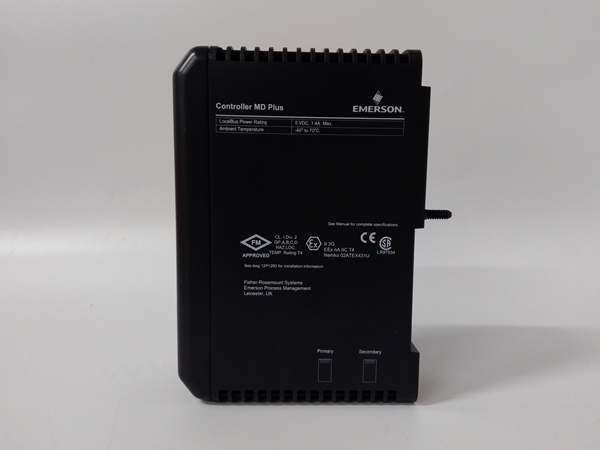
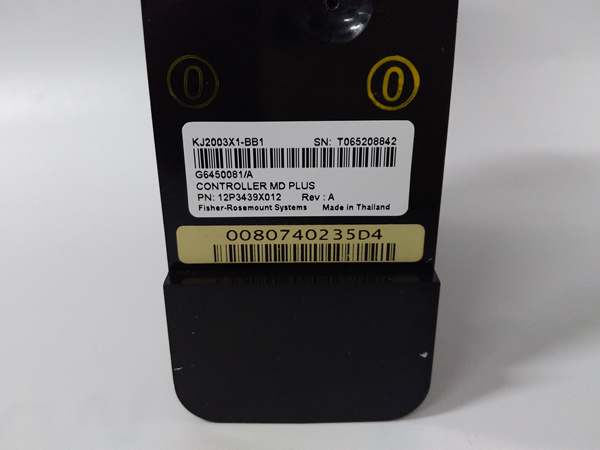
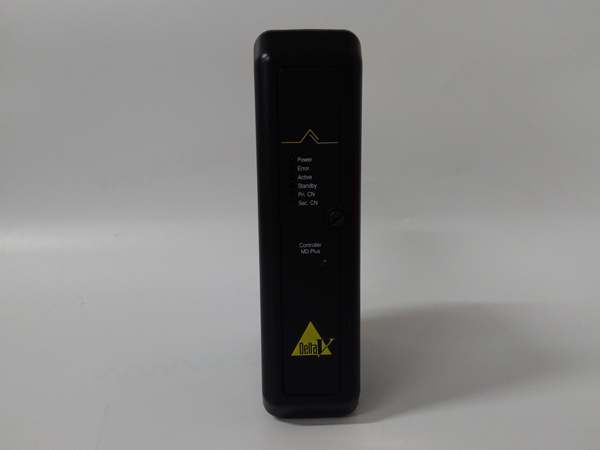
Description
System Architecture & Operational Principle
The Emerson VE3006 is an MD Plus Controller within the Emerson DeltaV DCS, designed for Level 2 (Control) of the Purdue Model in industrial automation. It resides in the DeltaV rack (typically in the right slot of a 2-wide Power/Controller Carrier) and serves as the bridge between field devices (e.g., sensors, actuators) and higher-level systems (e.g., SCADA, MES).
Upstream Communication
Receives raw data from field devices via DeltaV CHARM I/O Modules (e.g., VE4001S2T2B5 discrete inputs, VE4012S2B1 analog inputs) through the DeltaV LocalBus. These modules convert sensor signals (e.g., pressure, temperature) into digital data for the controller.
Downstream Communication
Transmits processed control commands to field devices via the same I/O modules. The controller also communicates with DeltaV System Carriers (e.g., KJ4110X1-EB1 IS Extenders) for intrinsically safe zone connectivity and FOUNDATION Fieldbus H1 devices (via VE4017PO H1 Interface Cards) for advanced process control.
Operational Advantages
-
Redundant Architecture: Dual processors ensure no single point of failure—if one processor fails, the other takes over seamlessly (bumpless transfer), critical for 24/7 operations.
-
Deterministic Control: 100ms base cycle time guarantees consistent execution of control strategies, even under maximum I/O loading.
-
Hot-Swappable Design: Can be replaced without shutting down the DeltaV system, minimizing downtime during maintenance.

EMERSON VE3006
Core Technical Specifications
|
Attribute
|
Specification
|
|---|---|
|
Processor Architecture
|
Dual redundant 32-bit RISC processors
|
|
Memory Capacity
|
128 MB RAM (program + data storage)
|
|
I/O Capacity
|
Up to 2,000 I/O points per controller
|
|
Control Execution Cycle
|
Deterministic, 100ms base cycle
|
|
Communication Protocols
|
DeltaV LocalBus (redundant), FOUNDATION Fieldbus H1, Modbus TCP/IP, OPC UA
|
|
Power Supply
|
Powered via 2-wide Power/Controller Carrier (24 VDC nominal)
|
|
Operating Temperature
|
-40°C to +70°C (-40°F to 158°F)
|
|
Storage Temperature
|
-40°C to +85°C (-40°F to 185°F)
|
|
Humidity Tolerance
|
5%–95% non-condensing
|
|
Vibration Resistance
|
1 mm peak-to-peak (5–16 Hz); 0.5 g (16–150 Hz)
|
|
Shock Resistance
|
10 g (½-sine wave, 11 ms)
|
|
Certifications
|
CE, UL, CSA, ATEX, IECEx, IEC 61508 (SIL 2)
|
|
Dimensions (W×H×D)
|
160 mm × 130 mm × 65 mm (6.3 in × 5.1 in × 2.6 in)
|
|
Weight
|
~0.75 kg (1.65 lbs)
|
Customer Value & Operational Benefits
Uninterrupted Process Control
The VE3006’s redundant processors and hot-swappable design ensure that control continues even during hardware failures or maintenance. For example, a chemical plant using the VE3006 reported zero downtime during a controller replacement, preventing a potential loss of $100,000+ in product.
Precise Process Regulation
With a 100ms control cycle and 128 MB of memory, the VE3006 executes complex control strategies (e.g., PID loops, cascade control) with high precision. This reduces process variability—for a power plant, this translates to a 5% reduction in fuel consumption.
Reduced Maintenance Costs
Advanced diagnostics (e.g., real-time health monitoring, I/O channel fault detection) reduce troubleshooting time by up to 60%. Technicians can identify and fix issues remotely using the DeltaV interface, minimizing the need for on-site visits.
Scalability
The VE3006 supports up to 2,000 I/O points, making it suitable for small to large process plants. It can be expanded with additional I/O modules or controllers as the process grows, protecting the customer’s investment.
Field Engineer’s Notes (From the Trenches)
When installing the VE3006, always verify the Power/Controller Carrier’s jumpers—the carrier must be configured for 24 VDC power. I once saw a site where a contractor forgot to set the jumpers, resulting in a “power fault” error. A simple check of the carrier’s documentation saved a 2-hour callout.Another gotcha: use shielded twisted-pair cables for LocalBus connections—unshielded cables can pick up EMI from nearby power lines, causing communication errors. I’ve fixed countless “lost I/O” faults by replacing unshielded cables with shielded ones.If the controller’s “Error” LED is red, check the DeltaV System Log—the log will tell you exactly what’s wrong (e.g., “I/O module not responding” or “processor mismatch”). Don’t guess—use the log to diagnose the problem.EMERSON VE3006
Real-World Applications
-
Oil & Gas: Offshore Platform Process ControlAn offshore oil platform uses the VE3006 to control the separation process (e.g., separating oil, gas, and water). The controller receives data from pressure and temperature sensors via CHARM I/O modules and adjusts valve positions to maintain optimal separation. The redundant design ensures that the process continues even if one processor fails.
-
Chemical: Batch Reactor ControlA chemical plant uses the VE3006 to manage batch reactions (e.g., polymer production). The controller executes recipe management logic, adjusting feed rates and temperatures based on real-time data from sensors. The 100ms control cycle ensures that the reaction stays within tight tolerances, improving product quality.
High-Frequency Troubleshooting FAQ
Q: What does the “Error” LED indicate on the VE3006?
A: The red “Error” LED indicates a critical fault, such as:
-
Processor Mismatch: The two processors are not synchronized (check the DeltaV System Log for details).
-
I/O Module Failure: An I/O module is not responding (verify the module’s status in the DeltaV interface).
-
Power Supply Issue: The Power/Controller Carrier is not providing enough power (check the carrier’s power supply).Use the DeltaV System Log to diagnose the exact cause and follow the manufacturer’s troubleshooting steps.
Q: Can the VE3006 be used with non-DeltaV systems?
A: No, the VE3006 is designed exclusively for Emerson DeltaV DCS. It relies on the DeltaV LocalBus and System Carriers for communication and power, so using it with non-DeltaV systems will result in compatibility issues.
Q: How do I replace the VE3006?
A: Follow these steps:
-
Power Down: Turn off the DeltaV rack’s main power supply.
-
Remove Old Controller: Unscrew the controller from the Power/Controller Carrier (use a Phillips screwdriver).
-
Install New Controller: Secure the new VE3006 to the carrier and tighten the screws.
-
Power Up: Turn on the main power supply and verify the controller’s operation (check the “Active” LED).
Q: Why is the VE3006 not communicating with the I/O modules?
A: Check three things first:
-
LocalBus Cables: Ensure the shielded twisted-pair cables are securely connected to the controller and I/O modules.
-
Carrier Configuration: Verify that the Power/Controller Carrier is configured for 24 VDC power.
-
I/O Module Status: Use the DeltaV interface to check if the I/O modules are online (green LED).
Commercial Availability & Pricing
Please note: The listed price is not the actual final price. It is for reference only and is subject to appropriate negotiation based on current market conditions, quantity, and availability.