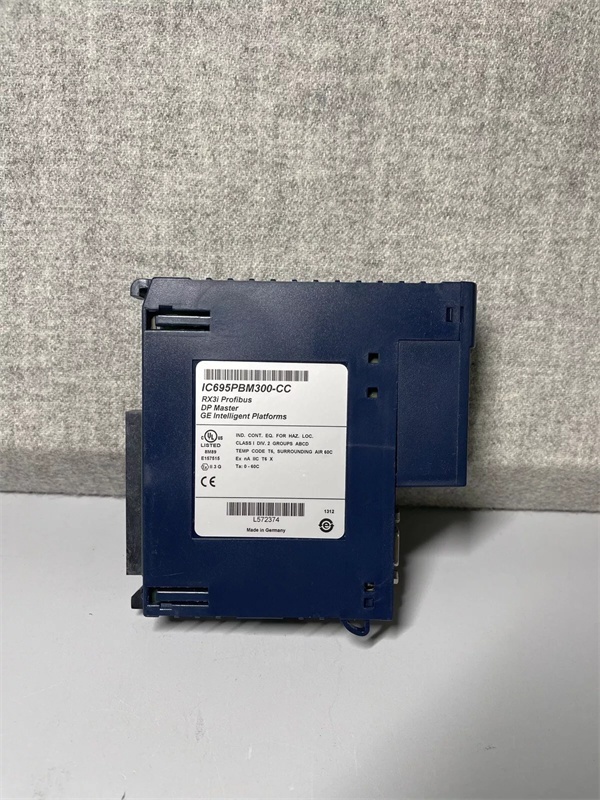
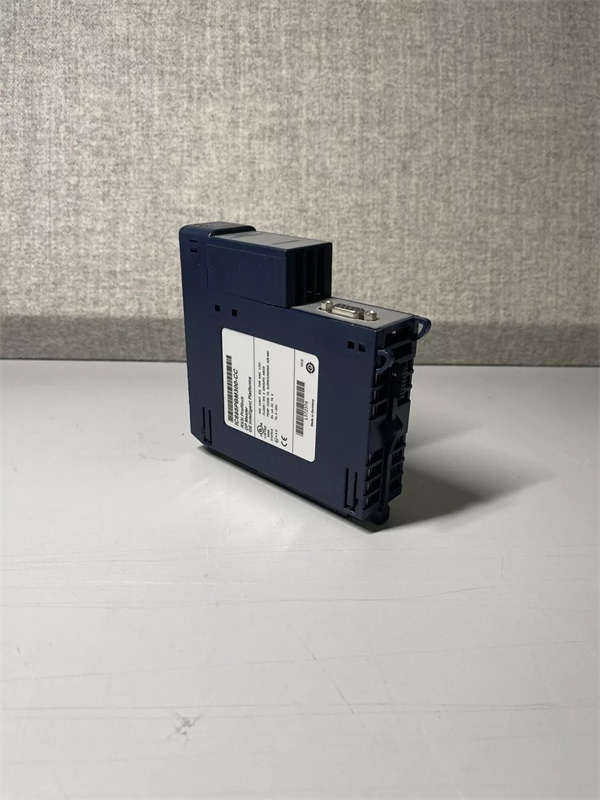
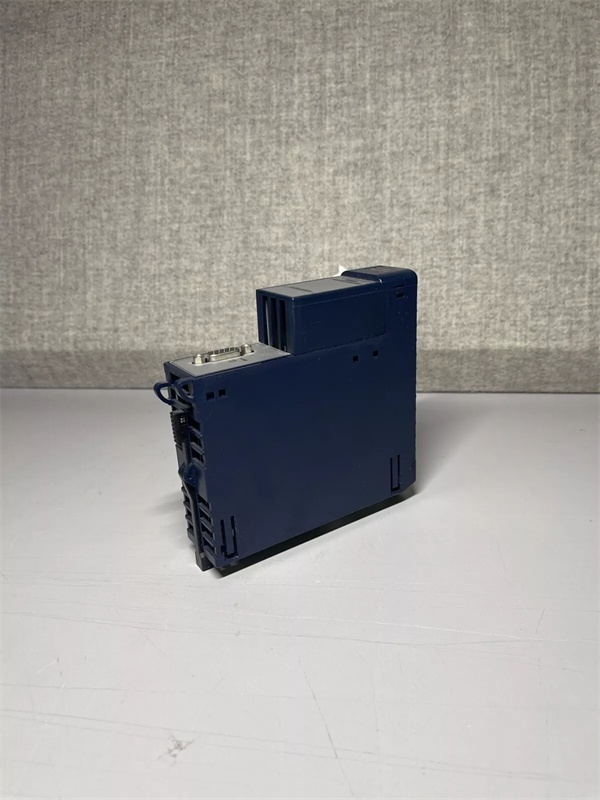
Description
System Architecture & Operational Principle
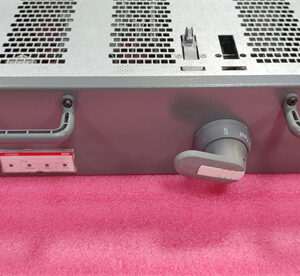
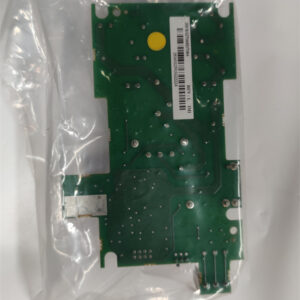
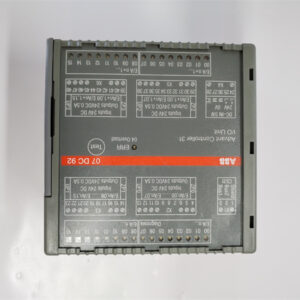
The GE IC695PBM300 is a PROFIBUS DP master communication module within the GE Fanuc PACSystems RX3i series, designed for Level 1 (Device) or Level 2 (Control) of the Purdue Model in industrial automation. It resides in control cabinets (mounted on an RX3i universal backplane) and serves as the backbone of PROFIBUS networks, connecting:
-
RX3i PLCs: Interfaces with RX3i CPUs (e.g., IC695CPE330) via the backplane to collect control logic and transmit field data.
-
PROFIBUS DP Slaves: Connects to up to 125 slave devices (e.g., Siemens VFDs, Allen-Bradley sensors) via a 9-pin D-sub connector, supporting full-duplex communication.
Upstream Communication
Receives control commands from the RX3i CPU via the backplane. The module uses a dedicated PROFIBUS processor to parse commands and prepare data for transmission to slave devices.
Downstream Communication
Transmits field data (e.g., sensor readings, actuator statuses) to slave devices via the PROFIBUS bus. The module supports DP-V1 functions (read/write operations, alarm messaging) and sync/freeze modes for synchronized control.
Operational Advantages
-
High Compatibility: Works with all RX3i CPUs (firmware ≥2.9) and supports standard PROFIBUS DP devices.
-
Flexible Configuration: Baud rates (9.6 kbps–12 Mbps) and data sizes (up to 3584 bytes) are software-configurable via GE’s Proficy Machine Edition.
-
Robust Diagnostics: On-module LEDs (network status, module status) and GSD file support simplify commissioning and troubleshooting.
Core Technical Specifications
|
Attribute
|
Specification
|
|---|---|
|
Product Type
|
PROFIBUS DP Master Communication Module
|
|
Part Number
|
IC695PBM300
|
|
System Platform
|
GE Fanuc PACSystems RX3i Series
|
|
Communication Protocol
|
PROFIBUS DP (EN 50170)
|
|
Baud Rates
|
9.6 kbps, 19.2 kbps, 93.75 kbps, 187.5 kbps, 500 kbps, 1.5 Mbps, 3 Mbps, 6 Mbps, 12 Mbps
|
|
Max Slave Devices
|
125
|
|
Data Capacity
|
Up to 3584 bytes input / 3584 bytes output
|
|
Connector
|
9-pin D-sub (female, standard PROFIBUS interface)
|
|
Power Consumption
|
440 mA @ 3.3V DC (from RX3i backplane)
|
|
Operating Temperature
|
0°C to +60°C (32°F to 140°F)
|
|
Storage Temperature
|
-40°C to +85°C (-40°F to 185°F)
|
|
Humidity
|
5–95% non-condensing
|
|
Dimensions (W×H×D)
|
~120 mm × 100 mm × 35 mm (4.7 in × 3.9 in × 1.4 in) (approximate)
|
|
Weight
|
~0.5 kg (1.1 lbs)
|
|
Certifications
|
CE, UL, CSA (compliant with EU/US/Canadian standards)
|
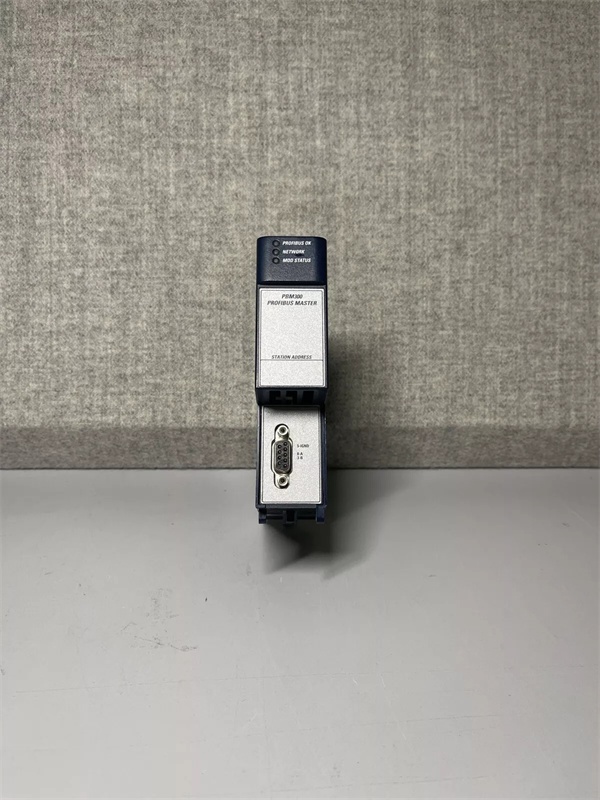
GE IC695PBM300
Customer Value & Operational Benefits
Enhanced System Flexibility
The IC695PBM300’s support for up to 125 PROFIBUS DP slaves allows users to expand their I/O capacity without replacing the entire PLC system. A manufacturing plant using the module reported a 30% reduction in cabling costs by using PROFIBUS’s daisy-chain topology instead of point-to-point wiring.
Reduced Maintenance Costs
The module’s hot-swap design (compatible with RX3i backplanes) allows technicians to replace it in minutes without shutting down the system. A chemical plant using the IC695PBM300 cut maintenance downtime by 40% compared to traditional non-hot-swappable communication modules.
Cost-Effective Integration
Compatible with GE’s RX3i PACSystem and third-party PROFIBUS devices (e.g., Siemens VFDs, Allen-Bradley sensors), the IC695PBM300 eliminates the need for custom gateways. A water treatment plant using the module saved $10,000 in integration costs by retaining its existing PLC infrastructure.
Field Engineer’s Notes (From the Trenches)
When installing the IC695PBM300, always enable the terminal resistor (switch ON) at the end of the PROFIBUS bus. I once saw a site where a technician forgot to enable the resistor, resulting in 50% data loss. Enabling the resistor fixed the issue immediately.Another gotcha: verify the CPU firmware version—the module requires RX3i CPU firmware ≥2.9. I’ve fixed countless “communication timeout” errors by updating the CPU firmware via GE’s WinLoader software.If the module’s “NETWORK” LED blinks red, check the PROFIBUS cable—loose connections or damaged cables are the most common causes of network faults. Use a multimeter to test the cable’s continuity and ensure it’s securely connected to the 9-pin D-sub connector.
Real-World Applications
-
Manufacturing Lines:An automotive manufacturing plant uses the IC695PBM300 to connect 32 proximity sensors (slave devices) to an RX3i PLC. The module’s 12 Mbps baud rate ensures real-time data transfer, allowing the PLC to adjust the assembly line speed based on sensor inputs, reducing product defects by 20%.
-
Chemical Processing:A chemical plant uses the IC695PBM300 to control 16 motor starters (slave devices) via PROFIBUS. The module’s sync mode ensures that all motor starters start simultaneously, reducing mechanical stress on the equipment.
-
Power Generation:A power plant uses the IC695PBM300 to monitor 8 temperature sensors (slave devices) in a turbine. The module’s alarm messaging function sends alerts to the SCADA system if the temperature exceeds a threshold, preventing turbine damage.

GE IC695PBM300
High-Frequency Troubleshooting FAQ
Q: What does the “MODULE OK” LED indicate on the GE IC695PBM300?
A: The green “MODULE OK” LED indicates that the module is powered on and functioning correctly. If it’s off, check the RX3i backplane power supply (3.3V DC) with a multimeter.
Q: Can the IC695PBM300 be used with non-GE PLCs?
A: No, the IC695PBM300 is designed exclusively for GE Fanuc PACSystems RX3i PLCs. Non-GE PLCs may not provide the correct backplane signals or power supply, leading to module failure.
Q: How do I configure the baud rate on the IC695PBM300?
A: Use GE’s Proficy Machine Edition software to configure the baud rate:
-
Open Proficy Machine Edition: Launch the software and connect to the RX3i PLC.
-
Select the IC695PBM300: Navigate to the “I/O Configuration” tab and select the module.
-
Set Baud Rate: Choose the desired baud rate (e.g., 1.5 Mbps) from the “PROFIBUS Settings” menu.
-
Save Configuration: Click “Save” to apply the changes to the module’s memory.
Q: Why is the IC695PBM300 not communicating with a slave device?
A: Check three things first:
-
Slave Address: Ensure the slave device has a unique address (1–125).
-
Terminal Resistor: Verify the end-of-bus resistor is enabled.
-
Cable Connection: Ensure the PROFIBUS cable is securely connected to the 9-pin D-sub connector.
Commercial Availability & Pricing
Please note: The listed price is not the actual final price. It is for reference only and is subject to appropriate negotiation based on current market conditions, quantity, and availability.