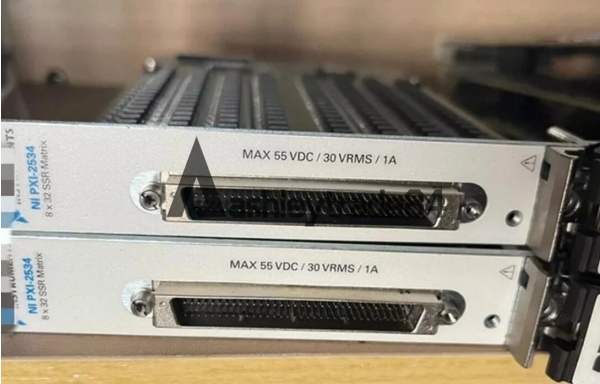
NI PXI-2534 | 2-Wire 64×16 Matrix Switch

  • Brand:​ National Instruments

  • Model:​ PXI-2534

  • Product Type:​ PXI Matrix Switch Module

  • Series:​ PXI Switch

  • Core Function:​ Provides high-density 2-wire signal routing for automated test systems with a 64×16 matrix configuration.

  • Key Specs:​ 64×16 matrix, 2-wire multiplexing, 256 crosspoints, 300V switching capability.
Manufacturer:
Part number: NI PXI-2534
Our extensive catalogue, including : NI PXI-2534 , is available now for dispatch to the worldwide.

Description

PXI-2534: Product Overview
The National Instruments PXI-2534 is a high-density 2-wire matrix switch module designed for PXI-based automated test and measurement systems. This module functions as a programmable signal router, providing a 64×16 cross-point matrix configuration that enables flexible connections between multiple signal sources and measurement instruments. Its primary role is to manage signal paths in complex test systems, allowing for the automated routing of analog and digital signals without manual reconfiguration.
Installed in a PXI chassis, the module operates by using electromechanical relays to establish connections between any of its 64 input rows and 16 output columns. This architecture supports multiple simultaneous connections, enabling parallel testing of multiple devices or test points. The 2-wire (single-pole) switching configuration is suitable for a wide range of applications where individual signal paths need to be controlled independently. The module is designed for integration into systems requiring high channel counts and reliable signal routing in production test, validation, and research and development environments.
PXI-2534: Technical Specifications

  • Model Number:​ PXI-2534

  • Manufacturer:​ National Instruments

  • Product Type:​ PXI Matrix Switch Module

  • Matrix Configuration:​ 64×16 cross-point matrix

  • Switching Type:​ 2-wire (single-pole) multiplexing

  • Number of Crosspoints:​ 256

  • Maximum Voltage:​ 300V channel-to-channel

  • Carry Current:​ 1A maximum per channel

  • Switching Speed:​ 10ms typical (including settle time)

  • Contact Life:​ 1 million operations minimum

  • Contact Resistance:​ <2Ω typical

  • Off-Isolation:​ >90dB at 1MHz

  • Bandwidth:​ DC to 100MHz

  • Relay Type:​ Electromechanical relays

  • Control Interface:​ PXI trigger lines

  • Operating Temperature:​ 0°C to 55°C

  • Power Consumption:​ 6W typical

    NI PXI-2534

    NI PXI-2534

Core Features & Customer Value
The primary value of this matrix switch lies in its high channel density and routing flexibility. The 64×16 configuration allows a single module to replace multiple smaller switching modules, reducing system size, cost, and complexity. For test engineers, this high density means fewer chassis and modules are required to achieve the same test coverage, resulting in significant space and cost savings in automated test equipment (ATE) systems.
The 2-wire switching architecture​ provides a cost-effective solution for applications where 4-wire Kelvin sensing is not required, such as digital signal routing, power switching, and general-purpose signal switching. The electromechanical relay technology​ offers reliable performance with low contact resistance and stable characteristics over time. While slower than solid-state alternatives, these relays provide excellent signal integrity for DC and low-frequency applications.
The module’s software-programmable architecture​ enables dynamic reconfiguration of signal paths during test execution, supporting complex test sequences without manual intervention. Integration with National Instruments’ Switch Executive software simplifies the programming and management of signal routes, reducing development time and potential configuration errors.
Typical Applications
In semiconductor test systems, the module routes test signals between parametric measurement units and multiple device pins for production testing of integrated circuits.
In automotive electronics testing, the matrix switches between multiple sensors and control units, enabling comprehensive functional testing of electronic control units (ECUs) and sensor interfaces.
For aerospace and defense systems, the module connects test instruments to various subsystems for component validation and system integration testing.