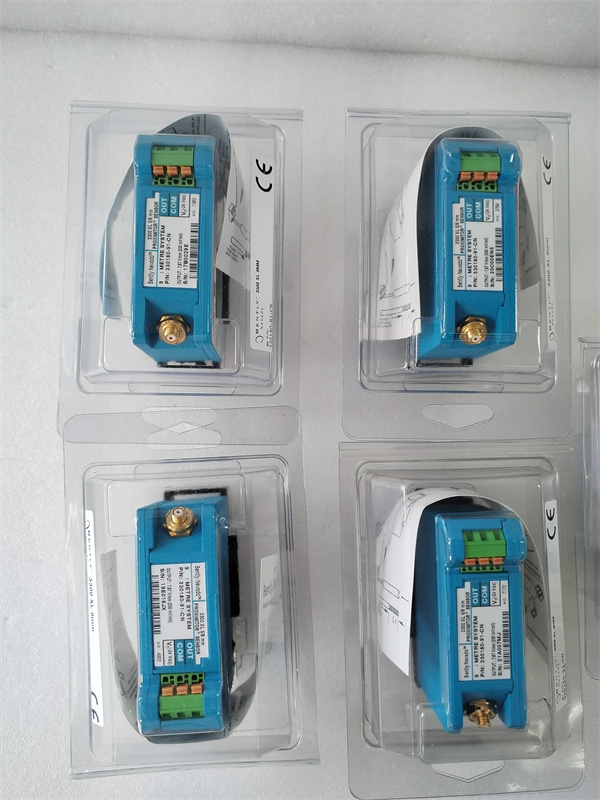
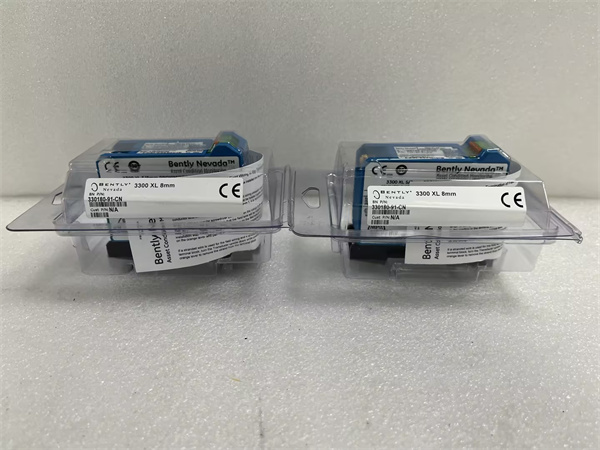
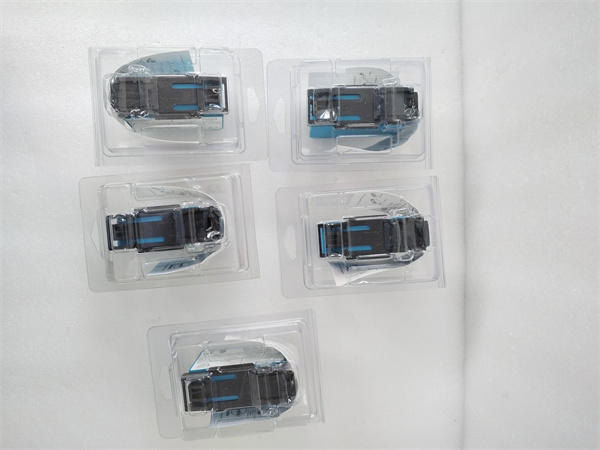
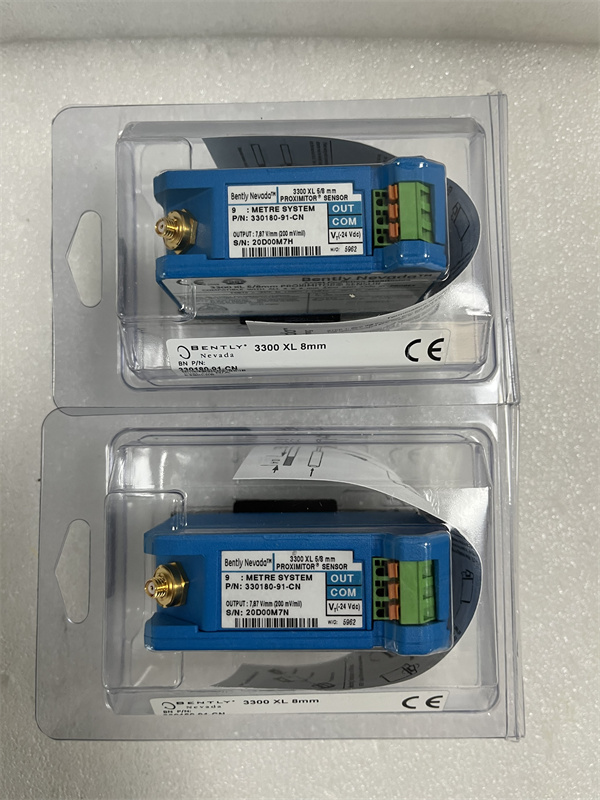
Description
System Architecture & Operational Principle
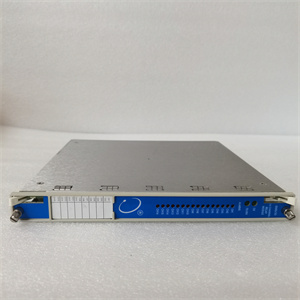
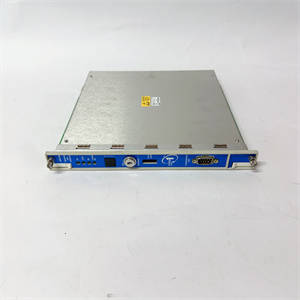
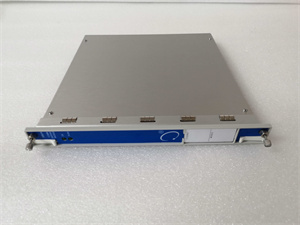
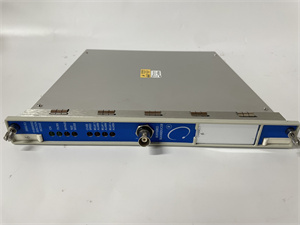
The Bently 3500/25-02-GCN is an enhanced keyphasor module within the Bently Nevada 3500 Series Machinery Protection System, designed for Level 1 (Device) or Level 2 (Control) of the Purdue Model in industrial automation. It resides in the 3500 Series rack (typically in Slots 3–14, adjacent to monitor modules) and serves as the bridge between keyphasor sensors (e.g., magnetic pickups, 3300 XL proximity probes) and 3500 Series monitor modules (e.g., 3500/40M vibration monitors, 3500/45 displacement monitors).
Upstream Communication
Receives raw keyphasor signals (pulses generated when a keyway on the rotating shaft aligns with the sensor) from up to two transducers via the 3500 rack’s backplane. The module processes these signals to extract timing references (e.g., shaft speed, phase angle) using advanced signal processing algorithms.
Downstream Communication
Transmits processed keyphasor signals to 3500 Series monitor modules via the backplane. These signals are used for:
-
Speed Measurement: Calculating shaft rotational speed (RPM) for process control or protection.
-
Phase Analysis: Determining the relative position of vibrating components (e.g., rotor imbalance) for fault diagnosis.
-
Synchronization: Aligning data from multiple sensors (e.g., X/Y vibration probes) for accurate machinery health monitoring.
Operational Advantages
-
Hot-Swappable Design: The module can be replaced without shutting down the 3500 system, minimizing downtime during maintenance.
-
Dual-Channel Redundancy: Two independent channels provide backup in case of a transducer or channel failure, enhancing system reliability.
-
Wide Input Range: Supports both magnetic pickups (passive) and proximity probes (active), making it versatile for different machinery types.

BENTLEY 330180-91-CN
Core Technical Specifications
|
Attribute
|
Specification
|
|---|---|
|
Channel Count
|
2 (independent, dual-channel)
|
|
Input Signal Range
|
Non-isolated: +0.8V to 21.0V; Isolated: +5V to -11V
|
|
Transducer Power Supply
|
-24V DC (per channel, max 40 mA)
|
|
Output Signal
|
Buffered keyphasor pulses (compatible with 3500 monitor modules)
|
|
Communication Interface
|
Via 3500 rack backplane (to monitor modules); RS-232/422 (via 3500/20 RIM)
|
|
Power Consumption
|
Typical: 3.2 W; Max: 5 W
|
|
Operating Temperature
|
-40°C to +70°C (-40°F to 158°F)
|
|
Storage Temperature
|
-50°C to +85°C (-58°F to 185°F)
|
|
Humidity
|
5% to 95% non-condensing
|
|
Dimensions (W×H×D)
|
119.9 mm × 24.4 mm × 256.5 mm (4.72 in × 0.96 in × 10.10 in)
|
|
Weight
|
0.34 kg (0.76 lbs)
|
|
Certifications
|
CE, UL, CSA, ATEX, DNV (maritime applications)
|
Customer Value & Operational Benefits
Enhanced Machinery Protection
The 3500/25-02-GCN’s keyphasor signals are critical for detecting incipient faults (e.g., rotor imbalance, bearing wear) in rotating machinery. By providing accurate timing references, the module enables early fault diagnosis, preventing catastrophic failures and reducing unplanned downtime. For example, a power plant using the module to monitor a steam turbine can detect abnormal phase shifts and shut down the turbine before damage occurs.
Seamless Integration with 3500 Series
As a core component of the 3500 Series, the 3500/25-02-GCN integrates seamlessly with other 3500 modules (e.g., 3500/40M vibration monitors, 3500/32 relay modules). This eliminates the need for custom wiring or protocol converters, reducing integration time and costs.
Reduced Maintenance Costs
The hot-swappable design and dual-channel redundancy minimize maintenance downtime. Technicians can replace a faulty module in minutes without interrupting the 3500 system’s operation, reducing labor costs and production losses.
Versatility for Multiple Machinery Types
The module’s support for both magnetic pickups and proximity probes makes it suitable for a wide range of rotating machinery, including turbines, compressors, pumps, and motors. This versatility allows facilities to standardize on the 3500 Series for all their machinery protection needs.
Field Engineer’s Notes (From the Trenches)
When installing the 3500/25-02-GCN, always verify the transducer type—the module supports both magnetic pickups and proximity probes, but the input signal range differs (non-isolated for magnetic pickups, isolated for proximity probes). Using the wrong transducer type will result in inaccurate keyphasor signals. I once saw a site where a contractor used a proximity probe with a non-isolated module, causing the module to misinterpret the signal and trigger false alarms.Another gotcha: check the transducer gap—for proximity probes, the gap between the probe and the shaft must be set to the manufacturer’s specification (typically 0.5–1.0 mm). An incorrect gap will cause the module to miss keyphasor pulses or generate noisy signals. Use a feeler gauge to verify the gap before powering up the module.If the module’s “FAULT” LED is red, check the transducer wiring—loose or reversed wires are a common cause of faults. Use a multimeter to test for continuity between the transducer and the module’s input terminals. Also, ensure the transducer’s shield is grounded to the 3500 rack’s earth ground to reduce EMI.BENTLEY 330180-91-CN
Real-World Applications
-
Power Generation: Steam Turbine MonitoringA coal-fired power plant uses the 3500/25-02-GCN to capture keyphasor signals from a magnetic pickup installed on the turbine’s shaft. The module transmits these signals to a 3500/40M vibration monitor, which calculates the turbine’s speed and phase angle. If the phase angle drifts outside the normal range (indicating rotor imbalance), the monitor triggers an alarm, allowing operators to shut down the turbine before damage occurs.
-
Oil & Gas: Centrifugal Compressor ProtectionAn offshore oil platform uses the 3500/25-02-GCN to process signals from two proximity probes (installed on the compressor’s shaft). The module provides keyphasor references to a 3500/45 displacement monitor, which measures the shaft’s axial displacement. If the displacement exceeds the trip threshold (indicating a bearing failure), the monitor sends a signal to the platform’s DCS to shut down the compressor, preventing a costly breakdown.
High-Frequency Troubleshooting FAQ
Q: What does the “FAULT” LED indicate on the 3500/25-02-GCN?
A: The red “FAULT” LED indicates a critical error, such as:
-
Transducer failure (e.g., broken wire, faulty probe).
-
Input signal out of range (e.g., too high or too low voltage).
-
Module hardware failure (e.g., corrupted firmware, damaged components).Check the 3500 Rack Configuration Software for detailed fault codes and follow the manufacturer’s troubleshooting steps.
Q: Can the 3500/25-02-GCN be used with non-Bently transducers?
A: No, the module is designed to work exclusively with Bently Nevada transducers (e.g., 3300 XL proximity probes, magnetic pickups). Non-Bently transducers may not meet the required signal specifications, leading to inaccurate keyphasor signals or module failure.
Q: How do I calibrate the 3500/25-02-GCN?
A: The module does not require regular calibration if the transducers are properly installed and maintained. However, if you suspect a calibration issue, use a keyphasor simulator (e.g., Bently’s 3300 XL Simulator) to test the module’s input and output signals. Follow the manufacturer’s instructions for simulator setup and testing.
Q: Why is the 3500/25-02-GCN not transmitting signals to the monitor module?
A: Check three things first:
-
Backplane Connection: Ensure the module is fully seated in the 3500 rack’s backplane. Loose connections are a common cause of communication failures.
-
Transducer Power: Verify the module is supplying -24V DC to the transducer (use a multimeter to measure the voltage at the transducer’s terminals).
-
Monitor Module Configuration: Ensure the monitor module (e.g., 3500/40M) is configured to receive keyphasor signals from the 3500/25-02-GCN. Use the 3500 Rack Configuration Software to verify the configuration.
Commercial Availability & Pricing
Please note: The listed price is not the actual final price. It is for reference only and is subject to appropriate negotiation based on current market conditions, quantity, and availability.