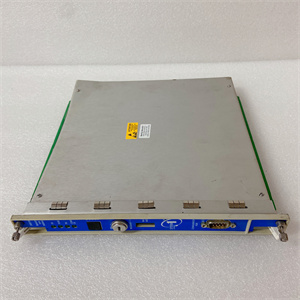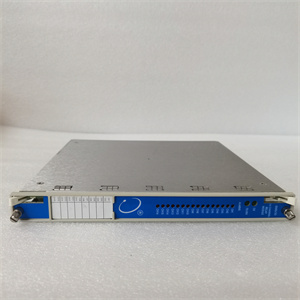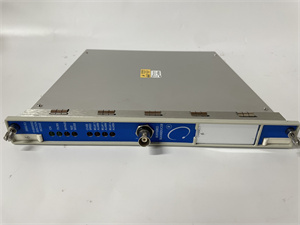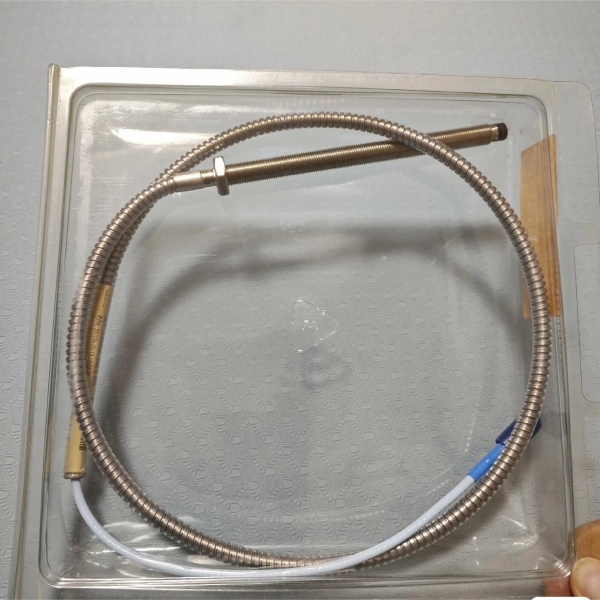
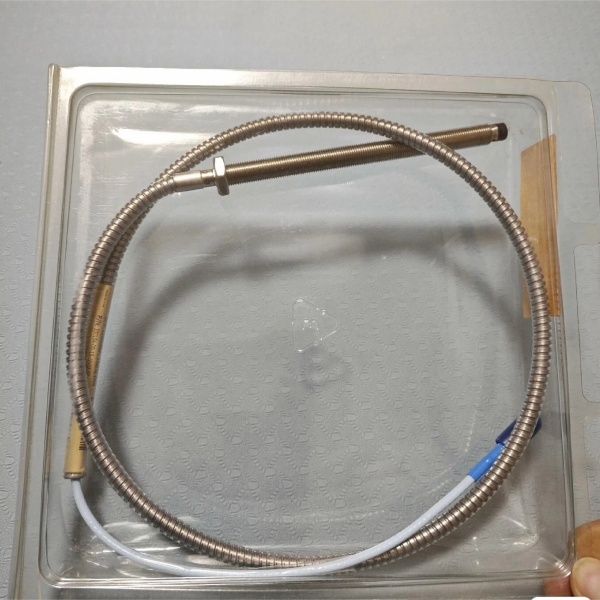
Description
Key Technical Specifications
-
Model Number: 330104-00-18-10-02-CN
-
Manufacturer: Bently Nevada (Baker Hughes)
-
Measurement Range: 0-18mm (0-710 mils) linear displacement
-
Output Signal: -18V to -2V DC (proportional to target displacement, 1V/10mm sensitivity)
-
Frequency Response: 0-10 kHz (covers most machinery vibration frequencies)
-
Target Material: Ferrous metals (steel, cast iron; non-ferrous requires special calibration)
-
Probe Length: 10 inches (254mm)
-
Thread Size: M10 x 1.5 (metric, for mounting bracket attachment)
-
Operating Temperature: -34°C to +177°C (probe), -29°C to +66°C (extension cable)
-
Supply Voltage: -24V DC (±10%, from 3500 monitor or power supply)
-
Electrical Isolation: 500Vrms (probe-to-cable, per IEC 60664-1)
-
Weight: 0.45kg (probe only)

Bently Nevada 330104-00-18-10-02-CN
Field Application & Problem Solved
In the field, monitoring rotating machinery health hinges on accurate shaft displacement data—but contact probes wear out, and optical sensors fail in dirty environments. This eddy current sensor solves that with non-contact measurement, surviving grime, oil, and high temps. You’ll find it on steam turbines tracking rotor eccentricity, centrifugal compressors measuring thrust bearing wear, or pumps detecting impeller imbalance. Its core value is reliability: the 18mm range covers most machinery gaps (e.g., 0.2-10mm typical shaft orbits), and the -18V to -2V output integrates directly with Bently 3500 monitors (no signal conditioning needed). For example, in a refinery’s hydrocracker turbine, it caught a 0.1mm shaft shift early—preventing a catastrophic rub that would have taken 3 weeks to repair. Unlike older 3300 series models, the CN variant meets China-specific EMC standards, cutting noise issues in local plants.
Installation & Maintenance Pitfalls (Expert Tips)
-
Incorrect Probe Gap Setting: Rookies set the gap too wide (>2mm) or too tight (<0.5mm), causing signal saturation or loss. Use a feeler gauge to set initial gap to 1.0-1.5mm (per manual), then fine-tune with the 3500 monitor’s “calibrate” function.
-
Ignoring Cable Shielding: The coaxial cable’s braided shield must be grounded only at the monitor end. Grounding at both ends creates ground loops, inducing 50/60Hz noise (common in paper mills). Tape exposed shielding with conductive tape if routing near VFDs.
-
Skipping Target Surface Prep: Rust, pitting, or paint on the shaft adds error. Polish the target area to a 32-microinch finish (Ra ≤ 0.8μm) with emery cloth—skip this, and you’ll see 0.05mm drift in readings.
-
Using Non-Ferrous Targets Uncalibrated: Aluminum or brass shafts change the eddy current response. Always order a “non-ferrous calibration” version (e.g., 330104-NF) or apply a ferrous shim (0.5mm thick) to the target.
-
Neglecting Extension Cable Length: Max cable length is 30m (98ft). Longer runs attenuate the signal—if you need 50m, use an active repeater (Bently 330180) to boost the voltage.
Bently Nevada 330104-00-18-10-02-CN
Technical Deep Dive & Overview
The 330104-00-18-10-02-CN is a Proximitor eddy current sensor from Bently’s 3300 Series, designed for non-contact shaft displacement measurement. It works via electromagnetic induction: a high-frequency oscillator in the probe generates a magnetic field; when a ferrous target approaches, eddy currents form in the target, altering the probe’s coil impedance. This impedance change is converted to a linear voltage output (-18V at max gap, -2V at zero gap). The 10-inch probe houses the coil and connector, with an M10x1.5 thread for mounting to a bracket (e.g., Bently 330130). The 18mm range is achieved via a specialized coil design, balancing sensitivity and linearity. It pairs with Bently 3500/42M monitors (or legacy 1700/3000 systems) to provide raw vibration data (peak-to-peak, RMS) for machinery protection. In short, it’s the “eyes” of the 3500 system—rugged, precise, and built to outlast the machines it monitors.