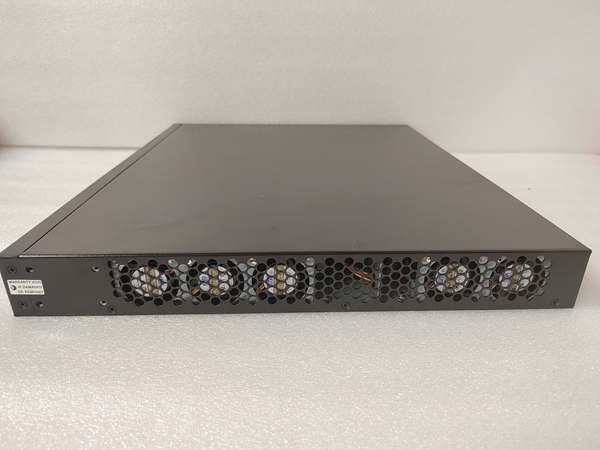
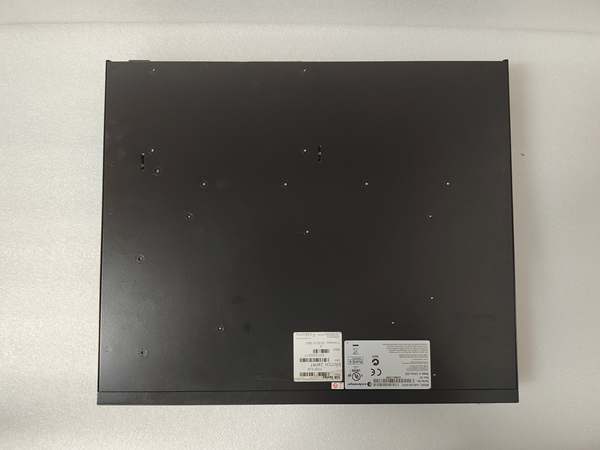
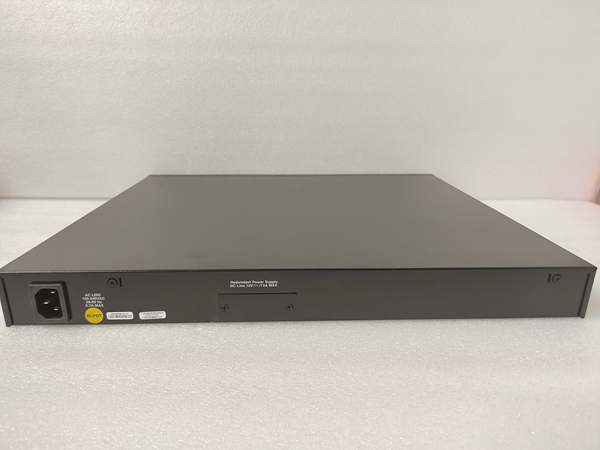
Description
System Architecture & Operational Principle
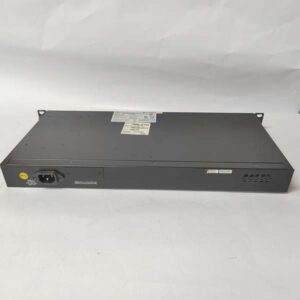
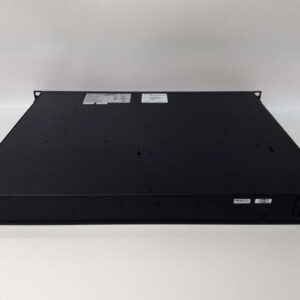
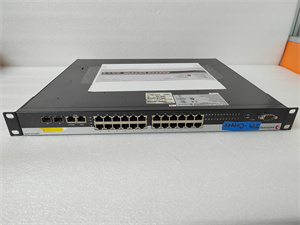
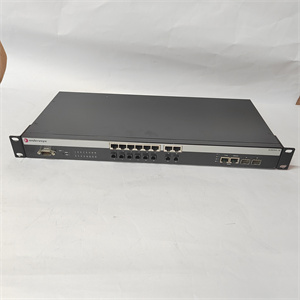
The Enterasys A4H124-24TX is a 24-port managed stackable switch designed for Level 2 (Distribution) or Level 3 (Core) of the Purdue Model in industrial automation. It resides in network closets or control cabinets and serves as the bridge between end devices (e.g., computers, IP cameras) and core networks (e.g., routers, servers).
Upstream Communication
Receives data from end devices via 10/100BASE-TX ports. For uplink to the core network, it uses 10/100/1000BASE-T ports or SFP slots (supports fiber or copper) to connect to routers or higher-layer switches.
Downstream Communication
Transmits data from the core network to end devices. The switch uses store-and-forward switching to ensure reliable data transfer, and supports VLAN segmentation to isolate traffic (e.g., separating office traffic from industrial control traffic).
Operational Advantages
-
Stackability: Up to 8 A4H124-24TX switches can be stacked to form a single virtual switch, increasing port density and simplifying management.
-
Redundant Power: Optional external redundant power supply (RPSM) ensures uninterrupted operation if the internal power fails.
-
Advanced QoS: Prioritizes critical traffic (e.g., VoIP, video) using 802.1p and DSCP, ensuring low latency for real-time applications.
Core Technical Specifications
|
Attribute
|
Specification
|
|---|---|
|
Port Count
|
24 10/100BASE-TX ports; 2 10/100/1000BASE-T uplink ports; 2 SFP slots
|
|
Switching Capacity
|
17.6 Gbps (non-blocking)
|
|
Forwarding Rate
|
13.1 Mpps
|
|
MAC Address Table
|
16,000 entries
|
|
VLAN Support
|
IEEE 802.1Q (up to 256 VLANs)
|
|
QoS Features
|
802.1p, DSCP, weighted fair queuing (WFQ)
|
|
Security
|
IEEE 802.1X (port-based authentication), MAC address filtering
|
|
Stacking
|
Up to 8 units (stackable via RJ45 or SFP ports)
|
|
Power Supply
|
Internal 100-240 VAC (50/60 Hz); optional RPSM (P0973BP) for redundancy
|
|
Operating Temperature
|
0°C to +50°C (32°F to 122°F)
|
|
Dimensions (W×H×D)
|
17.3 in × 1.7 in × 10.5 in (439 mm × 43 mm × 267 mm)
|
|
Weight
|
8.8 lbs (4 kg)
|
|
Certifications
|
CE, UL, FCC, RoHS
|
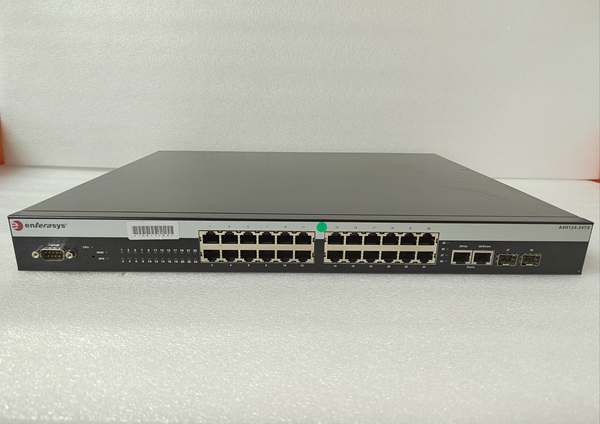
ENTERASYS A4H124-24TX
Customer Value & Operational Benefits
High Availability
The A4H124-24TX’s stackable design and redundant power options ensure that network connectivity is maintained even if a single switch or power supply fails. This is critical for industrial environments where downtime can result in significant production losses.
Simplified Management
Stacking up to 8 switches into a single virtual switch reduces the number of IP addresses and management tasks. The switch supports WebView (web-based management), CLI (command-line interface), and SNMP (Simple Network Management Protocol) for flexible configuration and monitoring.
Cost-Effective Scalability
The 24-port design allows for gradual expansion of the network without replacing existing infrastructure. As the number of end devices increases, additional A4H124-24TX switches can be added to the stack, saving costs compared to replacing the entire switch.
Industrial Compatibility
The switch supports IEEE 802.3af PoE (Power over Ethernet) for devices like IP phones and wireless access points, eliminating the need for separate power supplies. This makes it suitable for industrial environments where power outlets may be limited.
Field Engineer’s Notes (From the Trenches)
When installing the A4H124-24TX, always use shielded twisted-pair (STP) cables for 10/100BASE-TX ports—unshielded cables can pick up electromagnetic interference (EMI) from nearby machinery, leading to packet loss. I once saw a site where a contractor used unshielded cables, resulting in intermittent connectivity issues. Switching to STP cables resolved the problem immediately.Another gotcha: verify the SFP module compatibility—the A4H124-24TX supports SFP modules for fiber uplinks, but not all SFP modules are created equal. Use Enterasys-branded or approved third-party SFP modules to avoid compatibility issues. I’ve fixed countless “link down” faults by replacing non-approved SFP modules.If the switch’s “FAULT” LED is red, check the power supply first—the internal power supply may have failed. Use a multimeter to test the power input (100-240 VAC) and ensure the power cord is securely connected. If the power supply is faulty, replace it with a new one (part number: 109801-00).
Real-World Applications
-
Industrial Automation: Factory Floor ConnectivityA manufacturing plant uses the A4H124-24TX to connect 20 CNC machines, 4 IP cameras, and 2 workstations. The switch’s 24 10/100BASE-TX ports provide enough connectivity for all devices, and the 2 SFP slots are used for fiber uplinks to the plant’s core router. The stackable design allows the plant to add more switches as the factory expands.
-
Enterprise Networking: Office Building ConnectivityAn office building uses the A4H124-24TX to connect 15 computers, 5 IP phones, and 2 printers. The switch’s QoS features prioritize VoIP traffic, ensuring clear calls. The optional RPSM provides redundant power, so if the internal power supply fails, the switch continues to operate without interruption.

ENTERASYS A4H124-24TX
High-Frequency Troubleshooting FAQ
Q: What does the “FAULT” LED indicate on the A4H124-24TX?
A: The red “FAULT” LED indicates a critical error, such as:
-
Power Supply Failure: The internal power supply is not providing power (check the power cord and input voltage).
-
Fan Failure: The internal fan is not spinning (clean the fan or replace it).
-
Overheating: The switch is operating above the maximum temperature (check the ambient temperature and ventilation).Check the switch’s web interface or CLI for detailed fault codes and follow the manufacturer’s troubleshooting steps.
Q: Can the A4H124-24TX be used with non-Enterasys switches?
A: Yes, the A4H124-24TX supports standard Ethernet protocols (e.g., IEEE 802.3, 802.1Q) and can be used with switches from other vendors. However, stacking is only supported with other A4 Series switches.
Q: How do I stack A4H124-24TX switches?
A: Follow these steps:
-
Connect the Stack Cables: Use RJ45 or SFP cables to connect the stacking ports (labeled “STACK”) of each switch.
-
Configure the Stack: Use the web interface or CLI to configure the stack (assign a stack ID and priority).
-
Verify the Stack: Check the switch’s status LEDs—all switches in the stack should have a green “STACK” LED.
Q: Why is the A4H124-24TX not recognizing my SFP module?
A: Check three things first:
-
Module Compatibility: Ensure the SFP module is approved for use with the A4H124-24TX (check the manufacturer’s website).
-
Port Configuration: Verify that the SFP port is enabled (use the web interface or CLI to check).
-
Cable Connection: Ensure the fiber cable is securely connected to the SFP module and the port.
Commercial Availability & Pricing
Please note: The listed price is not the actual final price. It is for reference only and is subject to appropriate negotiation based on current market conditions, quantity, and availability.