Description
System Architecture & Operational Principle
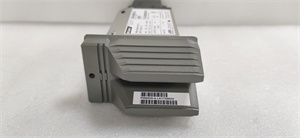
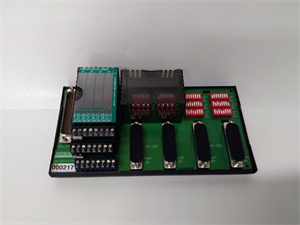
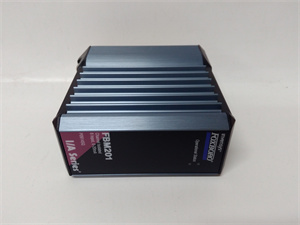
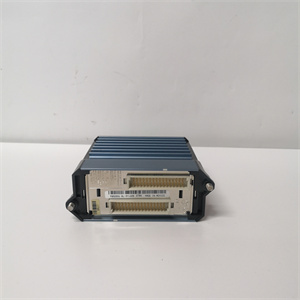
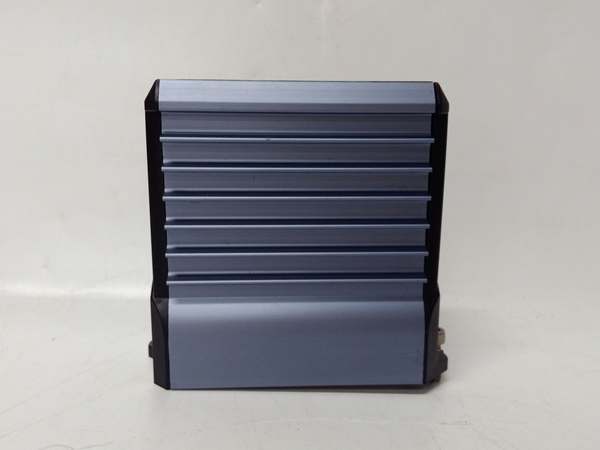
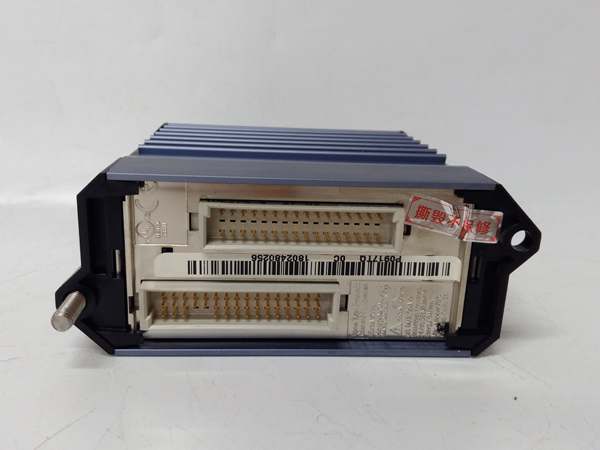
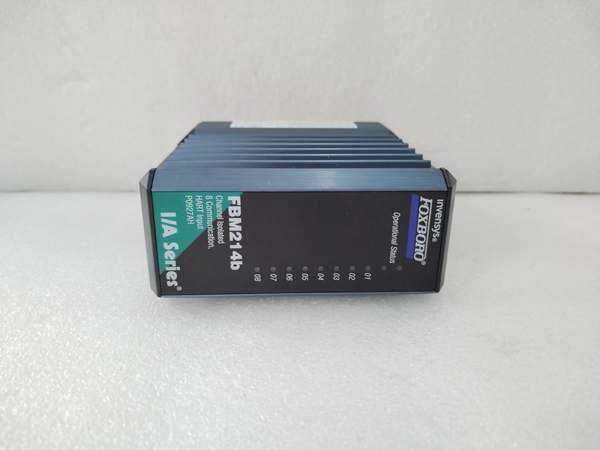
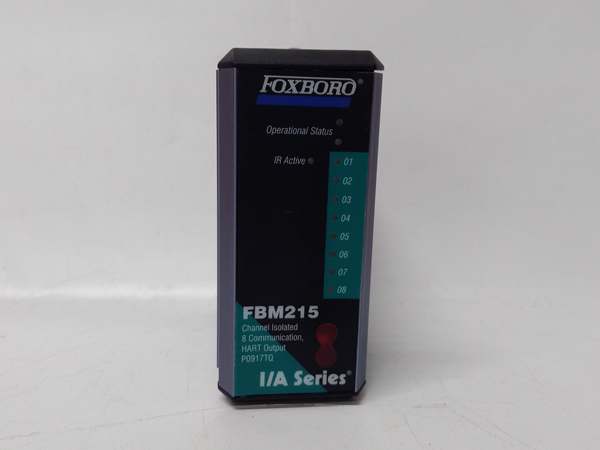
The Foxboro FBM216B is an 8-channel redundant HART communication input module within the Foxboro I/A Series DCS, designed for Level 1 (Device) or Level 2 (Control) of the Purdue Model in industrial automation. It resides in the I/A Series FBM rack (typically in field I/O cabinets) and serves as the bridge between HART-enabled field devices (e.g., pressure transmitters, temperature sensors) and I/A Series controllers (e.g., CP4000 control processors).
Upstream Communication
Receives 4-20 mA analog signals from HART-enabled field devices via 8 independent input channels. These signals represent process variables (e.g., pressure, temperature, flow) and are transmitted over shielded twisted-pair cables. The module also supports HART protocol (Highway Addressable Remote Transducer), allowing bidirectional communication with smart field devices for configuration, calibration, and diagnostics without disrupting process control.
Downstream Communication
Transmits processed digital data to I/A Series controllers via the FBM rack’s backplane. The module uses channel-to-channel isolation (1500 V RMS) to prevent electrical interference between channels, ensuring accurate signal conversion even in noisy industrial environments. The HART protocol support also enables the transmission of diagnostic data (e.g., sensor drift, device status) to the controller for predictive maintenance.
Operational Advantages
-
Redundant Architecture: Paired modules (Master-Tracker) ensure continuous operation—if the Master fails, the Tracker takes over within milliseconds, preventing process interruptions.
-
High Precision: 16-bit A/D conversion and ±0.1% accuracy ensure precise measurement of process variables, critical for maintaining process stability in industries like oil & gas and chemical processing.
-
HART Integration: Combines analog control with digital diagnostics, reducing the need for manual field visits and enabling predictive maintenance.
-
Hot-Swappable Design: Can be replaced without shutting down the I/A Series system, minimizing production losses during maintenance.
Core Technical Specifications
|
Attribute
|
Specification
|
|---|---|
|
Channel Count
|
8 independent, isolated analog input channels
|
|
Input Signal Type
|
4-20 mA current loop (superimposed with HART digital signal)
|
|
Accuracy
|
±0.1% of full scale (typical)
|
|
Resolution
|
16-bit A/D conversion
|
|
Power Supply
|
24 VDC (±10%, 5W max)
|
|
Operating Temperature
|
-40°C to +70°C (-40°F to 158°F)
|
|
Storage Temperature
|
-40°C to +85°C (-40°F to 185°F)
|
|
Humidity Tolerance
|
5%–95% non-condensing
|
|
Isolation
|
1500 V RMS channel-to-channel; 1500 V RMS channel-to-bus
|
|
HART Throughput
|
Up to 2 digital messages per second per device
|
|
Dimensions (W×H×D)
|
~130 mm × 200 mm × 30 mm (5.12 in × 7.87 in × 1.18 in)
|
|
Weight
|
~0.5 kg (1.1 lbs)
|
|
Certifications
|
CE, UL, CSA, ATEX, IECEx
|
|
Compatibility
|
Foxboro I/A Series DCS; works with CP4000 control processors
|
FOXBORO FBM215
Customer Value & Operational Benefits
Enhanced Process Reliability
The FBM216B’s redundant architecture and high isolation ensure accurate monitoring of field devices, reducing false alarms and ensuring reliable process control. For example, a chemical plant using the module to monitor reactor temperature can detect a stuck valve via HART diagnostics, triggering an alarm before it impacts production.
Reduced Downtime with Redundancy
The Master-Tracker configuration minimizes unplanned downtime—if one module fails, the other takes over seamlessly. This is critical for 24/7 operations like oil & gas production, where even a short outage can result in significant costs.
Cost-Effective I/O Expansion
The 8-channel design reduces the number of modules needed for complex control tasks, saving cabinet space and installation costs. Additionally, the module’s compatibility with I/A Series systems eliminates the need for custom wiring or protocol converters.
Compliance with Industry Standards
The module’s certifications (CE, UL, ATEX) ensure it meets the rigorous requirements of industries like oil & gas, power generation, and chemical processing. This compliance is essential for facilities seeking to adhere to regulatory or corporate safety standards.
Field Engineer’s Notes (From the Trenches)
When installing the FBM216B, always use shielded twisted-pair cables for field wiring—unshielded cables can pick up electromagnetic interference (EMI) from nearby power lines, leading to inaccurate signal readings. I once saw a site where a contractor used unshielded cables, resulting in a 5% error in pressure measurements. Shielded cables eliminated the problem immediately.Another gotcha: verify the HART device address—each HART-enabled field device must have a unique address (1–15) to communicate with the module. If two devices have the same address, the module will not be able to distinguish between them, leading to communication errors. Use a HART communicator to check and set the addresses before connecting the devices.If the module’s “FAULT” LED is red, check the field wiring first—loose or reversed wires are a common cause of faults. Use a multimeter to test for continuity between the field device and the module’s input terminals. Also, ensure the module’s shield is grounded to the I/A Series rack’s earth ground to reduce EMI.
Real-World Applications
-
Oil & Gas: Offshore Platform Pressure MonitoringAn offshore oil platform uses the FBM216B to monitor the pressure of crude oil pipelines. The module receives 4-20 mA signals from HART-enabled pressure transmitters installed on the pipelines and transmits the data to an I/A Series controller. If the pressure exceeds the setpoint (e.g., 1000 psi), the controller triggers an alarm, allowing operators to open a relief valve and prevent a pipeline rupture.
-
Chemical Processing: Reactor Temperature ControlA chemical plant uses the FBM216B to monitor the temperature of a polymerization reactor. The module receives signals from HART-enabled temperature sensors installed in the reactor and transmits the data to an I/A Series controller. The controller adjusts the cooling water flow to maintain the temperature within the optimal range (e.g., 80°C), ensuring consistent product quality.

FOXBORO FBM215
High-Frequency Troubleshooting FAQ
Q: What does the “FAULT” LED indicate on the FBM216B?
A: The red “FAULT” LED indicates a critical error, such as:
-
Field Wiring Issue: Loose or reversed wires between the field device and the module.
-
HART Communication Error: Duplicate HART addresses or faulty HART devices.
-
Module Hardware Failure: Corrupted firmware or damaged components.Check the I/A Series diagnostic software for detailed fault codes and follow the manufacturer’s troubleshooting steps.
Q: Can the FBM216B be used with non-HART devices?
A: Yes, the module supports both HART-enabled and non-HART 4-20 mA devices. However, non-HART devices will not benefit from the HART protocol’s diagnostic features.
Q: How do I replace the FBM216B?
A: Follow these steps:
-
Power Down: Turn off the I/A Series rack’s main power supply.
-
Remove Old Module: Unscrew the module from the I/A Series carrier (use a Phillips screwdriver).
-
Install New Module: Secure the new FBM216B to the carrier and tighten the screws.
-
Power Up: Turn on the main power supply and verify the module’s operation (check the “OK” LED).
Q: Why is the FBM216B not receiving signals from a HART device?
A: Check three things first:
-
HART Address: Ensure the device has a unique HART address (1–15).
-
Wiring: Check the shielded twisted-pair cable for loose connections or damage.
-
Module Configuration: Use the I/A Series configuration software to verify that the module is configured for HART communication.
Commercial Availability & Pricing
Please note: The listed price is not the actual final price. It is for reference only and is subject to appropriate negotiation based on current market conditions, quantity, and availability.