Description
System Architecture & Operational Principle
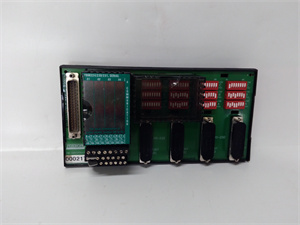
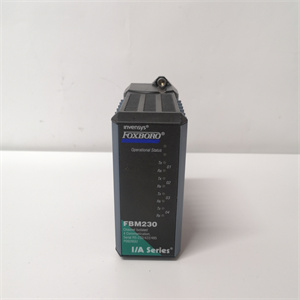
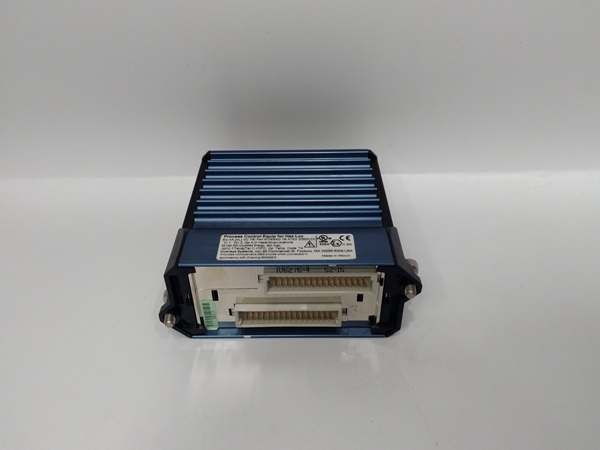
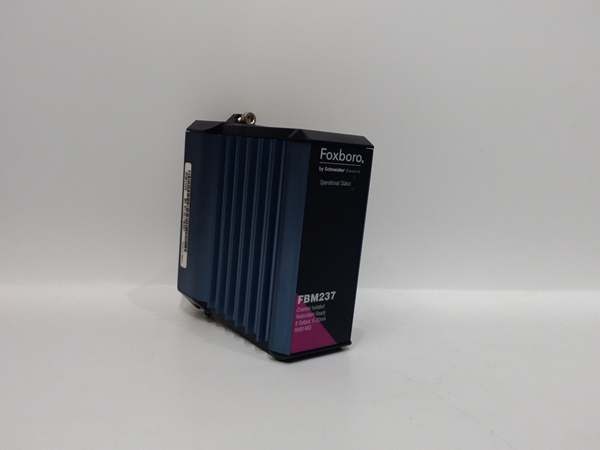
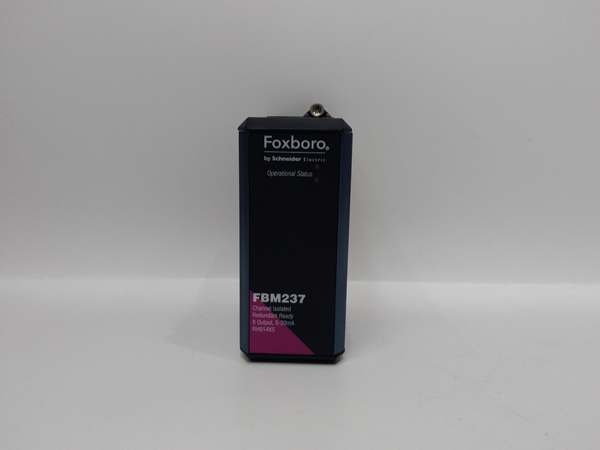
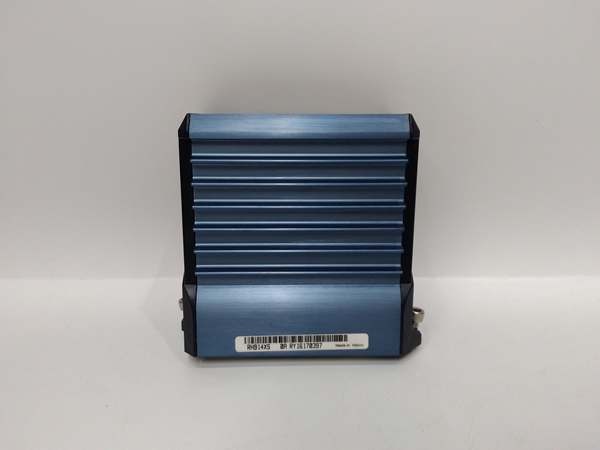
The Foxboro FBM237 is an 8-channel analog output module designed for Level 0 (Field Device Control) of the Purdue Model in industrial automation. It resides in the Foxboro I/A Series FBM rack (field-mounted or rack-mounted) and serves as the critical link between the Foxboro DCS controller (e.g., CP4000, FCP280) and field actuators (e.g., control valves, variable frequency drives, motor starters).
Upstream Communication
The FBM237 receives digital control signals from the Foxboro DCS via the FBM rack’s backplane using the Distributed Control Interface (DCI) protocol. The module converts these digital signals to precise 0-20 mA analog outputs, with each channel galvanically isolated from others and ground to prevent interference.
Downstream Communication
The 0-20 mA analog outputs from the FBM237 are transmitted to field devices (e.g., control valves) to regulate process variables (e.g., flow, pressure, temperature). The module supports HART protocol for two-way digital communication with smart field devices, enabling remote configuration, calibration, and diagnostics without interrupting the analog signal path.
Operational Advantages
-
Redundancy: Can be deployed in pairs with the P0916QD adapter for fault-tolerant control. The AOUTR function block automatically manages failover, ensuring uninterrupted output even if one module fails.
-
High Precision: 13-bit resolution and ±0.05% accuracy deliver laboratory-grade measurement for critical process variables.
-
HART Compatibility: Eliminates the need for separate handheld communicators by enabling remote configuration of smart field devices via the 4-20 mA signal.

FOXBORO FBM237
Core Technical Specifications
|
Attribute
|
Specification
|
|---|---|
|
Module Type
|
8-Channel Analog Output Module (Redundant-Ready)
|
|
Output Channels
|
8 galvanically isolated 0-20.4 mA DC channels
|
|
Accuracy
|
±0.05% of span (0.1-20 mA range); ±50 ppm/°C temperature coefficient
|
|
Resolution
|
13-bit
|
|
HART Support
|
Full compatibility with HART field devices (two-way digital communication)
|
|
Output Load
|
Maximum 750 Ω per channel
|
|
Processing Delay
|
≤30 ms (real-time control response)
|
|
Power Supply
|
24 V DC ±5–10% (supports redundant power via P0916QD adapter)
|
|
Power Consumption
|
7 W maximum
|
|
Operating Temperature
|
Rev A-J: -20°C to +70°C (-4°F to 158°F); Rev K+: 0°C to +70°C (32°F to 158°F)
|
|
Storage Temperature
|
-40°C to +70°C (-40°F to 158°F)
|
|
Humidity Tolerance
|
5–95% non-condensing
|
|
Dimensions (W×H×D)
|
45 mm × 102 mm × 104 mm (1.75 in × 4 in × 4.11 in)
|
|
Weight
|
284 g (10 oz)
|
|
Certifications
|
CE, UL, CSA, ATEX (Ex nA IIC T4), ABS, Bureau Veritas
|
Customer Value & Operational Benefits
Fault-Tolerant Control
The FBM237’s redundant configuration ensures uninterrupted output in mission-critical applications (e.g., nuclear power plants, oil refineries). For example, a chemical plant using redundant FBM237 pairs for reactor temperature control reported a 99.9% uptime, eliminating costly shutdowns due to module failures.
Reduced Maintenance Costs
The module’s hot-swappable design allows replacement without disrupting field wiring or communication, minimizing downtime during maintenance. A paper mill using the FBM237 reduced maintenance time by 50% compared to traditional analog modules.
Improved Process Efficiency
HART compatibility enables remote configuration of smart field devices, reducing the need for on-site technicians. For an oil refinery, this translates to $5,000+ per month in saved labor costs.
Cost-Effective Scalability
The 8-channel capacity per module reduces the number of required FBM slots, saving cabinet space and installation costs. Additionally, the module’s backward compatibility with Foxboro I/A Series systems protects existing investments, allowing gradual migration to modern DCS platforms.
Field Engineer’s Notes (From the Trenches)
When installing the FBM237, always use shielded twisted-pair (STP) cables for field device connections—unshielded cables can pick up electromagnetic interference (EMI) from nearby power lines, leading to signal noise and inaccurate output. I once saw a site where a contractor used unshielded cables, resulting in erratic valve positions. Switching to STP cables eliminated the problem immediately.Another gotcha: verify the HART device address—the FBM237 supports HART addresses 0-63. If the address is incorrect, the DCS won’t be able to communicate with the field device. I’ve fixed countless “no HART communication” errors by correcting the address in the DCS configuration.If the module’s “FAULT” LED is red, check the output load first—ensure the field device’s input impedance is within the 750 Ω limit. If the load is too high, the module will enter a fault state. I once encountered a site where a technician connected a 1 kΩ load to the FBM237, causing the module to fault. Reducing the load to 750 Ω resolved the issue.FOXBORO FBM237
Real-World Applications
-
Oil & Gas: Offshore Platform Drilling ControlAn offshore oil platform uses the FBM237 to control 8 subsea control valves via 0-20 mA signals. The module’s HART compatibility enables remote calibration of the valves from the platform’s control room, reducing the need for diver interventions. The redundant configuration ensures that the valves remain operational even if one module fails, preventing blowout risks.
-
Chemical Processing: Reactor Temperature RegulationA chemical plant uses the FBM237 to regulate the temperature of a polymerization reactor. The module sends 0-20 mA signals to 8 heating elements, adjusting the heat input based on feedback from temperature sensors. The HART protocol allows the plant to monitor the health of the heating elements remotely, predicting failures before they occur.
High-Frequency Troubleshooting FAQ
Q: What is the correct way to replace a legacy FBM227 (analog output) with the FBM237?
A: The FBM237 is a direct functional replacement, but you’ll need to:
-
Re-terminate field wiring: Use STP cables for field device connections (replace unshielded cables).
-
Load the correct I/O driver: Use Foxboro’s configurator to download the analog output driver for the FBM237.
-
Configure HART addresses: Assign unique HART addresses (0-63) to each field device in the DCS.Test the output using a multimeter to verify the 0-20 mA signal before connecting to the field device.
Q: Why is my FBM237 showing a “HART communication error”?
A: HART errors are usually caused by incorrect device addressing or cable issues. Check:
-
HART address: Ensure the field device’s HART address matches the configuration in the DCS.
-
Cable shielding: Ensure the STP cable’s shield is grounded to the FBM rack’s earth ground.
-
Baud rate: Verify the HART baud rate (default: 1200 bps) matches the DCS setting.
Q: Can the FBM237 be used with non-Foxboro DCS systems?
A: No, the FBM237 is designed exclusively for Foxboro I/A Series and EcoStruxure Foxboro DCS. It relies on the FBM rack’s backplane for power and communication, so using it with non-Foxboro systems will result in compatibility issues.
Q: How do I configure the FBM237 for redundant operation?
A: Use the P0916QD adapter to connect two FBM237 modules in parallel. Configure the AOUTR function block in the DCS to manage failover—this block will automatically switch to the backup module if the primary module fails.
Commercial Availability & Pricing
Please note: The listed price is not the actual final price. It is for reference only and is subject to appropriate negotiation based on current market conditions, quantity, and availability.