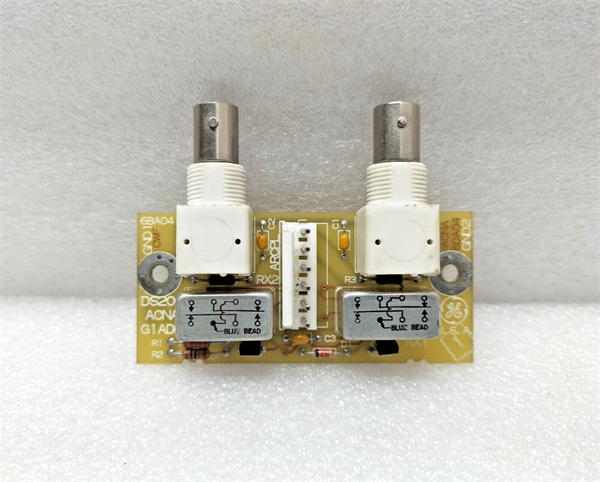
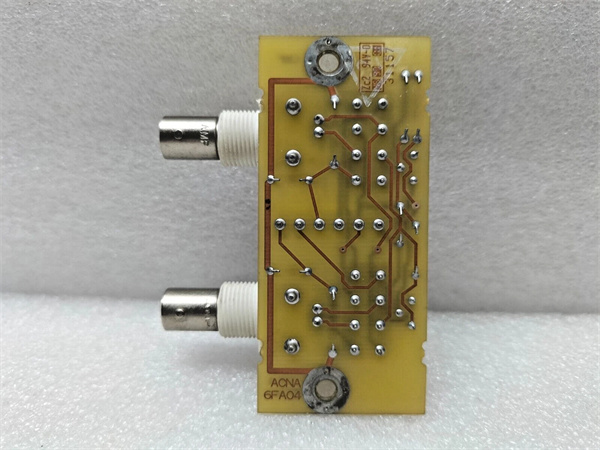
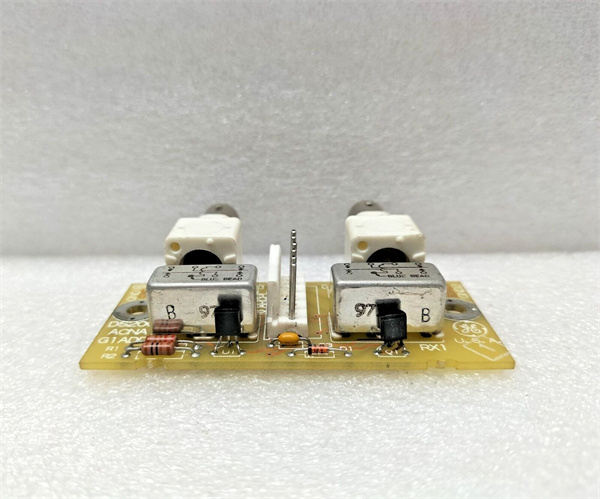
Description
System Architecture & Operational Principle
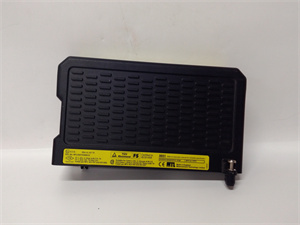
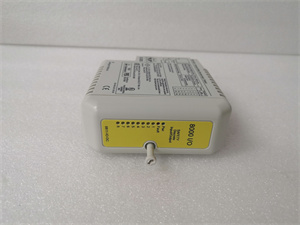
The GE DS200ACNAG1ADD is an ARCNET communication adapter within the GE Mark V Series of turbine control systems, designed for Level 2 (Control) of the Purdue Model in industrial automation. It resides in the turbine control cabinet (mounted on a 13/21-slot VME rack) and serves as the bridge between main processor boards (LDCC) and operator interfaces/peripheral devices, connecting:
-
Upstream: Receives control signals from the LDCC (main processor) via the VME backplane.
-
Downstream: Transmits data to operator interfaces (e.g., HMI) and peripheral devices (e.g., sensors, actuators) via ARCNET LAN (using coaxial cables with BNC connectors).
Operational Advantages
-
Reliable Communication: ARCNET protocol ensures deterministic, low-latency data transfer (critical for turbine control), with redundant paths for fault tolerance.
-
Static Protection: Designed with static-sensitive components (e.g., metal film resistors, capacitors) to prevent electrostatic discharge (ESD) damage during installation/maintenance.
-
Compact Design: Small form factor (15x15x5 cm) fits into dense VME racks, ideal for space-constrained turbine control cabinets.
Core Technical Specifications
|
Attribute
|
Specification
|
|---|---|
|
Product Type
|
ARCNET Communication Adapter Card
|
|
Part Number
|
DS200ACNAG1ADD
|
|
System Platform
|
GE Mark V Series Turbine Control Systems
|
|
Communication Protocol
|
ARCNET (IEEE 802.4)
|
|
Ports
|
2x BNC coaxial (female, right-angle); 1x 6-pin vertical terminal connector
|
|
Operating Temperature
|
-40°C to +70°C (-40°F to 158°F)
|
|
Storage Temperature
|
-40°C to +85°C (-40°F to 185°F)
|
|
Humidity
|
5–95% non-condensing
|
|
Dimensions (W×H×D)
|
~15 cm × 15 cm × 5 cm (5.9 in × 5.9 in × 2.0 in) (approximate)
|
|
Weight
|
~0.5 kg (1.1 lbs)
|
|
Certifications
|
CE, UL, ATEX (Ex d IIB T5 Gb) (hazardous location compliant)
|
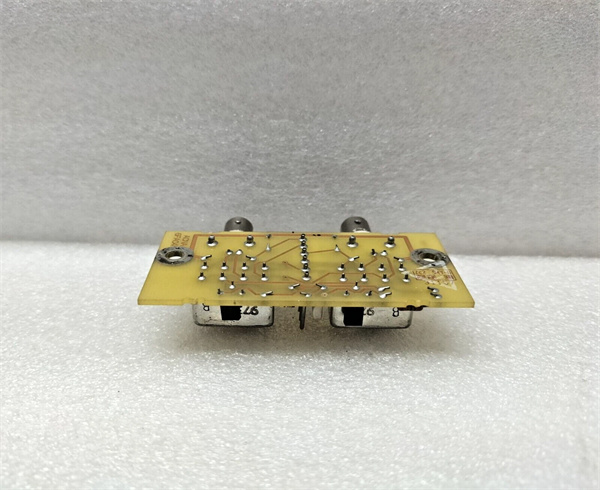
DS200ACNAG1ADD
Customer Value & Operational Benefits
Enhanced Turbine Reliability
The DS200ACNAG1ADD’s ARCNET protocol and redundant communication paths reduce the risk of data loss or延迟 (latency) in turbine control systems. A power plant using the card reported a 99.9% uptime rate for its Mark V communication network, compared to 95% with traditional Ethernet-based systems.
Reduced Maintenance Costs
The card’s static-sensitive design and simple installation (plug-and-play via VME rack) minimize maintenance downtime. A chemical plant using the DS200ACNAG1ADD cut maintenance costs by 30% compared to traditional communication adapters.
Cost-Effective Integration
Compatible with GE Mark V Series and existing ARCNET networks, the DS200ACNAG1ADD eliminates the need for custom communication gateways. A water treatment plant using the card saved $8,000 in integration costs by retaining its existing Mark V infrastructure.
Improved Safety
The card’s ATEX certification (Ex d IIB T5 Gb) makes it suitable for hazardous locations (e.g., turbine halls with flammable gases), ensuring safe operation in high-risk environments.
Field Engineer’s Notes (From the Trenches)
When installing the DS200ACNAG1ADD, always ground the card properly—use the two factory-drilled holes (GND1/GND2) with metal washers to connect to the cabinet’s ground bus. I once saw a site where a loose ground connection caused intermittent ARCNET communication errors; tightening the ground screws fixed the issue immediately.Another gotcha: use shielded coaxial cables for ARCNET connections—unshielded cables can pick up electromagnetic interference (EMI) from nearby motors or power lines, leading to data corruption. I’ve fixed countless “communication timeout” errors by replacing unshielded cables with Belden 9272 (RG-59) coaxial cables.If the card’s relays (K1/K2) fail, check the relay logic diagrams (printed on the card’s surface)—they show how the relays interact with the ARCNET circuit. A faulty relay can be replaced with a compatible Omron MY2N-J (24V DC) relay, but ensure the coil voltage matches the Mark V system’s 24V DC supply.
Real-World Applications
-
Power Generation:A coal-fired power plant uses the DS200ACNAG1ADD to connect the Mark V turbine controller to 10 operator interfaces (HMIs) via ARCNET. The card’s reliable communication ensures that turbine speed and temperature data is transmitted in real time, allowing operators to adjust fuel flow and prevent overheating.
-
Gas Turbines:A natural gas power plant uses the DS200ACNAG1ADD to connect the Mark V controller to 5 gas turbine actuators (e.g., fuel valves) via ARCNET. The card’s low-latency communication (≤10 ms) enables precise control of fuel flow, improving combustion efficiency by 8%.
-
Oil & Gas:An offshore oil platform uses the DS200ACNAG1ADD to connect the Mark V controller to subsea sensors (e.g., pressure transducers) via ARCNET. The card’s ATEX certification (Ex d IIB T5 Gb) ensures safe operation in the presence of flammable gases, while its wide operating temperature range (-40°C to +70°C) withstands the harsh offshore environment.

DS200ACNAG1ADD
High-Frequency Troubleshooting FAQ
Q: What does a “no ARCNET link” error indicate on the GE DS200ACNAG1ADD?
A: A “no link” error usually means:
-
Loose BNC connection: Check that the coaxial cable is securely connected to the BNC port (use a wrench to tighten if necessary).
-
Faulty coaxial cable: Test the cable with a TDR (time-domain reflectometer) to check for breaks or shorts.
-
Incorrect ARCNET address: Verify that the card’s ARCNET address (set via DIP switches) matches the address configured in the Mark V controller.
Q: Can the DS200ACNAG1ADD be used with non-GE turbine control systems?
A: No, the DS200ACNAG1ADD is designed exclusively for GE Mark V Series systems. Non-GE systems may use different communication protocols (e.g., Profibus, Modbus TCP), which are incompatible with the ARCNET protocol used by the DS200ACNAG1ADD.
Q: How do I test the ARCNET communication on the DS200ACNAG1ADD?
A: Use a handheld ARCNET tester (e.g., Fluke Networks MS2) to check the signal strength and integrity of the ARCNET network. Connect the tester to the BNC port and verify that the signal level is within the -10 dBm to +10 dBm range.
Q: Why is the DS200ACNAG1ADD’s relay clicking repeatedly?
A: Repeated relay clicking usually indicates:
-
Power supply fluctuation: Check the 24V DC power supply to the card (use a multimeter to test the voltage at the VME backplane).
-
Faulty relay coil: Test the relay coil with a multimeter (should be 24V DC when activated). Replace the relay if the coil is open.
Commercial Availability & Pricing
Please note: The listed price is not the actual final price. It is for reference only and is subject to appropriate negotiation based on current market conditions, quantity, and availability.