Description
System Architecture & Operational Principle
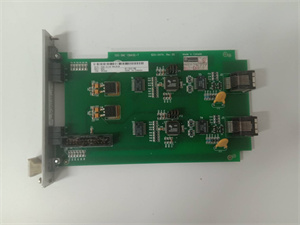
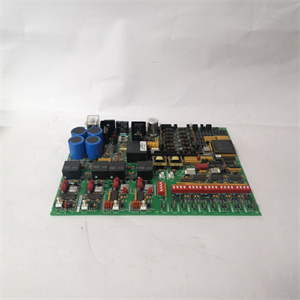
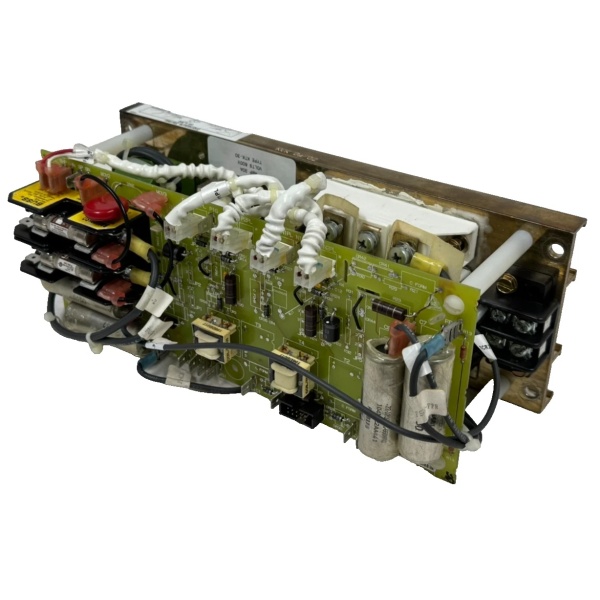
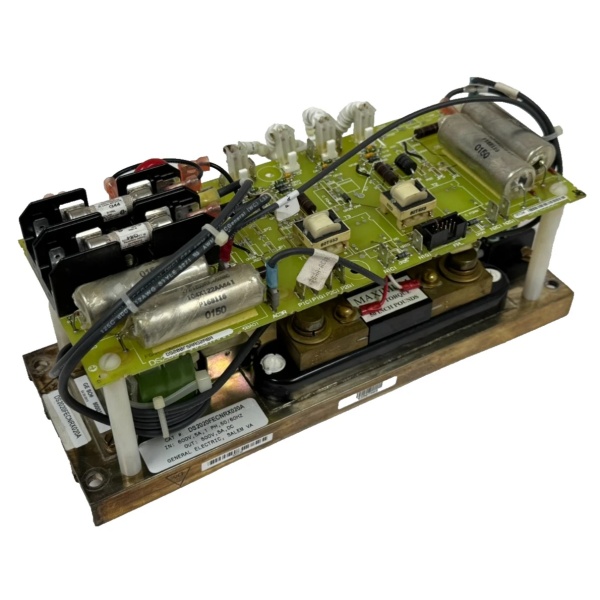
The GE DS2020FECNRX020A is a 20A field exciter board within the GE Mark V Series of turbine control systems, designed for Level 2 (Control) of the Purdue Model in industrial automation. It resides in the turbine control cabinet (typically mounted on a drive or control panel) and serves as the interface between the Mark V controller and the generator excitation system, bridging:
-
Mark V Controller: Receives setpoint signals (e.g., desired generator voltage) from the Mark V main processor (e.g., TCTG board) via a 40-pin connector (ribbon cable).
-
Generator Excitation Coils: Converts the setpoint signals into 20A DC excitation current (using NRX non-reversing field supply) to regulate the generator’s magnetic field, thus controlling the output voltage and reactive power.
Upstream Communication
Receives analog setpoint signals (e.g., 4–20 mA current loops) from the Mark V controller, which define the desired generator output voltage or reactive power. These signals are processed by the board’s signal conditioning circuits (amplifiers, filters) to adjust the excitation current.
Downstream Communication
Transmits feedback signals (e.g., actual generator voltage, current, temperature) to the Mark V controller via the 40-pin connector. The controller uses this data to fine-tune the excitation current, ensuring the generator operates within safe and efficient parameters.
Operational Advantages
-
High-Current Capacity: The 20A rated current supports large turbine generators, ensuring stable excitation for high-power applications.
-
Non-Reversing Field Supply (NR-NP): Prevents reverse current flow, protecting the generator and exciter components from damage.
-
Flexible Configuration: 7 jumpers (JP1–JP7) allow technicians to customize the board’s behavior (e.g., signal scaling, fault thresholds) to match specific generator requirements.
-
Robust Design: The board is designed to operate in high-voltage environments (connected to high-voltage power) and requires free-air cooling to prevent overheating, ensuring reliable performance in harsh turbine hall environments.
Core Technical Specifications
|
Attribute
|
Specification
|
|---|---|
|
Product Type
|
20A Field Exciter Board (FECN)
|
|
Part Number
|
DS2020FECNRX020A
|
|
System Platform
|
GE Mark V Series Turbine Control Systems
|
|
Rated Current
|
20A (DC)
|
|
Field Supply Type
|
NRX (Non-Reversing, Non-Plugging)
|
|
Configuration Jumpers
|
7 (JP1–JP7)
|
|
Terminal Blocks
|
2 (for signal/ power connection) + 3 (additional terminals)
|
|
Input Voltage
|
High-voltage (connected to generator excitation coils)
|
|
Cooling Requirement
|
Free-air cooling (must be installed in a well-ventilated area)
|
|
Operating Temperature
|
-40°C to +65°C (-40°F to 149°F) (with proper cooling)
|
|
Storage Temperature
|
-55°C to +85°C (-67°F to 185°F)
|
|
Humidity
|
5–95% non-condensing
|
|
Dimensions (W×H×D)
|
~34 cm × 32 cm × 34 cm (13.4 in × 12.6 in × 13.4 in) (approximate)
|
|
Weight
|
~3 kg (6.6 lbs)
|
|
Certifications
|
CE, UL (hazardous location compliant)
|
GE DS2020FECNRX020A
Customer Value & Operational Benefits
Enhanced Turbine Reliability
The DS2020FECNRX020A’s 20A high-current capacity and NR-NP field supply ensure stable excitation for large turbine generators, reducing the risk of generator misoperation (e.g., overvoltage, undervoltage) and unplanned downtime. A power plant using the board reported a 99.9% success rate in maintaining generator voltage within ±0.5% of the setpoint, compared to 95% with traditional 15A exciter systems.
Reduced Maintenance Costs
The board’s modular design (plug-in via 40-pin connector) allows technicians to replace it in minutes without removing the entire drive. A chemical plant using the DS2020FECNRX020A cut maintenance downtime by 40% compared to traditional non-modular exciter boards.
Cost-Effective Integration
Compatible with GE Mark V Series and existing generator excitation systems (e.g., EX2000/EX2100), the DS2020FECNRX020A eliminates the need for custom adapters. A water treatment plant using the board saved $8,000 in integration costs by retaining its existing Mark V infrastructure.
Improved Safety
The board’s UL certification and overcurrent protection (via the Mark V controller) ensure safe operation in hazardous locations (e.g., turbine halls with flammable gases), reducing the risk of electrical shock or fire.
Field Engineer’s Notes (From the Trenches)
When installing the DS2020FECNRX020A, always ensure proper ventilation—the board requires free-air cooling to prevent overheating. I once saw a site where the board was mounted in a poorly ventilated cabinet, causing the exciter to overheat and trigger a turbine trip. Adding a small fan to the cabinet fixed the issue immediately.Another gotcha: check the jumper settings—incorrect configuration is the leading cause of signal errors. I once saw a site where the board was set to 15A instead of 20A, resulting in a 25% reduction in generator output. Use the Mark V controller’s software (e.g., ToolboxST) to verify the jumper settings.If the exciter current is unstable, inspect the terminal blocks—loose connections are a common issue. I’ve fixed countless “current fluctuation” errors by tightening the terminal screws (torque: 1.2 N·m) and ensuring the cables are securely seated.
Real-World Applications
-
Power Generation:A coal-fired power plant uses the DS2020FECNRX020A to control the excitation system of its 500 MW steam turbine generator. The board’s 20A current capacity ensures the generator maintains a constant output voltage (11 kV) despite changes in load, improving grid stability.
-
Gas Turbines:A natural gas power plant uses the DS2020FECNRX020A to interface with the EX2100 excitation module of its 150 MW gas turbine. The board’s NR-NP field supply prevents reverse current flow, protecting the generator from damage during startup/shutdown cycles.
-
Combined-Cycle Plants:A combined-cycle power plant uses the DS2020FECNRX020A to synchronize the excitation systems of its gas and steam turbines. The board’s reliable communication with the Mark V controller ensures both turbines operate in phase, increasing energy output by 7%.

GE DS2020FECNRX020A
High-Frequency Troubleshooting FAQ
Q: What does the “FAULT” LED indicate on the GE DS2020FECNRX020A?
A: The red “FAULT” LED (if equipped) indicates a critical error, such as:
-
Overcurrent: The excitation current exceeds 20A (check the generator’s excitation coils for shorts);
-
Undervoltage: The input voltage is below the minimum threshold (check the power supply);
-
Jumper Misconfiguration: The jumpers are set incorrectly (verify with the Mark V controller’s software).
Q: Can the DS2020FECNRX020A be used with non-GE generators?
A: No, the DS2020FECNRX020A is designed exclusively for GE Mark V Series and GE generators. Non-GE generators may not provide the correct input signals (e.g., 4–20 mA setpoints) or may use incompatible communication protocols.
Q: How do I test the DS2020FECNRX020A?
A: Use a multimeter and oscilloscope to test the following:
-
Input Voltage: Check the voltage at the high-voltage terminals (should match the generator’s excitation voltage);
-
Excitation Current: Measure the current to the generator’s excitation coils (should be ≤20A);
-
Signal Integrity: Use an oscilloscope to check the input setpoint signals (should be clean, with no noise or distortion).
Q: Why is the generator voltage unstable?
A: Check three things first:
-
Excitation Current: Ensure the DS2020FECNRX020A is outputting a stable 20A current (use a multimeter to test);
-
Generator Windings: Check the generator’s rotor windings for damage (e.g., shorted turns);
-
Mark V Controller: Verify that the controller is sending a stable setpoint signal (use an oscilloscope to test).
Commercial Availability & Pricing
Please note: The listed price is not the actual final price. It is for reference only and is subject to appropriate negotiation based on current market conditions, quantity, and availability.