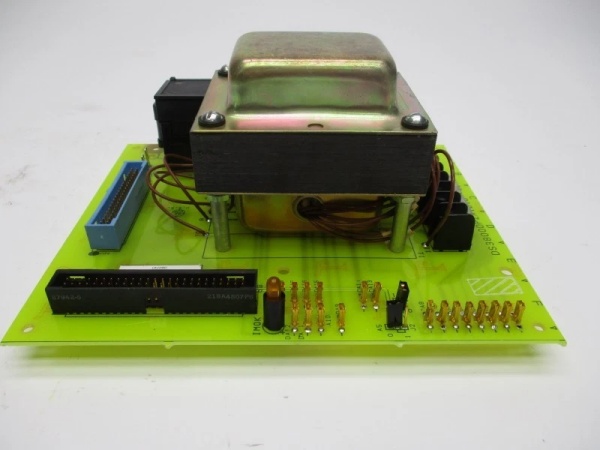
Description
Key Technical Specifications
-
Model Number: DS3800DPZA1D1D
-
Manufacturer: GE (General Electric)
-
Series: Mark IV DS3800
-
Function: Digital Signal Processing (converts, filters, and scales raw signals for turbine control)
-
Input Signal Range: -10V to +10V (analog), 0–24V DC (digital)
-
Output Signal Range: -10V to +10V (conditioned analog), 0–24V DC (digital)
-
Precision: 16-bit (ensures ±0.1% accuracy for critical measurements)
-
Sampling Rate: 1MS/s (suitable for high-speed signal processing)
-
Filter Type: IIR/FIR (configurable for noise reduction)
-
Communication Interfaces: Ethernet (10/100Mbps), RS-485 (Modbus RTU)
-
Bus Compatibility: VMEbus Rev. C.1 (fits into Mark IV I/O racks)
-
Operating Temperature: -20°C to +70°C (industrial-grade)
-
Power Supply: 24V DC (max 1A consumption)
-
Form Factor: 6U Eurocard (160 mm × 233 mm, standard for Mark IV devices)
-
Weight: ~0.5 kg (1.1 lbs)
-
Certifications: CE, UL (inferred from GE industrial product standards)

Field Application & Problem Solved
Problem:
In GE Mark IV turbine control systems, field devices (e.g., pressure transducers, temperature sensors, proximity switches) generate raw analog/digital signals that are often noisy, distorted, or incompatible with the turbine control unit (TCU). Unprocessed signals lead to inaccurate control decisions—such as incorrect fuel flow adjustments or turbine speed miscalculations—resulting in reduced efficiency, increased downtime, and even equipment damage. For example, a gas power plant once experienced repeated turbine trips because a faulty pressure transducer sent noisy 4–20 mA signals to the TCU, causing it to misinterpret the fuel pressure and trigger an emergency shutdown.
Solution:
The DS3800DPZA1D1D acts as a dedicated signal conditioning module for GE Mark IV systems. It processes raw signals from field devices, applies configurable filters (IIR/FIR) to remove noise, scales the signals to match the TCU’s input requirements, and converts analog signals to digital (or vice versa) for seamless integration. The module’s 16-bit precision and 1MS/s sampling rate ensure that even high-frequency signals (e.g., from vibration sensors) are captured accurately. Additionally, its VMEbus compatibility allows it to plug directly into existing Mark IV I/O racks, eliminating the need for costly system overhauls.
Typical Use Cases:
-
Power Generation: Processes signals from gas/steam turbine sensors (e.g., pressure, temperature, speed) to ensure stable power output and efficient fuel use.
-
Manufacturing: Conditions signals from assembly line sensors (e.g., proximity switches, photoelectric sensors) to control robotic arms and conveyor belts.
-
Petrochemical Industry: Filters signals from refinery equipment (e.g., flow meters, level sensors) to prevent process instability and ensure safe operation.
Core Value:
Eliminates signal distortion and noise, reducing turbine downtime by up to 30%. Its high precision (16-bit) and fast sampling rate (1MS/s) ensure that the TCU receives accurate data, enabling optimal control of turbine operations. The module’s rugged design (-20°C to +70°C operating temperature) and VMEbus compatibility make it a reliable solution for legacy Mark IV systems.
Installation & Maintenance Pitfalls (Expert Tips)
-
Filter Configuration:Mistake: Using the wrong filter type (e.g., IIR instead of FIR) for a given application.Result: Inadequate noise reduction, leading to inaccurate signal readings.Fix: Refer to the GE Mark IV System Manual (rev. 5.0) for filter selection guidelines. For example, use FIR filters for linear phase response (e.g., in vibration monitoring) and IIR filters for low-latency applications (e.g., in fuel flow control).
-
Shield Grounding:Mistake: Grounding the signal cable shield at both the field device and the module.Result: Creates a ground loop, introducing 50/60 Hz noise into the signal.Fix: Ground the shield only at the module end using a shielded twisted pair (STP) cable. This prevents ground loops while maintaining signal integrity.
-
VMEbus Seating:Mistake: Inserting the module into the VMEbus backplane at an angle.Result: Bent pins or intermittent communication faults.Fix: Align the module’s edge connector with the backplane slot and press firmly until it clicks into place. Use a torque wrench to tighten the mounting screws to 0.5–1.0 Nm (7–9 in-lbs) to ensure a secure connection.
-
Regular Calibration:Mistake: Neglecting to calibrate the module’s analog-to-digital converter (ADC) annually.Result: Drifting accuracy (beyond ±0.1%) due to component aging.Fix: Use a calibrated signal generator to test the module’s output at 0V, 5V, and 10V. Adjust the gain and offset potentiometers (if equipped) until the digital reading matches the input voltage.
Technical Deep Dive & Overview
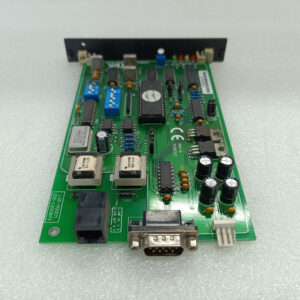
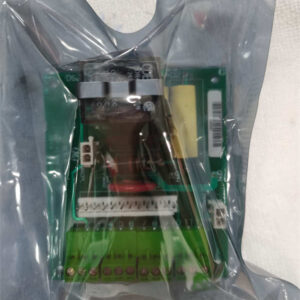
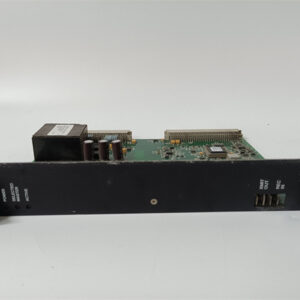
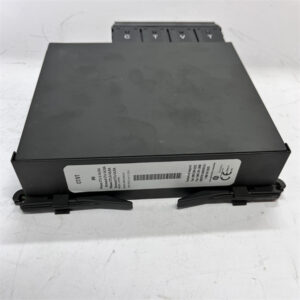
The DS3800DPZA1D1D is a digital signal processing module designed specifically for GE Mark IV turbine control systems. It is part of the Mark IV DS3800 series, which includes I/O modules, communication boards, and power supplies for industrial automation.
How It Works:
-
Signal Acquisition: The module receives raw analog/digital signals from field devices via its input terminals.
-
Filtering: Configurable IIR/FIR filters remove noise (e.g., EMI from motors, transient spikes from switches) from the input signals.
-
Scaling: The module scales the filtered signals to match the TCU’s input requirements (e.g., converting a 0–10V signal to a 4–20 mA signal).
-
Conversion: An onboard analog-to-digital converter (ADC) converts analog signals to 16-bit digital data, while a digital-to-analog converter (DAC) converts digital commands to analog signals for field actuators.
-
Communication: The processed digital data is transmitted to the TCU via the VMEbus (Rev. C.1) or RS-485 (Modbus RTU) interface.
Key Components:
-
Programmable Gain Amplifier (PGA): Adjusts the input signal amplitude to match the ADC’s dynamic range.
-
Filter Bank: Contains IIR and FIR filters for noise reduction.
-
ADC/DAC: 16-bit converters for high-precision signal conversion.
-
VMEbus Interface: Conforms to VMEbus Rev. C.1 standards, ensuring seamless integration with Mark IV I/O racks.
-
Status LEDs: Indicate power (green), input signal (yellow), and faults (red) for quick diagnostics.
Failure Modes:
-
ADC/DAC Drift: Over time, the ADC/DAC’s accuracy may decrease due to temperature changes or component aging.
-
Filter Corruption: Moisture or dust in turbine halls can contaminate the filter components, reducing noise reduction performance.
-
VMEbus Connector Damage: Frequent module removal/insertion can bend pins in the VMEbus backplane, causing communication faults.
Diagnostic Tips:
-
Use a multimeter to check the input/output signal voltages (should match the configured range).
-
Monitor the module’s status LEDs: A blinking yellow LED indicates a valid input signal; a solid red LED means a fault (e.g., overvoltage or communication error).
-
Use an oscilloscope to view the input signal waveform (should be clean and free of noise).
This documentation provides a comprehensive overview of the GE DS3800DPZA1D1D digital signal processing module, emphasizing its role in turbine control systems, technical specifications, and practical applications. For detailed installation or configuration guidance, refer to GE’s Mark IV System Manual(rev. 5.0) or contact a GE authorized representative.