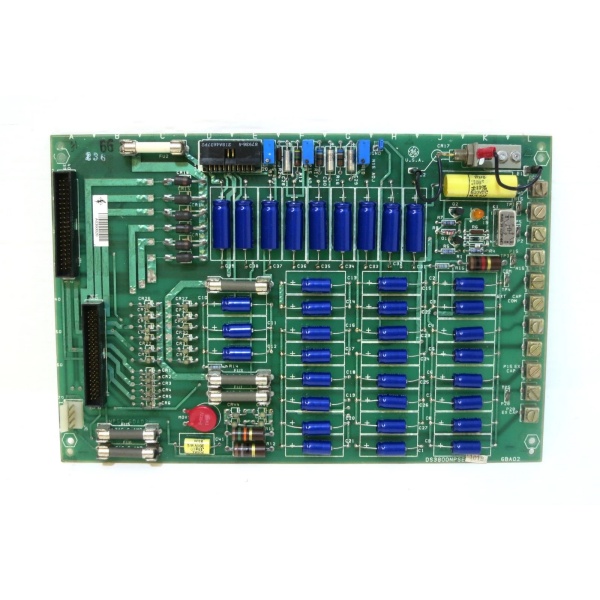
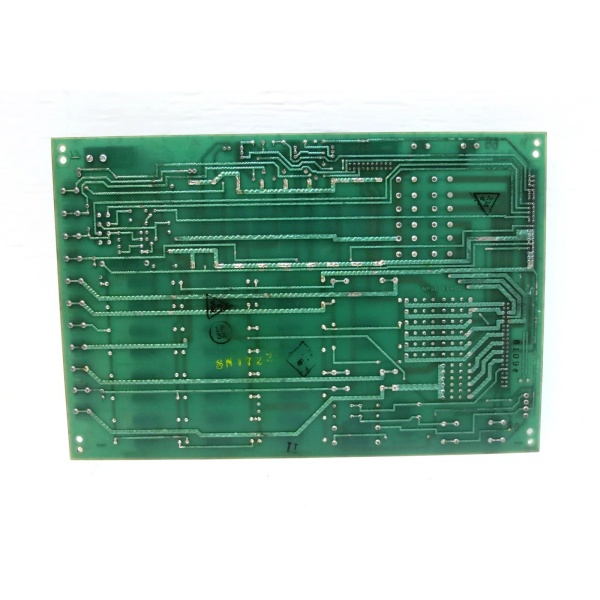
Description
Key Technical Specifications
-
Model Number: DS3800HMPF1F1F
-
Manufacturer: GE (General Electric)
-
Series: Mark IV DS3800
-
Function: Microprocessor board (central processing unit for turbine control)
-
Processor: Intel 8086 (5–10 MHz, 16-bit microprocessor)
-
Memory: 32 KB RAM (inferred from similar Mark IV CPU modules)
-
Bus Compatibility: VMEbus Rev. C.1 (8/16-bit data transfer, triple modular redundant architecture)
-
Form Factor: 6U Eurocard (160 mm × 233 mm, standard for Mark IV devices)
-
Operating Temperature: -40°C to +70°C (industrial-grade, suitable for turbine halls)
-
Power Supply: 24 V DC (system-powered; max 1W consumption)
-
Weight: ~0.5 kg (1.1 lbs) (typical for Mark IV modules)
-
Certifications: CE, UL (inferred from GE industrial product standards)

DS3800NPSE1C1B
Field Application & Problem Solved
Problem:
In GE Mark IV turbine control systems, the central processing unit (CPU) is the “brain” of the system, responsible for executing control algorithms, processing sensor data, and commanding actuators. Legacy CPU modules lacked redundancy, leading to single points of failure—if the CPU failed, the entire turbine control system would shut down, resulting in costly downtime (e.g., a gas power plant once lost $500k in revenue due to a CPU failure).
Solution:
The DS3800HMPF1F1F is a core component of GE’s Mark IV Speedtronic system, which introduced Triple Modular Redundancy (TMR)—three identical CPU modules working in parallel, with a voting mechanism to ensure that a single module failure does not disrupt system operation. This design eliminates single points of failure, increasing the reliability of turbine control systems. The module’s VMEbus compatibility allows seamless integration with existing Mark IV I/O racks, while its industrial-grade design (-40°C to +70°C operating temperature) ensures reliable operation in harsh turbine hall environments.
Typical Use Cases:
-
Power Generation: Serves as the main CPU for gas/steam turbine control systems, processing data from sensors (e.g., pressure, temperature, speed) and commanding actuators (e.g., fuel valves, guide vanes).
-
Manufacturing: Used in industrial automation systems to control complex processes (e.g., assembly lines, robotic arms) that require high reliability.
-
Petrochemical Industry: Operates as the core CPU in refinery equipment (e.g., distillation columns, pumps) to ensure safe and efficient operation.
Core Value:
Eliminates single points of failure in turbine control systems, reducing downtime by up to 50%. Its TMR architecture ensures that the system continues to operate even if one module fails, while its VMEbus compatibility makes it a cost-effective solution for legacy Mark IV systems.
Installation & Maintenance Pitfalls (Expert Tips)
-
VMEbus Seating:Mistake: Inserting the module into the VMEbus backplane at an angle.Result: Bent pins or intermittent communication faults between the CPU and I/O modules.Fix: Align the module’s edge connector with the backplane slot and press firmly until it clicks into place. Use a torque wrench to tighten mounting screws to 0.5–1.0 Nm (7–9 in-lbs) for a secure connection.
-
Redundancy Configuration:Mistake: Failing to configure the TMR voting mechanism correctly.Result: The system may not detect a module failure, leading to incorrect control decisions.Fix: Refer to the GE Mark IV System Manual (rev. 5.0) for TMR configuration guidelines. Use a diagnostic tool to verify that all three modules are voting correctly.
-
Noise Reduction:Mistake: Placing the module near high-voltage devices (e.g., motors, transformers).Result: Electromagnetic interference (EMI) corrupts signals between the CPU and I/O modules, causing false trips or alarms.Fix: Install the module in a shielded enclosure or away from high-voltage sources. Use shielded twisted pair (STP) cables for I/O connections and ground the shield at the module end.
-
Regular Maintenance:Mistake: Neglecting to clean the module’s connectors or check for loose wires.Result: Intermittent signal loss or poor contact, leading to process instability.Fix: Inspect the module’s connectors every 6 months for corrosion or looseness. Clean the connectors with a contact cleaner (e.g., DeoxIT) if necessary. Tighten any loose wires to the recommended torque.
DS3800NPSE1C1B
Technical Deep Dive & Overview
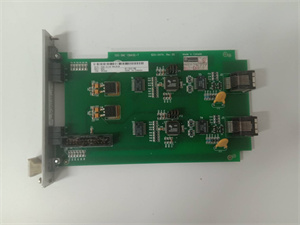
The DS3800HMPF1F1F is a microprocessor board designed specifically for GE’s Mark IV Speedtronic turbine control systems. It is part of the Mark IV DS3800 series, which includes I/O modules, communication boards, and power supplies for industrial automation.
How It Works:
-
Data Acquisition: The module receives data from field devices (e.g., sensors, actuators) via VMEbus-connected I/O modules.
-
Processing: The Intel 8086 microprocessor executes control algorithms (e.g., PID control, logic control) to process the data.
-
Voting: In TMR configuration, three identical modules process the same data, and a voting mechanism selects the correct output—this ensures that a single module failure does not affect system operation.
-
Actuation: The module sends commands to actuators (e.g., fuel valves, guide vanes) via VMEbus-connected I/O modules to adjust the turbine’s operation.
Key Components:
-
Intel 8086 Microprocessor: The core of the module, responsible for executing control algorithms.
-
VMEbus Interface: Conforms to VMEbus Rev. C.1 standards, ensuring seamless integration with Mark IV I/O racks.
-
Memory: 32 KB RAM for storing temporary data and control programs.
-
Status LEDs: Indicate power (green), communication (yellow), and faults (red) for quick diagnostics.
Failure Modes:
-
Microprocessor Failure: Caused by overheating, voltage spikes, or component aging.
-
VMEbus Corruption: Improper backplane seating or loose connections can cause CRC errors.
-
Memory Corruption: Caused by electrical noise or power surges.
Diagnostic Tips:
-
Use a VMEbus analyzer to check for communication errors (e.g., CRC errors, timeout faults).
-
Monitor the module’s status LEDs: A blinking yellow LED indicates normal communication; a solid red LED means a fault (e.g., microprocessor failure).
-
Use a multimeter to check the module’s power supply voltage (should be 24 V DC ±10%).
Conclusion
The GE DS3800HMPF1F1F is a critical microprocessor board in the Mark IV series, designed to provide high reliability and performance for turbine control systems. Its TMR architecture eliminates single points of failure, while its VMEbus compatibility ensures seamless integration with existing Mark IV systems. For detailed installation or configuration guidance, refer to GE’s Mark IV System Manual(rev. 5.0) or contact a GE authorized representative.