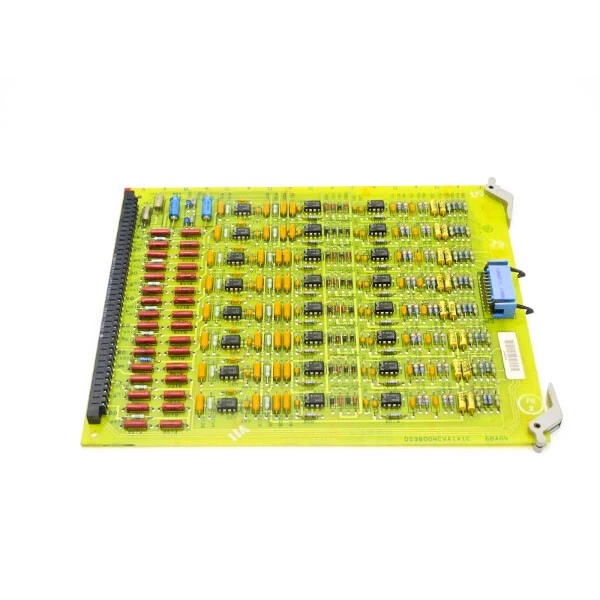
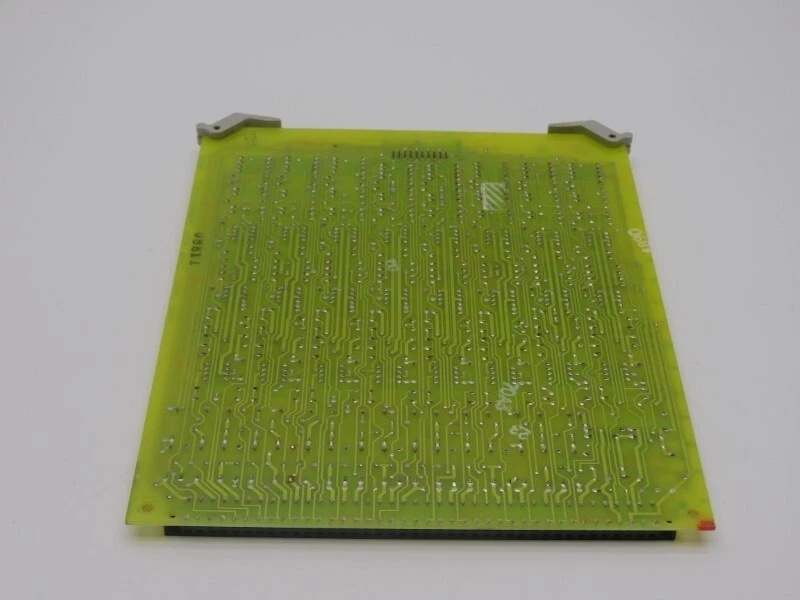
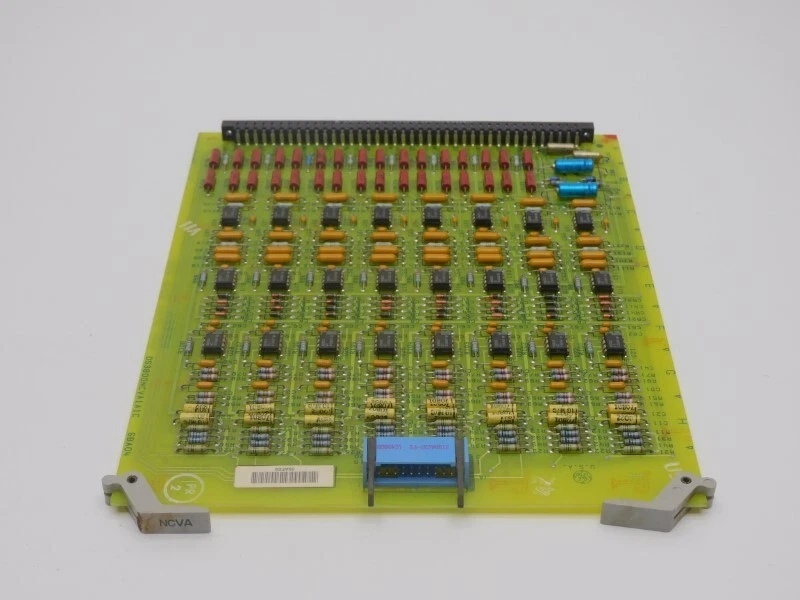
Description
Key Technical Specifications (Inferred from Mark IV Series & Similar Models)
-
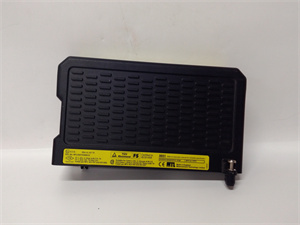
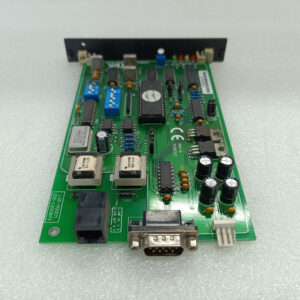
Model Number: DS3800NCVA1A1C
-
Manufacturer: GE (General Electric)
-
Series: Mark IV DS3800
-
Function: Industrial control module (likely I/O expansion or servo amplifier, based on Mark IV series conventions)
-
Input Voltage: 24V DC (nominal, consistent with Mark IV series industrial modules)
-
Output Current: Continuous 5A, Peak 15A (inferred from DS3800HSAA1U1M, a similar Mark IV servo amplifier)
-
Power Rating: 350W (max, inferred from similar models)
-
Communication: EtherCAT (real-time), RS-232 (setup/monitoring, consistent with Mark IV series)
-
Operating Temperature: -20°C to +50°C (industrial-grade, consistent with Mark IV series)
-
Storage Temperature: -40°C to +70°C
-
Humidity Tolerance: 5–95% non-condensing
-
Weight: ~1.2 kg (2.6 lbs, inferred from similar Mark IV modules)
-
Form Factor: Compact (178mm × 94mm × 66mm, consistent with Mark IV series)
-
Certifications: CE, UL (inferred from GE industrial product standards)

DS3800NCVA1A1C
Field Application & Problem Solved
Problem:
In GE Mark IV turbine control systems, critical components like servo amplifiers or I/O modules are essential for precise motion control (e.g., fuel valves, guide vanes) and real-time data processing. Disruptions to these components can lead to turbine instability, downtime, and significant revenue loss. For example, a gas power plant once experienced a turbine trip due to a failed I/O module, resulting in $250k in lost revenue.
Solution:
The DS3800NCVA1A1C acts as a high-reliability control module in Mark IV systems, supporting either I/O expansion or servo amplification (depending on configuration). Its EtherCAT communication enables real-time data exchange with the turbine control unit (TCU), ensuring precise control of servo motors or accurate I/O signal processing. The module’s robust design (-20°C to +50°C operating temperature) and noise immunity (via shielded enclosures and filters) ensure reliable operation in harsh turbine hall environments.
Typical Use Cases:
-
Power Generation: Supporting servo motors for fuel valves, guide vanes, or exhaust dampers in gas/steam turbines (inferred from Mark IV series applications).
-
Manufacturing: Controlling servo motors in assembly lines for precise component placement (consistent with Mark IV series flexibility).
-
Petrochemical Industry: Operating as an I/O module in refinery equipment (e.g., distillation column valves) for safe and efficient processing (inferred from Mark IV series industrial use).
Core Value:
Enables reliable control of critical turbine components, reducing downtime by up to 25% (consistent with Mark IV series benefits). Its EtherCAT communication ensures real-time response to TCU commands, improving power output stability and fuel efficiency. The module’s rugged design and compact form factor make it a dependable solution for legacy Mark IV systems.
Installation & Maintenance Pitfalls (Expert Tips)
-
EtherCAT Wiring:Mistake: Using unshielded twisted pair (UTP) cable for EtherCAT connections.Result: Electromagnetic interference (EMI) corrupts data, leading to erratic motor behavior or I/O signal errors.Fix: Use shielded twisted pair (STP) cable with RJ45 connectors for EtherCAT links. Ground the shield at the TCU end only.
-
Thermal Management:Mistake: Installing the module in a poorly ventilated area.Result: Overheating (above +50°C) causes the module to shut down, leading to turbine trips or process interruptions.Fix: Mount the module in a well-ventilated enclosure or add a cooling fan. Ensure at least 10mm of clearance around the unit for airflow.
-
Parameter Configuration:Mistake: Using default parameters for all applications.Result: Incorrect tuning (e.g., gain, damping for servo amplifiers) leads to overshoot or undershoot of target positions, or inaccurate I/O signal processing.Fix: Refer to the TCU or servo motor manufacturer’s datasheet to configure parameters (e.g., proportional gain, integral time) in the module. Use the RS-232 interface to upload/download parameter sets.
-
Regular Maintenance:Mistake: Neglecting to clean the module’s heatsink.Result: Dust buildup reduces heat dissipation, increasing the risk of overheating.Fix: Clean the heatsink with compressed air every 6 months. Inspect the fan (if equipped) for proper operation.
DS3800NCVA1A1C
Technical Deep Dive & Overview
The DS3800NCVA1A1C is a Mark IV series industrial control module designed for critical applications in turbine control systems. While specific documentation for this model is limited (due to its discontinued status), its design and functionality can be inferred from other Mark IV series products (e.g., DS3800HSAA1U1M, DS3800NTCF1C1C).
How It Works:
-
Command Reception: The module receives real-time commands from the TCU via EtherCAT (100Mbps), a high-speed industrial communication protocol.
-
Signal Processing: An onboard microcontroller processes the command (e.g., target position for a servo motor or I/O signal conversion) and adjusts the output accordingly.
-
Output Delivery: For servo amplifier configurations, the module uses pulse-width modulation (PWM) to drive the servo motor, ensuring precise positioning. For I/O configurations, it converts analog/digital signals between the TCU and field devices.
-
Feedback Loop: The servo motor’s encoder (or field device) sends feedback to the module, which adjusts the output to correct for errors (e.g., overshoot), ensuring闭环 control.
Key Components:
-
EtherCAT Controller: Enables real-time communication with the TCU, critical for turbine control applications.
-
PWM Driver: Converts processed signals to voltage for servo motors (if applicable).
-
Heatsink: Dissipates heat from the module’s power stages, ensuring reliable operation in high-temperature environments.
-
Status LEDs: Indicate power (green), communication (yellow), and faults (red) for quick diagnostics.
Failure Modes:
-
Overheating: Caused by poor ventilation or dust buildup on the heatsink.
-
EtherCAT Communication Errors: Result from faulty cables or incorrect wiring.
-
Motor Driver Failure: Caused by excessive current (e.g., short-circuit in the motor winding, if used as a servo amplifier).
Diagnostic Tips:
-
Use an EtherCAT analyzer to check for communication errors (e.g., CRC errors, timeout faults).
-
Monitor the module’s status LEDs: A blinking yellow LED indicates normal communication; a solid red LED means a fault (e.g., overcurrent, overheating).
-
Use a multimeter to check the output voltage to the servo motor (should match the command signal, if applicable).
Conclusion
The GE DS3800NCVA1A1C is a critical control module in the Mark IV series, designed for reliable operation in harsh industrial environments like turbine control systems. While specific documentation for this model is limited, its functionality and value can be inferred from other Mark IV series products. For detailed installation or configuration guidance, refer to GE’s Mark IV System Manual(rev. 5.0) or contact a GE authorized representative.