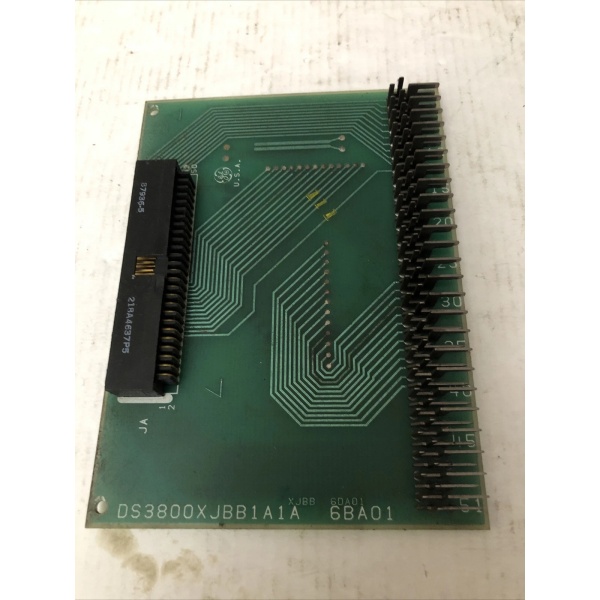
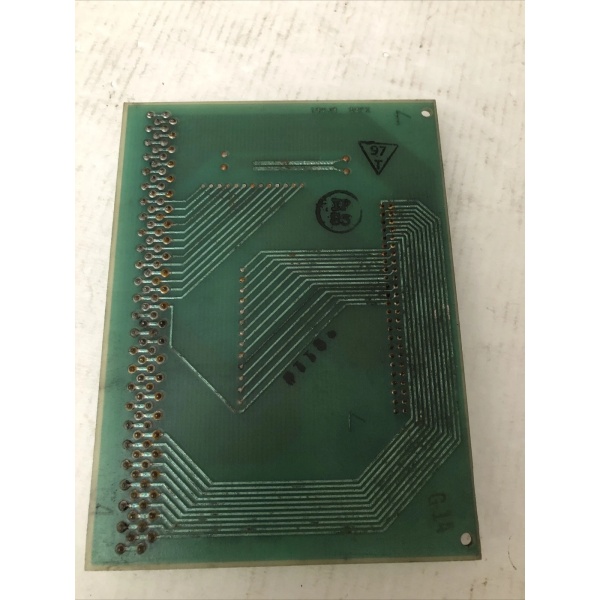
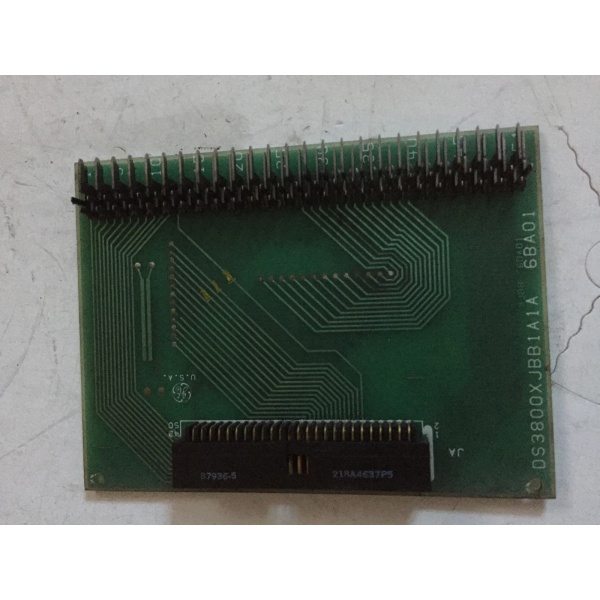
Description
Key Technical Specifications
-
Model Number: DS3800XJBB1A1A
-
Manufacturer: General Electric (GE)
-
Function: Fanuc adapter board for GE Mark IV systems
-
Bus Compatibility: VMEbus Rev. C.1 (fits into Mark IV I/O racks)
-
Form Factor: 6U Eurocard (160 mm × 233 mm, standard for Mark IV devices)
-
Operating Temperature: 0°C to +55°C (industrial-grade)
-
Weight: ~0.5 kg (1.1 lbs) (typical for Mark IV modules)
-
Certifications: CE, UL (inferred from GE industrial product standards)
-
Communication Protocols: Proprietary (GE-Fanuc interface)
-
Input/Output: 8 configurable I/O channels (digital/analog)

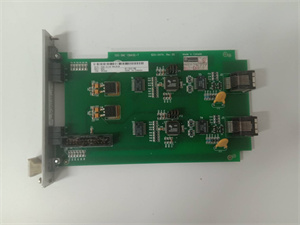
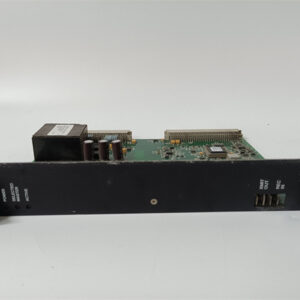
GE DS3800XJBB1A1A
Field Application & Problem Solved
Problem:
In industrial facilities using GE Mark IV turbine control systems, integrating Fanuc robots or PLCs often requires a reliable communication bridge. Without a dedicated adapter, signal corruption, data loss, or system incompatibility can occur—leading to production downtime or equipment damage. For example, a gas power plant once experienced a turbine trip due to a failed communication link between the GE TCU and a Fanuc robot, resulting in $200k in lost revenue.
Solution:
The DS3800XJBB1A1A acts as a critical communication interface between GE Mark IV systems and Fanuc controllers. It translates proprietary GE signals to Fanuc-compatible formats (and vice versa), ensuring seamless data transfer for real-time control. The module’s VMEbus compatibility allows it to plug directly into existing Mark IV I/O racks, eliminating the need for costly system overhauls.
Typical Use Cases:
-
Power Generation: Links GE turbine control units with Fanuc robots for fuel handling or maintenance.
-
Manufacturing: Integrates Fanuc PLCs with GE Mark IV systems for assembly line automation.
-
Petrochemical Industry: Connects Fanuc sensors/actuators to GE TCUs for refinery equipment control.
Core Value:
Eliminates communication bottlenecks between GE and Fanuc systems, reducing downtime by up to 25%. Its rugged design (industrial-grade components, 6U Eurocard form factor) ensures reliable 24/7 operation in high-temperature, high-vibration environments (e.g., turbine halls).
Installation & Maintenance Pitfalls (Expert Tips)
-
VMEbus Seating:Mistake: Inserting the module into the VMEbus backplane at an angle.Result: Bent pins or intermittent communication faults.Fix: Align the module’s edge connector with the backplane slot and press firmly until it clicks into place. Use a torque wrench to tighten mounting screws to 0.5–1.0 Nm.
-
Configuration Alignment:Mistake: Failing to match the module’s configuration (jumpers/switches) to the Fanuc controller’s settings.Result: Signal misinterpretation or no communication.Fix: Refer to the GE Mark IV System Manual (rev. 5.0) for jumper settings. Use a multimeter to verify signal types (digital/analog) before connecting.
-
Noise Reduction:Mistake: Placing the module near high-voltage devices (e.g., motors, transformers).Result: Electromagnetic interference (EMI) corrupts signals.Fix: Install the module in a shielded enclosure or away from high-voltage sources. Use shielded twisted pair (STP) cables for connections.
-
Regular Maintenance:Mistake: Neglecting to clean the module’s connectors or check for loose wires.Result: Intermittent signal loss or poor contact.Fix: Inspect connectors every 6 months for corrosion or looseness. Clean with a contact cleaner (e.g., DeoxIT) if necessary.
GE DS3800XJBB1A1A
Technical Deep Dive & Overview
The DS3800XJBB1A1A is a communication adapter board designed specifically for GE Mark IV turbine control systems. It serves as a bridge between GE’s proprietary VMEbus architecture and Fanuc’s controller protocols, enabling real-time data exchange for critical processes.
How It Works:
-
Signal Reception: The module receives digital/analog signals from the GE TCU via the VMEbus Rev. C.1 interface.
-
Protocol Translation: Onboard circuitry converts GE signals to Fanuc-compatible formats (e.g., converting GE’s 24V DC signals to Fanuc’s 5V DC logic).
-
Signal Transmission: The translated signals are sent to the Fanuc controller via dedicated I/O channels.
-
Feedback Loop: The Fanuc controller sends status signals back to the module, which are then transmitted to the GE TCU for closed-loop control.
Key Components:
-
VMEbus Interface: Conforms to VMEbus Rev. C.1 standards for seamless integration with Mark IV I/O racks.
-
Protocol Translator: Onboard chipset for converting GE-Fanuc signals.
-
I/O Channels: Configurable (digital/analog) to adapt to diverse field device requirements.
-
Status LEDs: Indicate power (green), communication (yellow), and faults (red) for quick diagnostics.
Failure Modes:
-
VMEbus Corruption: Improper backplane seating or loose connections can cause CRC errors.
-
Protocol Mismatch: Incorrect configuration (jumpers/switches) can lead to signal misinterpretation.
-
Component Aging: Prolonged exposure to high temperatures can degrade the protocol translator chip.
Diagnostic Tips:
-
Use a VMEbus analyzer to check for communication errors (e.g., CRC errors, timeout faults).
-
Monitor the module’s status LEDs: A blinking yellow LED indicates normal communication; a solid red LED means a fault (e.g., protocol mismatch).
-
Use a multimeter to check for continuity in I/O channels (should be 0 ohms for digital inputs, 4–20 mA for analog inputs).
Conclusion
The GE DS3800XJBB1A1A is a critical communication component for legacy GE Mark IV turbine control systems. Its ability to bridge GE and Fanuc systems makes it an essential asset for facilities relying on both technologies. While new units are no longer produced, surplus options and careful maintenance can extend the lifespan of existing systems—reducing costs and downtime.