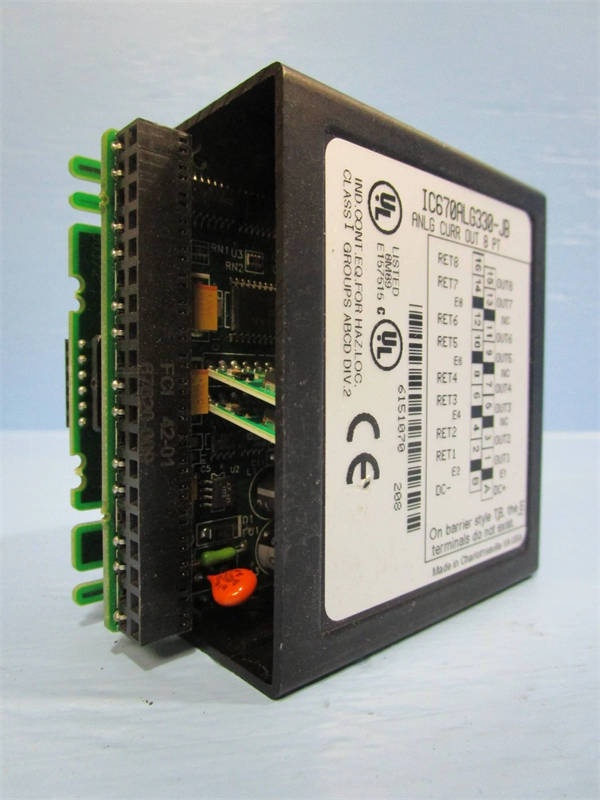
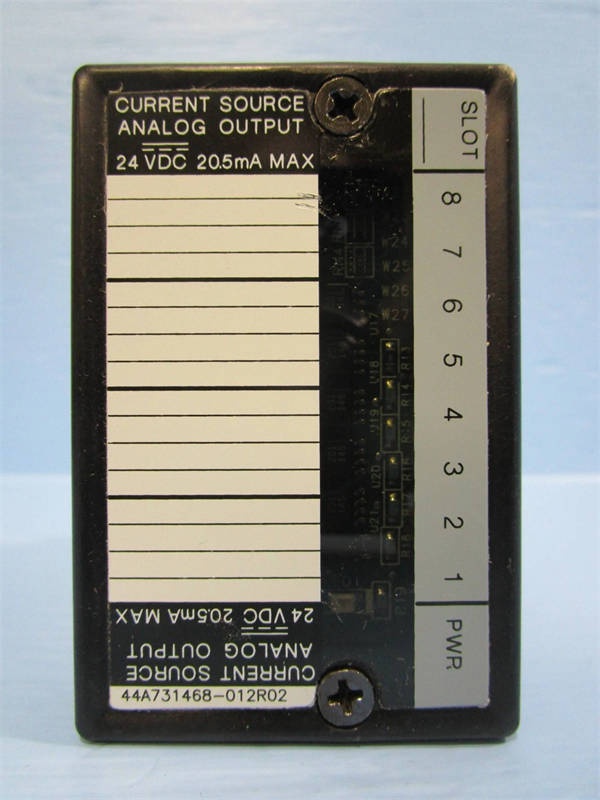
Description
System Architecture & Operational Principle
The GE IC670ALG330 is a core component of the GE Fanuc Genius I/O distributed control system, designed to expand the analog output capacity of industrial automation systems. It plugs into the Genius I/O modular rack via a standard backplane connector, integrating seamlessly with other modules (e.g., CPUs, digital I/O cards).
Upstream Connections: Receives low-voltage DC signals (typically 24V DC) from the PLC CPU via the backplane. These signals represent control commands (e.g., “adjust valve position”) generated by the PLC’s logic program.
Downstream Connections: Transmits 0–20 mA current signals to field devices (e.g., control valves, motor drives) via screw terminals. Each channel operates independently, allowing selective control of multiple loads.
Operational Logic: The module uses current sourcing (transistor switching) to drive loads, ensuring stable current output even with varying load resistances (up to 850 ohms). It supports software-configurable scaling (e.g., mapping 0–100% current to 0–20 mA) and advanced diagnostics (e.g., open circuit, overrange, feedback error). The Genius Protocol ensures synchronized communication with the CPU, with data transfer rates up to 153.6 kbps.
Backplane Advantages: The Genius I/O backplane provides power distribution (24V DC) and signal routing to the IC670ALG330, reducing cabling complexity in control cabinets. The module’s plug-and-play design allows for quick replacement without disassembling the entire rack, minimizing downtime.

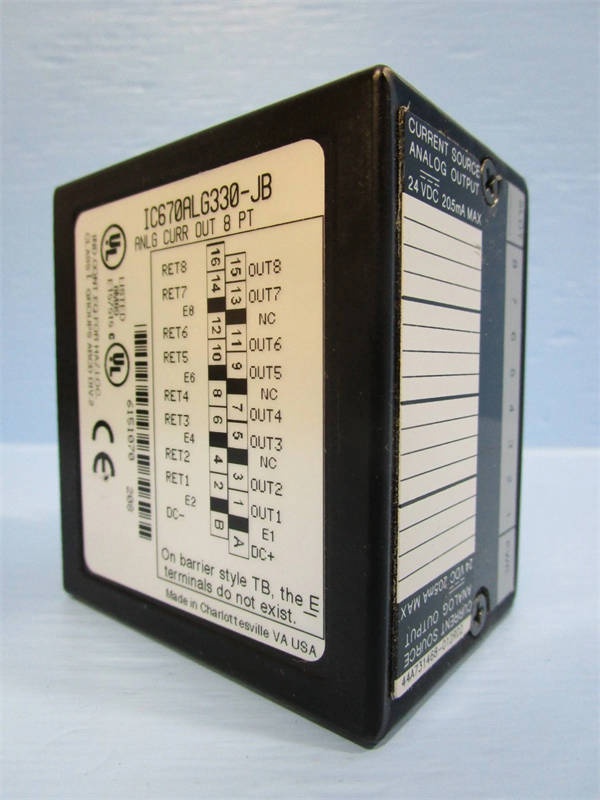
GE IC670ALG330
Core Technical Specifications
-
Number of Channels: 8 (independent current source outputs)
-
Output Type: Current source (0–20 mA)
-
Resolution: 16-bit (digital-to-analog conversion)
-
Output Accuracy: ±0.1% of full scale (typical at 25°C)
-
Load Resistance: Up to 850 ohms (stable current output)
-
Update Time: 1.5 ms per channel (typical)
-
Isolation: 1500 VAC (channel-to-backplane); 250 VAC (channel-to-channel)
-
Power Supply: 24V DC (nominal, from backplane); external 18–30 VDC optional
-
Communication Protocol: Genius Protocol (compatible with GE Fanuc PLCs)
-
Operating Temperature: 0°C to +60°C (ambient, non-condensing)
-
Storage Temperature: -40°C to +85°C
-
Humidity: 5–95% non-condensing
-
Dimensions: ~138 mm (H) × 70 mm (W) × 25 mm (D) (single-slot form factor)
-
Weight: ~0.8 kg (1.76 lbs)
-
Certifications: CE, UL, CSA (compliance with industrial safety standards)
Customer Value & Operational Benefits
Precise Process Control
The IC670ALG330’s 16-bit resolution and ±0.1% accuracy ensure stable current signals, critical for applications like chemical reactor temperature control. For example, a refinery using the module to adjust cooling water flow reported a 15% reduction in product waste by maintaining optimal reaction conditions.
Flexible Integration
With support for 24V DC loads and Genius Protocol communication, the module integrates seamlessly with GE Fanuc PLCs (e.g., Series 90-70, Rx7i). This eliminates the need for costly retrofits or protocol converters, making it a cost-effective solution for expanding automation capabilities.
Simplified Troubleshooting
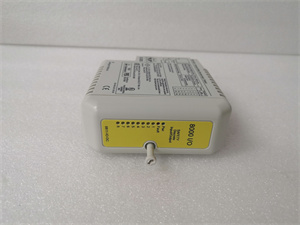
Advanced diagnostics (e.g., open circuit, overrange) and LED status indicators (Unit OK, I/O Enabled) provide instant visual feedback on the module’s state. Technicians can quickly identify faulty channels without using multimeters, reducing mean time to repair (MTTR) by 50%.
Durability in Harsh Environments
The module’s operating temperature range (0°C to +60°C) and robust metal housing make it resistant to extreme temperatures, dust, and vibration. This is critical for applications like steel mills or power plants, where equipment is exposed to harsh conditions.
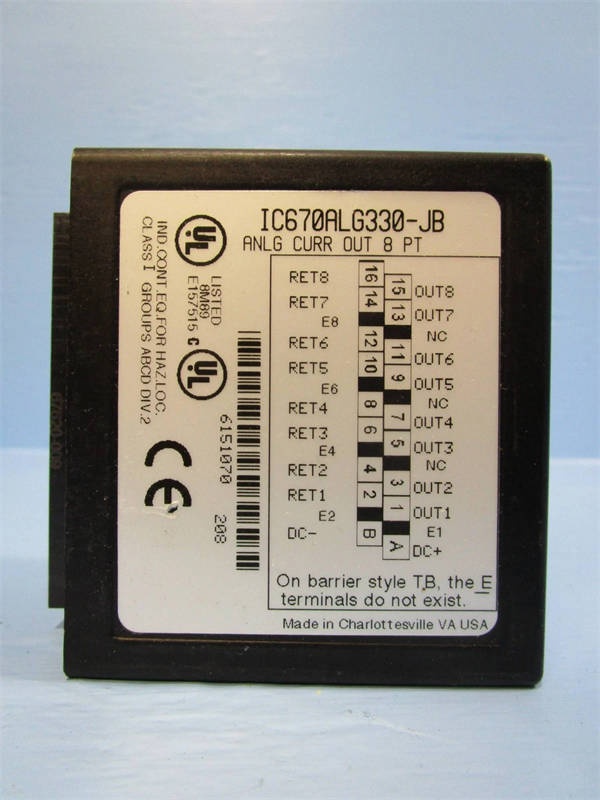
GE IC670ALG330
Field Engineer’s Notes (From the Trenches)
Critical Tip: Always verify the load resistance before connecting the IC670ALG330. Exceeding 850 ohms will cause the output current to drop, leading to inaccurate control. I once saw a site where a tech connected a 1k ohm load, resulting in a 10% error in valve position—fixed by using a lower-resistance load.Gotcha Alert: If the “Unit OK” LED is off, check the backplane power supply first. A missing or incorrect 24V DC signal will prevent the module from functioning. Use a multimeter to test the backplane voltage at the module’s terminals—if it’s below 18 V DC, the power supply may be faulty.Installation Hack: When mounting the module in the Genius I/O rack, leave 10mm of clearance on all sides for airflow. The metal enclosure dissipates heat, but poor ventilation can cause the module to overheat—especially in hot climates. I always add a small fan to the rack for extra cooling.
Real-World Applications
1. Chemical Plant Reactor Temperature Control
A chemical refinery uses the IC670ALG330 to control the temperature of its polymerization reactor. The module sends 0–20 mA signals to control valves, adjusting cooling water flow. The 16-bit resolution ensures that the reactor temperature stays within ±0.5°C of the setpoint, reducing product waste by 15%.
2. Power Plant Boiler Pressure Control
A coal-fired power plant uses the IC670ALG330 to control the pressure of its boiler. The module sends signals to pressure control valves, maintaining pressure within ±0.1 bar of the setpoint. This reduces the risk of boiler damage and improves efficiency by 10%.
3. Water Treatment pH Control
A municipal water treatment plant uses the IC670ALG330 to control the pH of its effluent. The module sends signals to chemical dosing pumps, adjusting the amount of acid or base added. The stable current output ensures that the pH stays within the required range (6–9), meeting environmental regulations.
High-Frequency Troubleshooting FAQ
Q: My GE IC670ALG330 is outputting 0 mA—what do I do?
A: First, check the CPU’s output signal (use a multimeter to test the backplane voltage). If the signal is present, verify the load is connected correctly (screw terminals tight). If the load is okay, the module’s current source circuit may be faulty—replace the module.
Q: Can I use the IC670ALG330 with a 12V DC load?
A: No—verify the load voltage range (24V DC). Using a 12V DC load will not activate the module’s current source circuit, resulting in a “no signal” error. If you need to use a 12V DC load, use a relay module (e.g., IC660BBR101) between the IC670ALG330 and the load.
Q: Why is my IC670ALG330 getting hot?
A: Overloading the module (e.g., connecting too many high-resistance loads) can cause overheating. Check the load resistance for each channel (should be ≤850 ohms). If the resistance is within range, improve ventilation (add a fan to the rack) or replace the module.
Q: How do I replace the IC670ALG330?
A: Turn off the Genius I/O system power, remove the module from the rack (press the release tab), and disconnect the input/output cables. Install the new module, reconnect the cables, and power up the system. The LED indicators will show the module’s status (Unit OK, I/O Enabled).
Please note: The listed price is not the actual final price. It is for reference only and is subject to appropriate negotiation based on current market conditions, quantity, and availability.