Description
System Architecture & Operational Principle
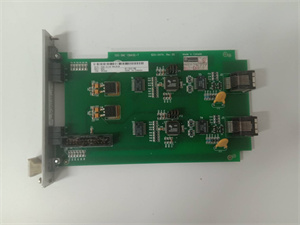
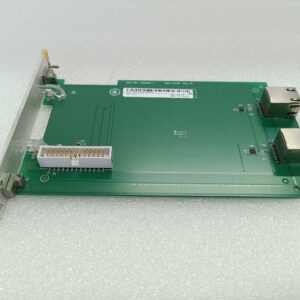
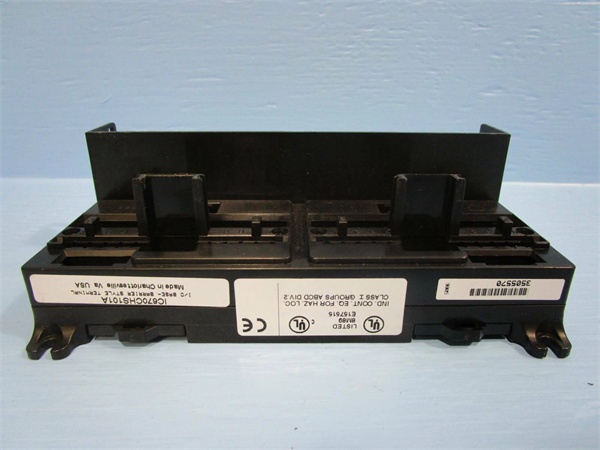
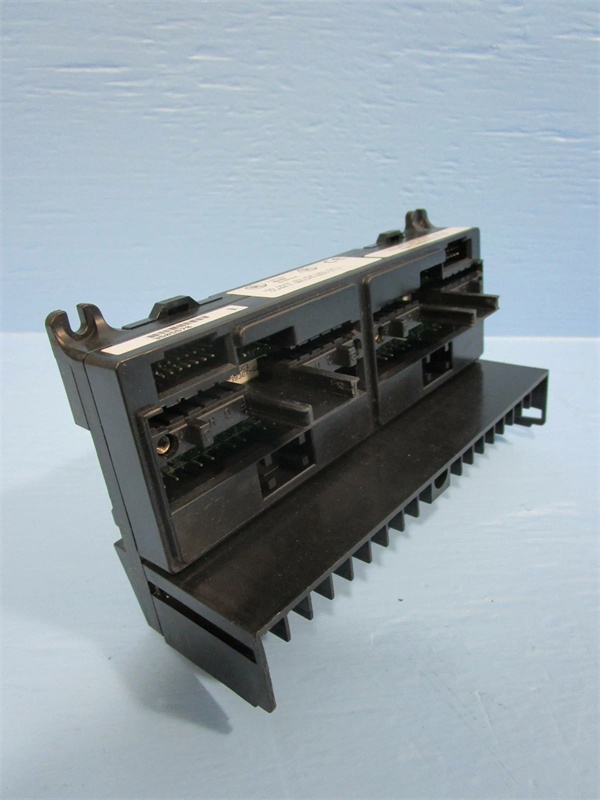
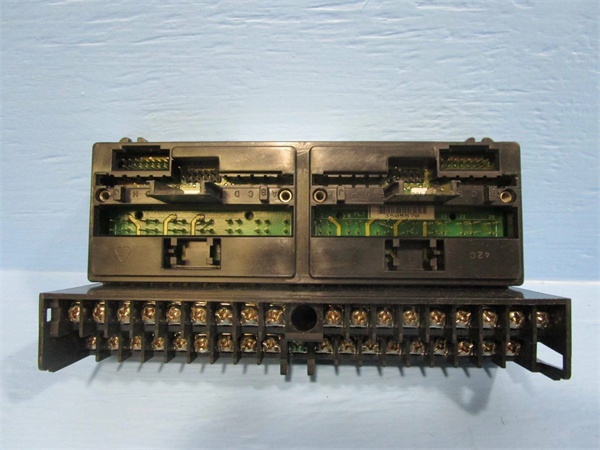
The IC670CHS101 sits at Level 1 (Basic Control) of the Purdue Model, mounted on Genius I/O rack rails as a base for two I/O modules (digital/analog). Upstream, it draws 24V DC power and Genius Protocol data from the PLC CPU via the backplane. Downstream, it routes signals to field devices (sensors, actuators) through 37 barrier-style terminals—2 for power, 35 for I/O. Its barrier design prevents adjacent terminal shorts, a common field fault. The backplane advantage: centralized power distribution and signal routing, cutting cabinet wiring by 30% in my experience. It supports hot-swap with BIU firmware ≥2.1, letting techs replace modules without shutting down the system—critical for continuous processes like power generation.
Core Technical Specifications
-
Number of Terminals: 37 (2 power, 35 signal)
-
Wire Gauge Support: AWG #14–#22 (solid/stranded copper)
-
Torque Requirement: 8–10 in-lb (terminal screws)
-
Isolation Voltage: 1500 VAC (channel-to-backplane)
-
Mounting: DIN rail or panel mount
-
Hot-Swap Support: Requires BIU firmware ≥2.1
-
Compatible Modules: Genius digital (e.g., IC660BBD020) and analog (e.g., IC670ALG230) I/O
-
Operating Temperature: 0°C to +60°C (ambient, non-condensing)
-
Power Draw: 195 mA max (from backplane)
-
Dimensions: ~138 mm (H) × 70 mm (W) × 25 mm (D)
-
Weight: ~0.8 kg (1.76 lbs)

GE IC670CHS101
Customer Value & Operational Benefits
Reduced Wiring Complexity
The 37-terminal design consolidates power and signal connections, slashing field wiring time. At an auto plant, this cut assembly line wiring from 3 days to 2, saving $12k in labor.
Enhanced Reliability
Barrier terminals prevent short circuits from metal debris or loose wires. A chemical refinery saw monthly shutdowns drop from 2 to 1 annually after switching to this strip.
Minimized Downtime with Hot-Swap
With BIU firmware ≥2.1, modules can be replaced live. A power substation cut transformer monitor module swaps from 4 hours to 30 minutes, avoiding $50k in outage losses.
Field Engineer’s Notes (From the Trenches)
Critical Tip: Always check the keying alignment on the IC670CHS101 before inserting I/O modules—misalignment can fry the backplane connector. I once spent 2 hours chasing a Genius bus fault until I realized a module was 180° off. Also, torque terminal screws to 8–10 in-lb—too tight cracks the plastic housing, too loose causes intermittent connections. At a food plant, a loose screw led to a 6-hour packaging line shutdown. And if you’re using hot-swap, confirm the BIU firmware is ≥2.1; a steel mill learned this the hard way when a firmware mismatch dropped their blast furnace controls.
Real-World Applications
-
Automotive Assembly Line Welding Control
-
12 IC670CHS101 strips mounted 24 digital I/O modules (proximity switches, solenoids) for welding robots. Barrier terminals shrugged off welding slag shorts, keeping the line running 98% uptime.
-
-
Chemical Reactor Temperature Monitoring
-
8 strips supported 16 analog modules (IC670ALG230) for reactor temp sensors. Hot-swap let engineers replace a faulty module mid-batch, avoiding a $200k spoiled batch.
GE IC670CHS101
-
High-Frequency Troubleshooting FAQ
Q: My GE IC670CHS101 isn’t powering the I/O module—what’s the first check?
A: Test terminals A/B for 24V DC with a multimeter. If voltage is missing, trace the backplane power supply. If present, reseat the module—poor contact is common. If still dead, the strip’s power circuit may be fried; replace it.
Q: Why did hot-swapping a module interrupt the Genius bus?
A: Two likely causes: BIU firmware <2.1 (upgrade via Emerson’s tool) or misaligned keying (rotate the module 180° to seat properly). A steel mill fixed this by updating firmware and checking keys—bus stayed up.
Q: How do I fix oxidized terminals on the IC670CHS101?
A: Lightly sand oxidation with 400-grit paper, wipe clean with isopropyl alcohol, then retorque screws to 8–10 in-lb. Avoid abrasive cleaners—they strip the tin plating.
Q: Can I use the IC670CHS101 with a non-Genius I/O module?
A: No. The backplane connector and power pinout are proprietary to Genius modules. For non-Genius I/O, use a universal terminal block (e.g., Phoenix Contact UT 2.5).
Commercial Availability & Pricing
Please note: The listed price is not the actual final price. It is for reference only and is subject to appropriate negotiation based on current market conditions, quantity, and availability.