Description
System Architecture & Operational Principle
The IC693APU301 is a single-slot module designed for GE Series 90-30 PLC racks, typically deployed at Level 1 (Basic Control) or Level 2 (Supervisory Control) of the Purdue Model. It acts as an intelligent co-processor for motion control, handling real-time servo commands while the PLC manages broader logic, I/O, and networking.
Operational Workflow:
-
Mode Selection: The module can be configured for standard mode (combines PLC logic with motion control for independent moves) or follower mode (provides electronic gearing for master-slave applications).
-
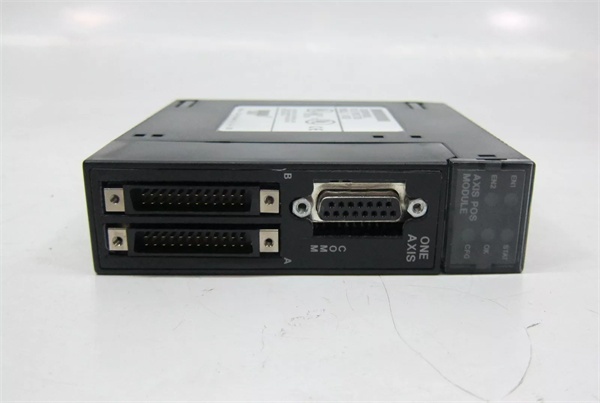
Servo Communication: It connects to servo drives via a 25-pin servo interface and 24-pin high-density connectors, supporting analog velocity/torque commands (±10V) and encoder feedback (A-quad-B up to 200 kHz).
-
Data Exchange: The PLC automatically transfers data between its memory tables and the APM, enabling real-time motion control without interrupting PLC logic execution.
-
Diagnostics: Built-in LEDs (EN1, EN2, STST, OK, CFG) provide status feedback (e.g., module power, configuration validity, axis position).
Architectural Advantage:
The IC693APU301’s 1 ms servo loop update rate ensures high-precision motion control, while its compact design (occupies 1 slot) minimizes cabinet space. The electronic gearing feature in follower mode allows synchronized master-slave motion, critical for applications like conveyor systems or robotic arms.

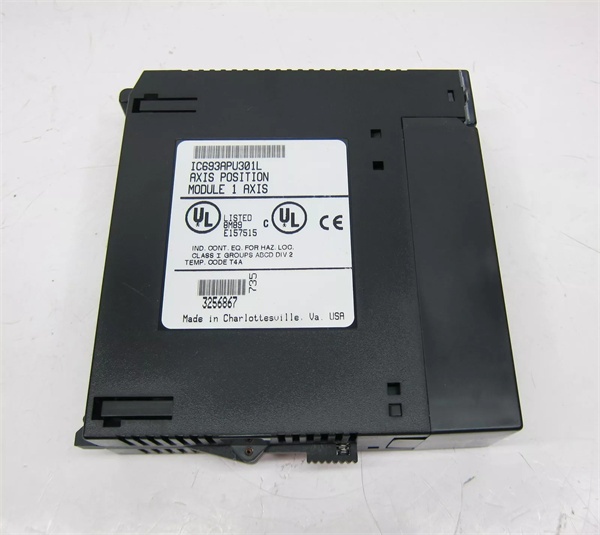
GE IC693APU301
Core Technical Specifications
-
Control Axes: 1 axis (per module)
-
Servo Loop Update Rate: 1 ms (real-time)
-
Operating Modes: Standard (independent motion), Follower (electronic gearing)
-
Communication Ports: 25-pin servo interface (for servo drives), 24-pin high-density (for encoder feedback)
-
Encoder Support: A-quad-B (up to 200 kHz), analog (±10V)
-
Output Signals: Analog velocity/torque (±10V), digital (24VDC)
-
Isolation: 1500 VAC RMS (field-to-logic, field-to-outputs)
-
Power Consumption: 250 mA at 5 VDC (from backplane)
-
Operating Temperature: 0°C to 60°C (32°F to 140°F)
-
Certifications: UL, CE, RoHS
Customer Value & Operational Benefits
High-Precision Motion Control
The 1 ms servo loop update rate and ±0.01 mm positioning accuracy enable precise control of servo motors, critical for applications like precision machining (where micron-level accuracy is required) or robotic pick-and-place (where misalignment can cause product defects).
Flexible Integration
The module’s compatibility with Series 90-30 PLCs (CPU 311 and higher) allows seamless integration into existing systems. The VersaPro software (version 1.1 or later) simplifies configuration and programming, reducing setup time.
Reduced Downtime
Built-in diagnostics (LEDs, fault logs) and hot-swappable design enable quick troubleshooting and replacement, minimizing unplanned downtime. For example, if a servo drive fails, the module’s fault LED will indicate the issue, allowing technicians to replace the drive without shutting down the entire system.
Cost Savings
By combining PLC logic with motion control in a single module, the IC693APU301 eliminates the need for separate motion controllers, reducing hardware costs and cabinet space. This is particularly valuable for small to medium-sized applications (e.g., packaging machines) where space is limited.
Field Engineer’s Notes (From the Trenches)
When installing the IC693APU301, always use shielded cables for encoder feedback—unshielded cables will pick up EMI from nearby motors or drives, causing erratic position readings. I once saw a site where a technician used unshielded cable, resulting in a robotic arm misaligning parts by 5 mm.Double-check the mode configuration (standard/follower) in the VersaPro software before commissioning. A misconfigured mode (e.g., follower mode for an independent motion application) will cause the axis to move unexpectedly, potentially damaging equipment.Test the encoder feedback with a oscilloscope during commissioning. Verify that the A-quad-B signals are clean and within the 200 kHz limit—dirty signals will cause the module to lose position, leading to process upsets.
Real-World Applications
-
Precision Machining: Controls the position of a milling machine’s spindle, using the 1 ms servo loop update rate to maintain a cutting accuracy of ±0.01 mm. The PLC adjusts the feed rate based on sensor feedback, ensuring consistent part quality.
-
Robotic Pick-and-Place: Uses follower mode to synchronize the movement of a robotic arm with a conveyor belt. The electronic gearing feature ensures that the arm picks parts from the conveyor at the correct position, reducing product damage.
-
Conveyor Positioning: Controls the speed and position of a conveyor belt, using the module’s analog output (±10V) to adjust the motor drive. The PLC monitors the belt’s position via an encoder, ensuring that products are delivered to the correct station.

GE IC693APU301
High-Frequency Troubleshooting FAQ
Q: What is the maximum encoder frequency supported by the IC693APU301?
A: The module supports encoder frequencies up to 200 kHz (A-quad-B). If your application requires higher frequencies, consider upgrading to the Emerson IC694APU301 (which supports up to 1 MHz).
Q: How do I switch between standard and follower modes?
A: Use the VersaPro software (version 1.1 or later) to select the desired mode. The module does not have physical jumpers—configuration is done via software.
Q: What does the “CFG” LED indicate?
A: The “CFG” LED turns on when the module’s configuration (e.g., mode, encoder type) is valid. If it’s off, check the VersaPro software for configuration errors (e.g., invalid encoder settings).
Q: Can I replace the IC693APU301 with a newer module?
A: Yes—consider the Emerson IC694APU301 (a direct replacement for Series 90-30 PLCs). It offers higher encoder frequency support (1 MHz) and enhanced features (e.g., 32-bit position counters). Verify the new module’s footprint and power requirements before swapping.
Commercial Availability & Pricing
Please note: The listed price is not the actual final price. It is for reference only and is subject to appropriate negotiation based on current market conditions, quantity, and availability.