Description
Product Introduction
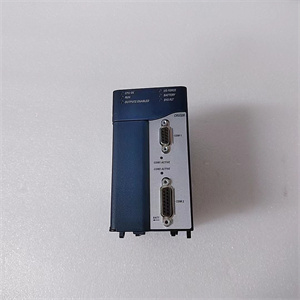
Maximum count rate: 1MHz. That’s the number that matters when you’re tracking encoder pulses on a high-speed packaging line. The GE IC694APU300 is a dedicated high-speed counter module for the RX3i platform that handles pulse signals directly—no CPU intervention needed for basic counting operations.I’ve used these on rotary encoders and turbine flow meters where scan time matters. What sets this module apart is its independent processing: it can count, compare, and generate outputs locally at 80kHz. That’s fast enough for most motion control applications, though honestly, you’ll rarely push it to the full 1MHz spec. The dual voltage input selection (5V or 10-30V) gives you flexibility for different sensor types.
Key Technical Specifications
| Parameter | Value |
|---|---|
| Counter Channels | 4 |
| Maximum Count Frequency | 1 MHz (25% to 87% duty cycle) |
| Processing Speed | 80 kHz |
| Input Voltage Range | 5 VDC or 10-30 VDC (configurable via TSEL jumper) |
| Output Voltage Range | 10-30 VDC @ 500mA or 4.75-6 VDC @ 20mA |
| Power Consumption | 250 mA (1.25 W) |
| Operating Modes | Classic and Enhanced |
| Input Types | Differential or single-ended |
| Memory Allocation | 16 words input, 16 bits discrete output |
| Operating Temperature | 0°C to +60°C |
| Dimensions (W×H×D) | 34 × 145 × 140 mm |
| Weight | Approximately 0.36 kg |
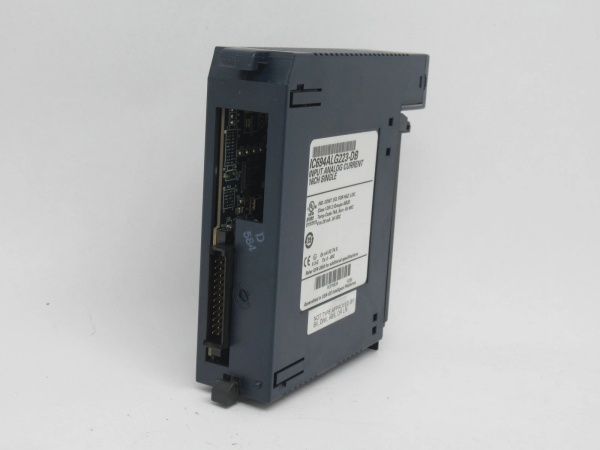
GE IC694ALG223
Quality Control Process (SOP Transparency)
Testing high-speed counters requires precision timing equipment—a regular multimeter won’t cut it.
- Incoming Verification: Serial validation against Emerson’s database, visual inspection of the TSEL jumper block and terminal connections. We check for any physical damage to the high-frequency input terminals specifically.
- Frequency Response Test: Using an Agilent 33220A function generator, we apply pulse trains from 1Hz to 1MHz to each channel. A Tektronix TBS2000 oscilloscope verifies the module accurately counts pulses across the entire frequency range, checking for missed counts at the upper limits.
- Voltage Threshold Test: We test both input voltage ranges (5V and 24V) by applying signals at the minimum and maximum thresholds. The module must reliably detect 5V signals when configured for 5V input, and 10V signals when configured for 10-30V range.
- Output Drive Test: We connect resistive loads to the output channels and verify they can switch the specified currents (20mA for low voltage, 500mA for high voltage). Output response time is measured with the oscilloscope—must be under 1µs.
- Final QC & Packaging: QC inspector signs off, all jumpers are set to factory default (5V input), module is sealed in anti-static bag with desiccant, placed in custom foam. QC label shows “1MHz pulse verification passed on all 4 channels.”

GE IC694ALG223
Replacement Pitfall Guide (Field Engineer’s Warnings)
High-speed counting looks simple until your production line stops because of a missed pulse.
- ❗ TSEL Jumper Determines Input Voltage: This module has a physical TSEL jumper that selects between 5V and 10-30V input ranges. If you replace a module and don’t check this jumper, your 24V encoder signals won’t be recognized (or worse, you’ll fry a 5V encoder). Always photograph the jumper setting before removal.
- ❗ Ground Loops Destroy Signal Integrity: High-frequency signals are noise magnets. Run separate shielded twisted-pair cables for each channel, ground at one end only, and keep away from AC power lines. I’ve seen 500kHz signals become unreadable because the cable ran parallel to a motor feeder for 3 meters.
- ❗ CPU Scan Time Still Matters: While the module processes counts independently, the CPU still needs to read the accumulated values. If your program scans too slowly, you’ll miss overflow conditions. Set up interrupt-driven reads for critical applications.
- ❗ Output Current Limits Are Real: The low-voltage outputs max at 20mA, high-voltage at 500mA. Connect a solenoid drawing 30mA to a low-voltage output and it won’t actuate reliably. Check your load specifications before wiring.
- ❗ Enhanced Mode Requires Firmware Support: The enhanced mode provides 32-bit diagnostic data versus 16-bit in classic mode. But you need Proficy Machine Edition v7.0 or later to use it. Older systems might default to classic mode without warning.
Keep these five points in mind and you’ll eliminate roughly 90% of rework.