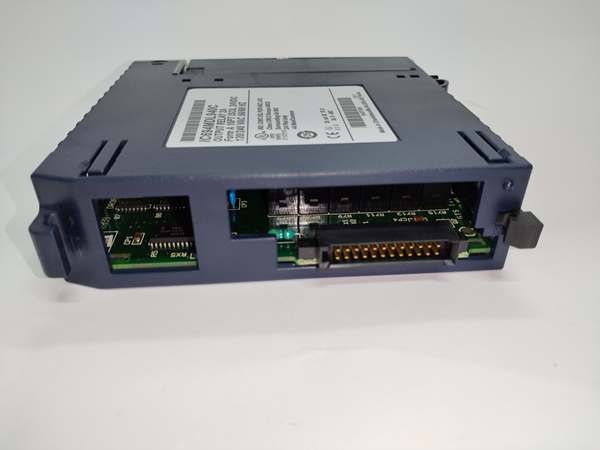
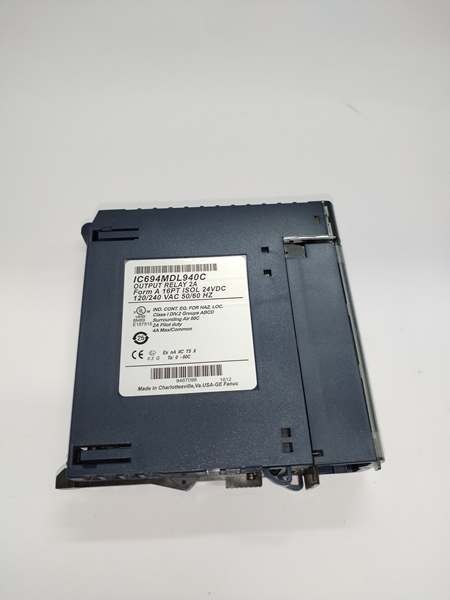
Description
Product Introduction
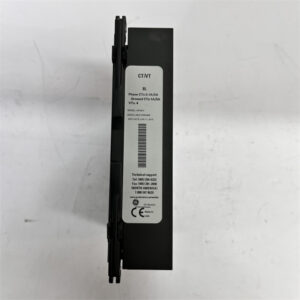
I’ve calibrated dozens of these modules for furnace temperature control—they handle millivolt signals without external transmitters. The GE IC695ALG412 is a 12-channel isolated differential input module for PACSystem RX3i systems, designed for direct strain gauge and thermocouple connection .This unit supports nine thermocouple types (J, K, T, E, R, S, B, N, C) plus ±150 mV and ±50 mV voltage ranges. The Σ-Δ ADC delivers 32-bit IEEE floating point resolution with configurable update rates from 15 to 120 milliseconds .
Key Technical Specifications
| Parameter | Value |
|---|---|
| Input Channels | 12 isolated differential |
| Signal Types | Thermocouples J/K/T/E/R/S/B/N/C; ±150 mV, ±50 mV |
| Resolution | 32-bit IEEE float or 16-bit integer (32-bit field) |
| Update Rate | 15 ms @ 28 Hz to 120 ms @ 2.3 Hz (configurable) |
| Accuracy | ±0.25% of full scale over temperature range |
| Input Impedance | ≥500 kΩ |
| Isolation | 250 VAC continuous; 1500 VAC for 1 minute |
| Current Draw | 400 mA @ 3.3 V or 425 mA @ 5 V |
| Operating Temperature | 0 to 60°C (32 to 140°F) |
| Storage Temperature | -40 to 85°C (-40 to 185°F) |
| Terminal Blocks | IC694TBB032, IC694TBS032, IC694TBC032 |
| Noise Rejection | 10 dB improvement |
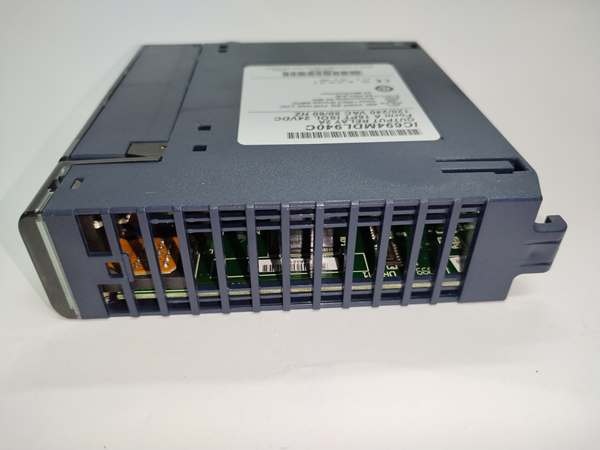
IC694MDL940
Quality Control Process (SOP Transparency)
Strain gauge modules fail when you need them most—during thermal stress testing. Here’s our verification sequence for the GE IC695ALG412.
- Incoming Verification: Cross-reference part number against Emerson’s active compatibility matrix. Check for GE Intelligent Platforms or Emerson Automation branding. Inspect connector pins for gold plating integrity—corrosion here means moisture exposure.
- Live Functional Test: Install in test RX3i rack with CPE400 CPU. Configure all 12 channels as different thermocouple types using Proficy Machine Edition. Apply calibrated mV signals from Fluke 725S process calibrator. Verify measurement accuracy within ±0.25% across full temperature range.
- Electrical Parameter Test: Measure insulation resistance at 500 V between adjacent channels (>100 MΩ). Verify channel-to-ground isolation withstands 1500 VAC for 60 seconds. Check input impedance with Keithley 2400 source meter.
- Firmware Verification: Read firmware version via Ethernet Station Manager. Document DIP switch settings (though this module has fewer than analog versions). Photograph all status LED patterns during normal operation and fault conditions.
- Final QC & Packaging: Inspector signs off after confirming UL/CE/ATEX markings. Seal in anti-static bag with desiccant. Bubble wrap and carton with QC label showing calibration date and measured accuracy.
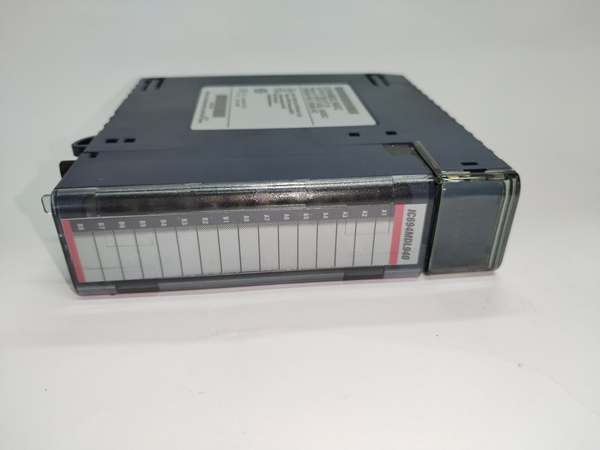
IC694MDL940
Replacement Pitfall Guide (Field Engineer’s Warnings)
The IC695ALG412 looks like other RX3i analog modules but has specific quirks. Keep these five points in mind and you’ll eliminate roughly 90% of rework.
- ❗ Terminal Block Compatibility: Requires specific removable terminal blocks—IC694TBB032, TBS032, or TBC032. Case: An engineer tried using a standard 90-30 terminal block—the module powered up but all channels read open circuit.
- ❗ Configuration Overhead: Each channel configures independently for thermocouple type or voltage range. “The factory default is all channels as Type K thermocouples. If you’re using strain gauges at ±50 mV, you must reconfigure every single channel in PME.”
- ❗ Update Rate Trade-off: 15 ms update gives faster response but higher noise. For furnace control, I typically set 60 ms—fast enough for temperature loops without picking up SCR noise.
- ❗ Cold Junction Compensation: Built into the module, but requires stable ambient temperature. Mount away from heat sources. I’ve seen 2°C errors from a nearby power supply raising the local temperature.
- ❗ Grounding Scheme: Isolated differential inputs mean careful grounding. Float all thermocouple negatives unless you have a solid earth reference. Ground loops here introduce more noise than signal.