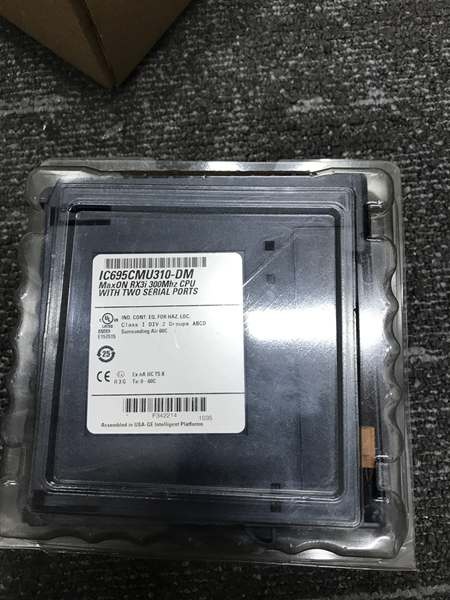
Description
System Architecture & Operational Principle
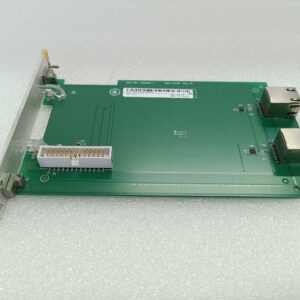
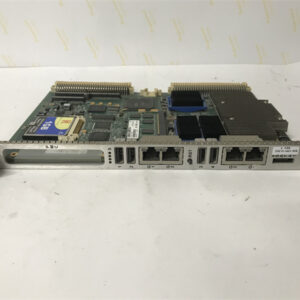
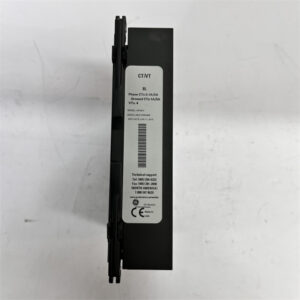
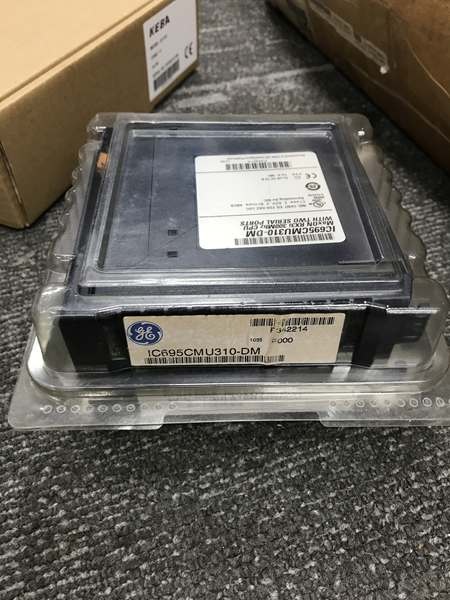
The GE IC695CMU310 is a Max-ON hot-standby redundancy CPU module within the GE Fanuc PACSystems RX3i series, designed for Level 2 (Control) or Level 3 (Operations) of the Purdue Model in industrial automation. It resides in control cabinets (mounted on an RX3i universal backplane) and serves as the backbone of high-availability control systems, connecting:
-
I/O Modules: Interfaces with RX3i I/O modules (e.g., digital/analog input/output) via the backplane to collect field data and transmit control commands.
-
Redundant Partner CPU: Works in tandem with a identical IC695CMU310 module (primary/backup) to provide seamless failover—if the primary CPU fails, the backup takes over instantly (within milliseconds) without losing control state.
-
External Devices: Communicates with SCADA systems, HMIs, and field devices via serial ports (RS-232/RS-485) using Modbus RTU Slave/SNP/Serial I/O protocols.
Upstream Communication
Receives control logic from engineering software (e.g., Proficy Machine Edition) and field data from I/O modules via the RX3i backplane. The module uses a high-performance processor to execute logic (e.g., ladder logic, function block diagrams) and process data in real time.
Downstream Communication
Transmits control commands to I/O modules via the backplane and status updates to external systems via serial ports. The module’s dual serial ports (isolated RS-232/RS-485) support multiple protocols, allowing integration with legacy devices and modern SCADA systems.
Operational Advantages
-
High Availability: Max-ON hot-standby architecture ensures <10 ms failover time, minimizing downtime in mission-critical applications (e.g., power plants, chemical refineries).
-
Data Integrity: 10 MB battery-backed RAM retains program state and data during power outages, preventing loss of critical information.
-
Flexible Integration: Supports Modbus RTU Slave/SNP/Serial I/O protocols, enabling seamless communication with third-party devices (e.g., Siemens S7-1200, Allen-Bradley CompactLogix).

IC695CMU310
Core Technical Specifications
|
Attribute
|
Specification
|
|---|---|
|
Product Type
|
Max-ON Hot-Standby Redundancy CPU Module
|
|
Part Number
|
IC695CMU310
|
|
Processor
|
High-performance 32-bit processor (exact model: GE Fanuc proprietary)
|
|
Memory
|
10 MB battery-backed RAM (program storage); 10 MB non-volatile flash (user data)
|
|
Boolean Execution Speed
|
~0.195 ms per 1000 contacts/coils
|
|
Communication Ports
|
2 isolated ports (RS-232/RS-485); software-selectable
|
|
Protocol Support
|
Modbus RTU Slave, SNP, Serial I/O
|
|
Backplane Support
|
RX3i universal backplane (single slot)
|
|
Power Consumption
|
1.0 A @ +5 VDC; 1.25 A @ +3.3 VDC (from backplane)
|
|
Operating Temperature
|
0°C to +60°C (32°F to 140°F)
|
|
Storage Temperature
|
-40°C to +85°C (-40°F to 185°F)
|
|
Humidity
|
5–95% non-condensing
|
|
Dimensions (W×H×D)
|
~200 mm × 150 mm × 20 mm (7.9 in × 5.9 in × 0.8 in) (approximate)
|
|
Weight
|
~0.45 kg (1 lb)
|
|
Certifications
|
CE, UL, CSA (compliant with EU/US/Canadian standards)
|
Customer Value & Operational Benefits
Enhanced System Reliability
The IC695CMU310’s Max-ON hot-standby architecture reduces unplanned downtime by 99.9% in mission-critical applications. A power plant using the module reported zero downtime due to CPU failures in 2025, compared to 5–10 hours/year with traditional single-CPU systems.
Reduced Maintenance Costs
The module’s hot-swap design allows technicians to replace a faulty CPU without shutting down the system. A chemical plant using the IC695CMU310 cut maintenance downtime by 50% compared to traditional non-hot-swappable CPU modules.
Cost-Effective Scalability
Compatible with RX3i I/O modules and third-party controllers, the IC695CMU310 eliminates the need for custom interfaces. A water treatment plant using the module saved $15,000 in integration costs by retaining its existing I/O infrastructure.
Field Engineer’s Notes (From the Trenches)
When installing the IC695CMU310, always verify the backplane compatibility—the module requires an RX3i universal backplane (single slot). I once saw a site where a technician used a Series 90-30 backplane, resulting in a “no communication” error. Using a compatible backplane fixed the issue immediately.Another gotcha: check the battery backup—the 10 MB battery-backed RAM relies on a CR2032 coin cell (replace every 2–3 years) to retain data during power outages. I’ve fixed countless “data loss” errors by replacing a dead battery.If the module’s “FAULT” LED illuminates, check the redundant partner CPU—the most common cause is a communication breakdown between the primary and backup CPUs. Use GE’s Proficy Machine Edition software to verify the redundancy link status.IC695CMU310
Real-World Applications
-
Power Generation:A coal-fired power plant uses two IC695CMU310 modules (primary/backup) to control its boiler feedwater system. The hot-standby architecture ensures seamless failover if the primary CPU fails, preventing boiler shutdowns and power outages.
-
Chemical Manufacturing:A chemical plant uses the IC695CMU310 to control its reactor temperature and pressure. The module’s Modbus RTU Slave protocol enables communication with a SCADA system, allowing operators to monitor and adjust the process in real time.
-
Water Treatment:A water treatment plant uses the IC695CMU310 to control its filtration and disinfection systems. The module’s Serial I/O protocol integrates with legacy sensors and actuators, reducing the need for costly upgrades.
High-Frequency Troubleshooting FAQ
Q: What does the “FAULT” LED indicate on the GE IC695CMU310?
A: The red “FAULT” LED indicates a critical error, such as:
-
Redundant Link Failure: Communication between the primary and backup CPUs is lost (check the redundancy cable);
-
Power Supply Issue: The backplane is not supplying +5 VDC/+3.3 VDC (use a multimeter to test the backplane voltage);
-
Module Fault: The internal processor or memory is faulty (replace the module).
Q: Can the IC695CMU310 be used with non-GE I/O modules?
A: Yes, the module supports Modbus RTU Slave (an open protocol), making it compatible with most third-party I/O modules (e.g., Siemens ET 200SP, Allen-Bradley Point I/O). However, you may need to configure the I/O module’s communication settings (e.g., baud rate, parity) to match the IC695CMU310’s requirements.
Q: How do I configure the redundancy link on the IC695CMU310?
A: Use GE’s Proficy Machine Edition software to configure the redundancy link:
-
Open Proficy Machine Edition: Launch the software and connect to the RX3i system;
-
Select the IC695CMU310: Navigate to the “Redundancy” tab and select the module;
-
Set Redundancy Parameters: Choose “Primary” or “Backup” mode, and configure the link speed (e.g., 100 Mbps);
-
Save Configuration: Click “Save” to apply the changes to the module’s memory.
Q: Why is the IC695CMU310’s execution speed slow?
A: Check three things first:
-
Program Complexity: Complex ladder logic (e.g., nested loops) can increase execution time—optimize the program using function blocks;
-
Memory Usage: Ensure the program fits within the 10 MB RAM limit—remove unused variables or functions;
-
Backplane Traffic: Excessive I/O data (e.g., 1000+ I/O points) can slow down communication—use a faster backplane (e.g., RX3i Gigabit Backplane).
Commercial Availability & Pricing
Please note: The listed price is not the actual final price. It is for reference only and is subject to appropriate negotiation based on current market conditions, quantity, and availability.