Description
System Architecture & Operational Principle
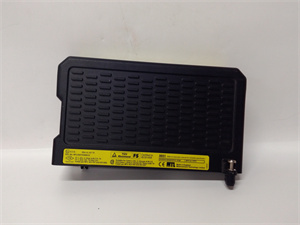
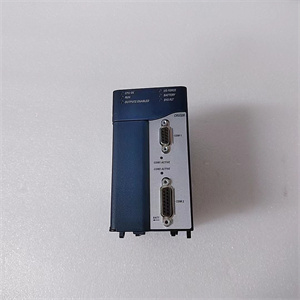
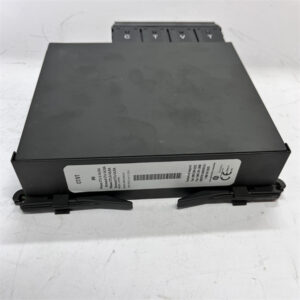
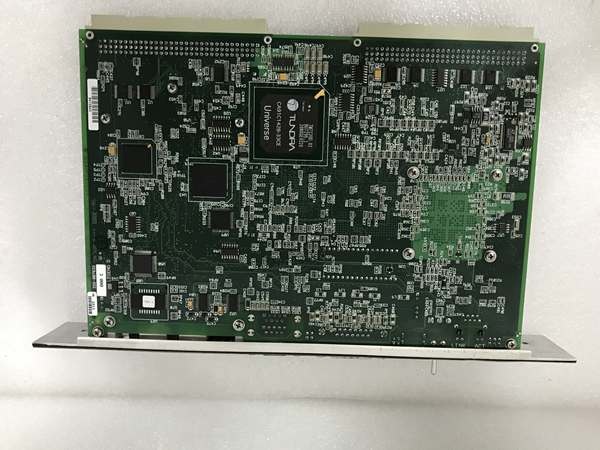
The IC698CPE010 is a single-width CPU module designed for the GE PACSystems RX7i family, positioned at Level 2 (Basic Control) of the Purdue Model. It resides in Slot 1 of an RX7i rack and serves as the computational core for process control, data acquisition, and equipment coordination.
The CPU executes user-defined control programs downloaded from a programming terminal (e.g., Proficy Machine Edition) and communicates with I/O modules in the same rack or in remote racks via the RX7i high-speed backplane and Ethernet Global Data (EGD) protocols. It supports multiple programming languages (Ladder Diagram, Structured Text, Function Block Diagram) and can perform floating-point math, PID control, and data logging.
The module contains a 300 MHz Intel Celeron M processor and 10 MB of battery-backed RAM/10 MB of Flash memory for program storage and runtime data. A 10/100 Mbps Ethernet port on the front provides connectivity to HMIs, SCADA systems, and other controllers for peer-to-peer messaging. The CPU also features watchdog timers and self-diagnostics to detect hardware faults, memory corruption, or program execution errors, triggering a fail-safe state (e.g., controlled shutdown) if a critical fault occurs.

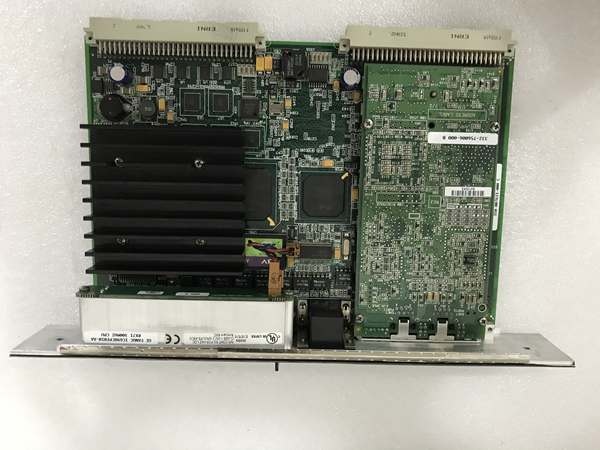
GE IC698CPE010
Core Technical Specifications
-
Processor: 300 MHz Intel Celeron M
-
Memory: 10 MB battery-backed RAM, 10 MB Flash
-
Backplane Compatibility: RX7i (PacerStack) rack, Slot 1
-
I/O Capacity: Up to 16 local I/O modules; unlimited remote I/O via Ethernet
-
Communication Ports: 2x 10/100 Mbps Ethernet (RJ45), 1x RS-232 (programming/diagnostics)
-
Programming Languages: Ladder, Structured Text, Function Block, C
-
Execution Speed: 0.33 ms per 1000 Boolean contacts/coils
-
Redundancy Support: Compatible with IC698RPM100 hot-standby processor
-
Operating Temperature: -40°C to +70°C (-40°F to +158°F)
-
Storage Temperature: -55°C to +85°C (-67°F to +185°F)
-
Humidity: 5–95% RH non-condensing
-
Power Consumption: 8 W typical, 12 W max
-
Dimensions: ~312 mm × 27 mm × 215 mm (12.3 in × 1.06 in × 8.5 in)
-
Weight: ~0.9 kg (2.0 lbs)
-
Certifications: UL/cUL, CE, FCC Class A
Customer Value & Operational Benefits
High-Speed Processing for Complex Control Strategies
The 300 MHz processor and 0.33 ms/1000 coils execution speed enable the IC698CPE010 to handle large, complex programs with multiple PID loops, data logging tasks, and peer-to-peer communications. This is critical for batch processing in pharmaceuticals or high-speed packaging lines where cycle times are measured in milliseconds.
Scalable I/O and Network Integration
Support for up to 16 local I/O modules and unlimited remote I/O via Ethernet allows the CPU to scale with plant growth. The 10/100 Mbps Ethernet port facilitates integration with modern SCADA systems, historians, and enterprise networks, enabling real-time data visibility and remote diagnostics.
Redundancy and Fault Tolerance
When paired with the IC698RPM100 hot-standby processor, the IC698CPE010 provides seamless failover in case of primary CPU failure. This is essential for safety-critical systems (e.g., turbine control, chemical reactors) where downtime can result in significant financial loss or environmental harm.
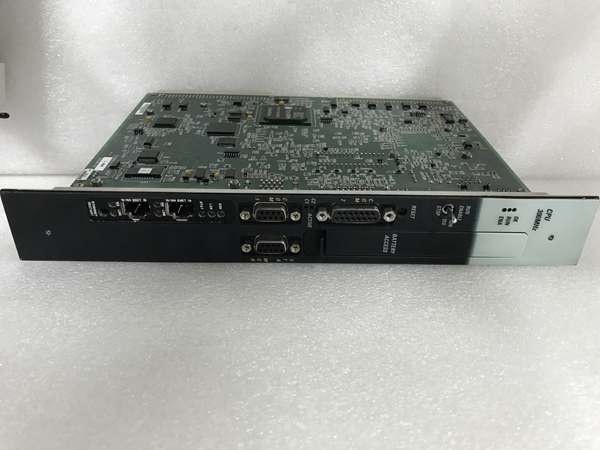
GE IC698CPE010
Field Engineer’s Notes (From the Trenches)
When replacing an IC698CPE010, always back up the program and configuration files first—losing the runtime database means re-downloading and re-validating the entire control strategy, which can take days. Also, check the battery-backed RAM (if present) for date/time accuracy; a dead battery can cause the CPU to lose its clock, messing up data logs and alarm timestamps. If the CPU’s Ethernet port isn’t communicating, verify the link LED and check for IP address conflicts—I’ve seen duplicate IPs cause intermittent comms that look like hardware faults.
Real-World Applications
In a Michigan automotive plant, the IC698CPE010 controls a robotic welding line with 12 servo axes and 50+ I/O points. The CPU’s fast execution speed handles real-time motion control calculations, while the Ethernet port sends production data to the plant MES system. The ability to add remote I/O racks allowed the plant to expand the line without replacing the main controller.
On a Texas wind farm, the IC698CPE010 serves as the master controller for 20 wind turbine units. It communicates with each turbine’s local PLC via Ethernet, collecting power output, vibration, and temperature data. The CPU’s redundancy support (with a hot-standby) ensures continuous operation even if the primary controller fails, maximizing energy production and revenue.