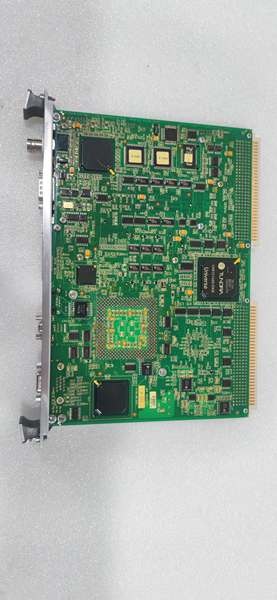
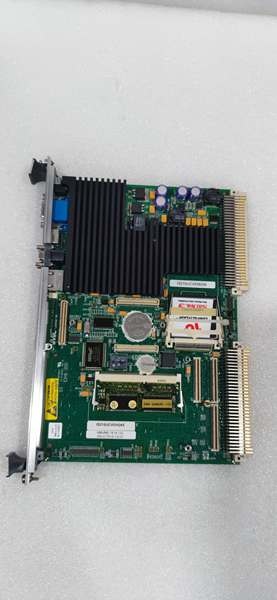
Description
System Architecture & Operational Principle
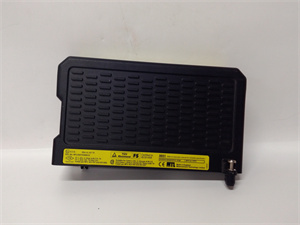
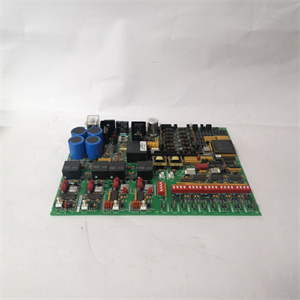
The IS215UCVEM09B is a UCVEM (Universal Control & Voter Electronics, M-Series) board designed for the GE Mark VIe turbine control platform, typically installed in a controller carrier within a Mark VIe rack (Purdue Level 1–2 boundary). It serves as the computational heart of the control system, executing protection, sequencing, and regulation logic for gas and steam turbines.
The board is part of a Triple Modular Redundancy (TMR) architecture, where three independent control lanes (A, B, C) run in parallel. The UCVEM board hosts the voting logic that compares outputs from each lane and selects the correct value, ensuring fault-tolerant operation. It communicates with I/O packs (e.g., IS200 series) via the VME backplane and with other controllers via redundant Ethernet or serial links.
Internally, the IS215UCVEM09B contains a 300 MHz PowerPC processor, 128 MB of RAM, and 256 MB of Flash memory for program storage. It supports real-time multitasking for control loops, event sequencing, and data logging. The board’s watchdog timers and self-diagnostics detect hardware faults, memory errors, or software exceptions, triggering a safe shutdown if a critical condition is detected.
The UCVEM board also interfaces with the Mark VIe human-machine interface (HMI) and historian for real-time monitoring and post-event analysis. Its rugged design and wide temperature range make it suitable for installation in turbine control cabinets, which often experience high temperatures and vibration.

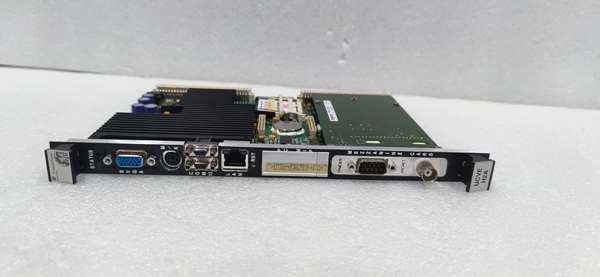
GE IS215UCVEM09B
Core Technical Specifications
-
Processor: 300 MHz PowerPC (MPC8245)
-
Memory: 128 MB SDRAM, 256 MB Flash
-
Backplane Compatibility: Mark VIe VME rack, controller carrier slot
-
I/O Capacity: Interfaces with up to 12 I/O packs per controller lane
-
Communication Ports: 2x 10/100 Mbps Ethernet (redundant), 1x RS-232 (diagnostics)
-
Redundancy: Triple Modular Redundancy (TMR) support with voter logic
-
Execution Speed: 0.2 µs per typical control instruction
-
Operating Temperature: -40°C to +70°C (-40°F to +158°F)
-
Storage Temperature: -55°C to +85°C (-67°F to +185°F)
-
Humidity: 5–95% RH non-condensing
-
Power Consumption: 15 W typical, 20 W max
-
Dimensions: ~240 mm × 30 mm × 180 mm (9.4 in × 1.2 in × 7.1 in)
-
Weight: ~1.2 kg (2.6 lbs)
-
Certifications: UL/cUL, CE, IEEE 1613 (substation environmental compliance)
Customer Value & Operational Benefits
Fault-Tolerant Control for Safety-Critical Turbines
The TMR architecture and voting logic of the IS215UCVEM09B ensure that a single control lane failure does not compromise turbine operation. This is essential for power generation and petrochemical applications where turbine trips can result in millions of dollars in lost production or safety incidents.
High-Performance Processing for Real-Time Control
The 300 MHz PowerPC processor and 0.2 µs instruction execution speed enable the board to handle complex control algorithms (e.g., rotor stress analysis, combustion optimization) and fast-acting protection functions (e.g., overspeed trip, bearing temperature monitoring).
Seamless Integration with Mark VIe Ecosystem
The board’s compatibility with Mark VIe I/O packs, communication networks, and HMI systems allows for scalable and modular system design. This simplifies upgrades and expansions, as new I/O or controllers can be added without replacing the entire control system.
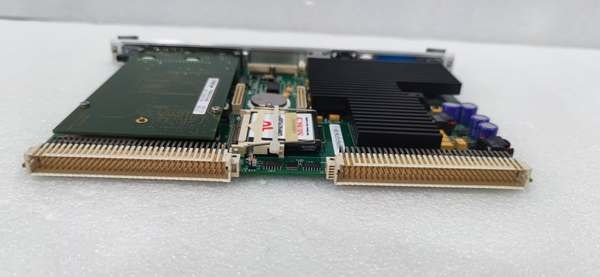
GE IS215UCVEM09B
Field Engineer’s Notes (From the Trenches)
When troubleshooting an IS215UCVEM09B, always check the voter status LEDs on the front panel first—they indicate if all three control lanes are in agreement. A mismatch (e.g., Lane A disagrees with B and C) often points to a faulty I/O pack or a software configuration error, not necessarily a bad UCVEM board. Also, use a static wrist strap when handling the board—static discharge can corrupt the Flash memory, requiring a full reprogramming from a backup file.
Real-World Applications
In a California natural gas power plant, the IS215UCVEM09B controls a 500 MW combined-cycle turbine. The TMR architecture ensures continuous operation even if one control lane fails, while the 300 MHz processor handles real-time monitoring of exhaust temperature, vibration, and fuel flow. The board’s Ethernet ports send data to the plant’s SCADA system for performance optimization.
On a Texas refinery, the IS215UCVEM09B is used in a steam turbine driver for a compressor train. The board’s wide temperature range (-40°C to +70°C) withstands the refinery’s hot control room, and its TMR design prevents unplanned shutdowns during critical process operations. The ability to log high-resolution data helps maintenance teams analyze turbine health trends.