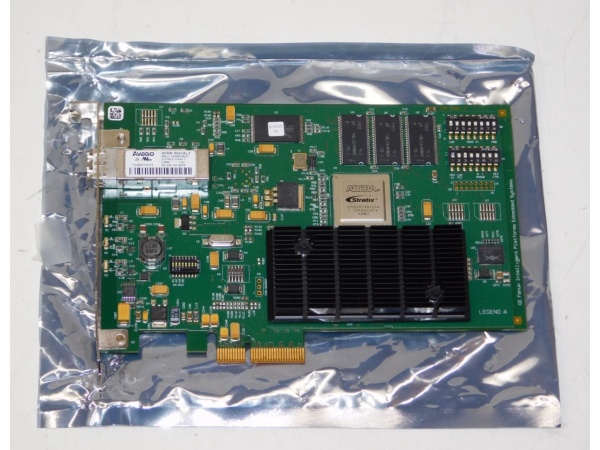
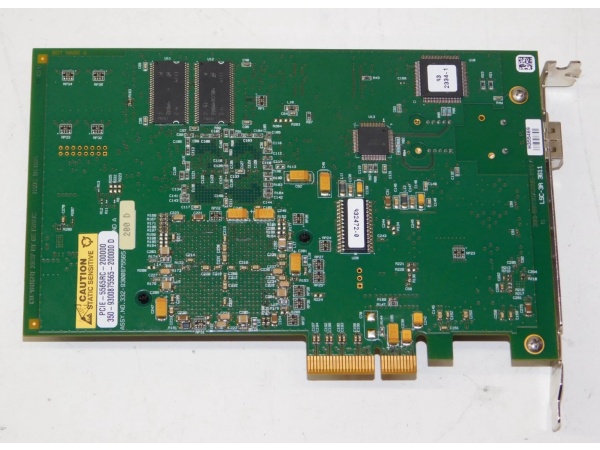
Description
System Architecture & Operational Principle
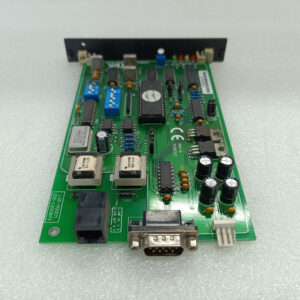
The GE PCIE-5565PIORG is a reflective memory node card that operates at Level 2 (Control) or Level 3 (Operations) of the Purdue Model, typically residing in a host computer (e.g., industrial PC, SBC) via a PCIe slot. It creates a deterministic data-sharing network where any write to the card’s local SDRAM is automatically broadcast to all other nodes in the ring or star topology. Upstream, it receives data writes from the host CPU as standard memory operations. Downstream, it outputs identical data copies to all networked nodes through fiber optic transceivers, bypassing software protocols. The inherent advantage is the hardware-enforced data consistency and microsecond-level latency, which is critical for synchronizing simulators, distributed control systems, and test rigs. The backplane or network it connects to is a high-speed fiber optic loop, often with dual-ring redundancy for fault tolerance.
Core Technical Specifications
-
Interface: PCI Express x4 (Gen1)
-
Memory: 128MB or 256MB SDRAM with ECC/parity
-
Fiber Ports: 2x ST/LC (SFP), multi-mode (300m) or single-mode (10km)
-
Bandwidth: 174 MB/s (peak, 64-byte burst)
-
Latency: 0.4 µs (node-to-node, typical 1 µs)
-
Topology: Ring (deterministic) or Star (with hub)
-
Node Capacity: Up to 256 nodes
-
Redundancy: Dual-ring failover (<1 µs switch time)
-
Operating Temperature: -40°C to +85°C
-
Power Draw: ~3.3V @ 1.5A from PCIe slot
-
Form Factor: Standard height, half-length PCIe card
-
Certifications: MIL-STD-202G (vibration/shock)

GE PCIE-5565PIORG
Customer Value & Operational Benefits
Deterministic Data Sync
The card’s hardware-based reflection eliminates software-induced jitter, providing sub-microsecond synchronization for multi-axis motion simulators or distributed I/O. This prevents data staleness in closed-loop control across facilities.
Reduced Integration Time
With no driver-level programming for data sharing, engineers can network up to 256 nodes in hours instead of weeks. A military simulation lab reported a 70% reduction in setup time when migrating from a TCP/IP solution.
Fault Tolerant Operation
The dual-ring architecture allows a node or fiber segment failure without network collapse. A test cell using the card maintained operation during a fiber cut, with failover occurring in under 1 microsecond.
Field Engineer’s Notes (From the Trenches)
When cabling the PCIE-5565PIORG, always use the correct SFP module for your fiber type—multimode 62.5/125µm fiber requires a 1300nm SFP, while single-mode 9/125µm needs a 1310nm SFP. I once saw a site use a 850nm SFP on multimode fiber, resulting in a 90% signal loss and constant link errors. Also, torque the ST connectors to 1.0-1.2 N·m; overtightening cracks the ceramic ferrules. For the SDRAM, populate the card with 256MB if you’re running 64-bit applications—I’ve seen 128MB cards page to host memory under heavy load, adding 5-10µs of latency.
Real-World Applications
-
Flight Simulator Motion Cueing:The card synchronizes hydraulic actuator commands across 12 networked servers, ensuring all 6 degrees of freedom move in lockstep. Each server writes its axis data to local SDRAM; the card reflects it to others in <1µs.
-
Distributed Test Cell Control:In an automotive durability rig, the card shares load-cell data from 8 test stands to a central DAQ system. A failing load cell is isolated by the star topology hub without halting other stations.
GE PCIE-5565PIORG
High-Frequency Troubleshooting FAQ
Q: What does a solid red LED on the GE PCIE-5565PIORG indicate?
A: Solid red signifies a fiber link fault. Check SFP module seating, fiber continuity with an OTDR, and ensure Tx/Rx polarity isn’t reversed. Clean connectors with lint-free wipes—oil contamination is a common culprit.
Q: Can the PCIE-5565PIORG be used in a PCIe Gen2 slot?
A: Yes, it’s backward compatible. However, the card negotiates Gen1 speeds (2.5 GT/s). Don’t expect doubled bandwidth. Verify slot voltage—some Gen2 slots drop to 1.5V, causing boot failures.
Q: How do I migrate from a PCI-5565PIORC to the PCIE-5565PIORG?
A: The reflective memory protocol is identical. Physically, move the fiber cables to the new card. In software, update the driver to the PCIe version but retain the same memory map. Expect a 15-minute downtime per node for the swap.
Q: Why is my network latency higher than 1µs?
A: Measure with the vendor’s diagnostic tool. Common causes: mixing single-mode and multimode fibers (adds 5-10µs), exceeding 256 nodes (adds arbitration delay), or using unterminated stubs in the ring.
Commercial Availability & Pricing
Please note: The listed price is not the actual final price. It is for reference only and is subject to appropriate negotiation based on current market conditions, quantity, and availability.