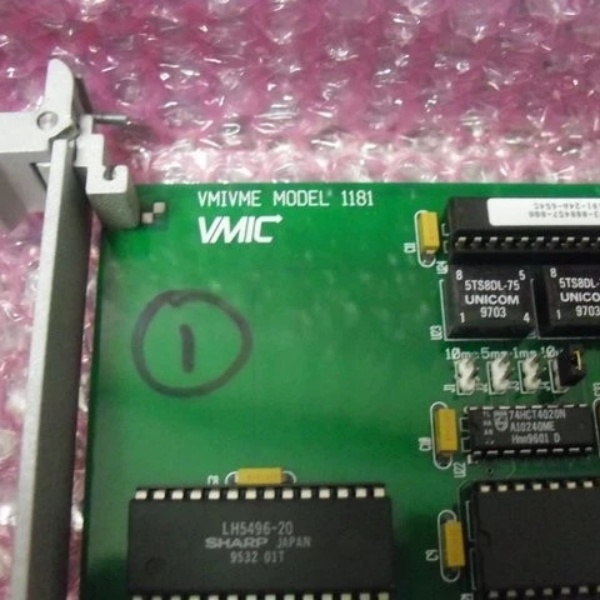
Description
VMIVME-1181: Product Overview
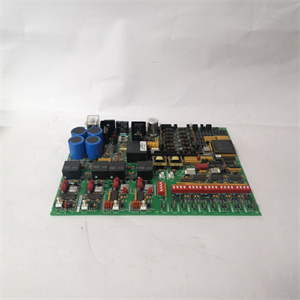
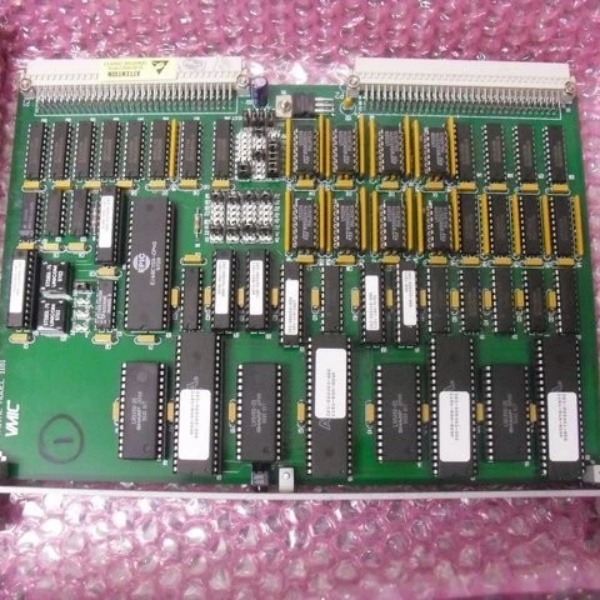
The GE VMIVME-1181 is a 32-bit change-of-state (COS) digital input board designed for VMEbus-based industrial automation systems. As a member of GE’s VMEbus ecosystem, it focuses on state-change detection—a critical feature for applications requiring real-time response to digital signal transitions (e.g., turbine blade position changes, valve actuation). The board combines optical isolation for noise immunity with programmable interrupt logic, making it suitable for harsh industrial environments where reliable signal monitoring is paramount.
Role in Automation Systems:
Positioned as a “smart digital input interface” in VMEbus architectures, the VMIVME-1181 performs two primary functions:
-
State-Change Monitoring: Continuously monitors 32 digital input channels for transitions (e.g., a limit switch opening/closing) and records the event with a timestamp.
-
Interrupt Triggering: Generates a VMEbus interrupt when a predefined state change (rising/falling edge) is detected, allowing the main controller to respond immediately (e.g., adjusting turbine fuel flow based on valve position).
Core Functionality:
-
Optical Isolation: Each channel uses optocouplers to provide galvanic isolation between field devices and the VMEbus, protecting sensitive controller circuits from voltage spikes and electromagnetic interference (EMI).
-
Programmable COS Detection: Users can configure each channel to detect rising edges, falling edges, or both via software, enabling customization for different field devices (e.g., sensors with active-high/active-low outputs).
-
512-Event FIFO Buffer: Stores up to 512 state-change events with timestamps, preventing data loss during high-frequency signal transitions (e.g., rapid valve cycling in a turbine).
-
VMEbus Compatibility: Conforms to VMEbus Rev. C.1, supporting 8/16/32-bit data transfer and seamless integration with VMEbus-based controllers (e.g., GE Fanuc 90-30 series).

GE VMIVME-1181
Platform Benefits (VMEbus Series):
The VMIVME-1181 leverages GE’s VMEbus platform, which is renowned for:
-
Reliability: Industrial-grade components and a rugged design ensure 24/7 operation in harsh environments (e.g., high temperature, vibration).
-
Scalability: Supports expansion with additional I/O boards to accommodate growing system demands (e.g., adding more sensors to a turbine control system).
-
Integration: Seamlessly integrates with VMEbus-based controllers and other I/O modules, reducing setup time and effort.
Technical Specifications
-
Model Number: VMIVME-1181 (Variant: VMIVME-1181-000)
-
Manufacturer: GE (General Electric)
-
Product Type: 32-Bit Change-of-State (COS) Digital Input Board
-
Series: VMEbus
-
Channels: 32 (optically isolated, COS detection)
-
Input Voltage Range: 5–48 V DC (configurable via jumpers)
-
Isolation: 1500 V AC channel-to-channel (galvanic isolation)
-
Interrupt Functionality: Programmable rising/falling edge detection, 512-event FIFO buffer
-
Bus Standard: VMEbus Rev. C.1 (supports 8/16/32-bit data transfer)
-
Operating Temperature: 0°C to +55°C (32°F to 131°F)
-
Storage Temperature: -40°C to +85°C (-40°F to 185°F)
-
Humidity: 5–95% non-condensing
-
Dimensions: 160 mm × 100 mm × 20 mm (6.3 in × 3.9 in × 0.8 in) (standard VMEbus single-slot)
-
Weight: 0.2 kg (0.44 lbs)
-
Certifications: CE, UL (inferred from GE industrial product standards)
Core Features & Customer Value
1. Reliable State-Change Detection:
The VMIVME-1181’s optical isolation and programmable COS detection ensure accurate monitoring of digital signals, even in electrically noisy environments. For example, in a power plant, the board can reliably detect when a turbine’s emergency stop button is pressed (a falling edge), triggering an immediate shutdown to prevent damage.
2. Real-Time Interrupt Handling:
The 512-event FIFO buffer and programmable interrupt logic allow the main controller to respond to state changes in real time, which is critical for maintaining turbine stability. This reduces the risk of incorrect control decisions (e.g., misadjusting fuel flow due to delayed signal processing).
3. Flexible Configuration:
Jumpers allow users to customize the input voltage range (5–48 V DC) and COS detection mode (rising/falling edge) for each channel, reducing the need for additional signal conditioning hardware. This flexibility saves time and money during installation.
4. Rugged Industrial Design:
The board’s operating temperature range (0°C to +55°C) and compact form factor make it suitable for harsh industrial environments. Its DIN rail mounting option simplifies installation in crowded control cabinets, reducing setup time and effort.
GE VMIVME-1181
Typical Applications
The GE VMIVME-1181 is widely used in industrial automation systems for:
-
Power Generation:
-
Monitors state changes from gas/steam turbines (e.g., valve position switches, emergency stop buttons) and triggers interrupts for real-time control.
-
-
Manufacturing:
-
Detects state changes from assembly line sensors (e.g., limit switches, proximity sensors) to control robotic arms and conveyor belts.
-
-
Petrochemical Industry:
-
Monitors state changes from valves and pumps in chemical plants, ensuring safe and efficient operation in hazardous environments.
-