Description
System Architecture & Operational Principle
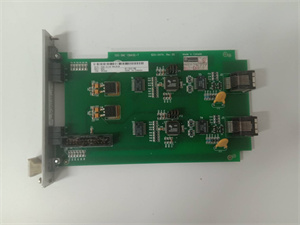
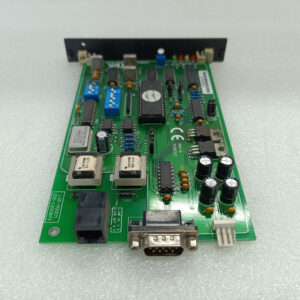
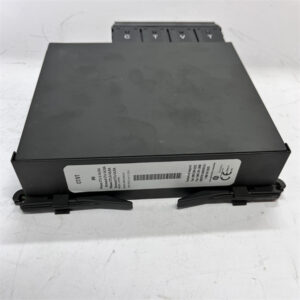
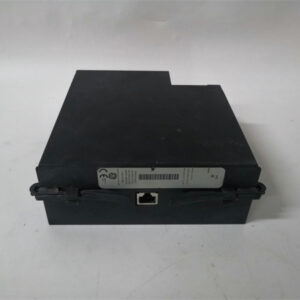
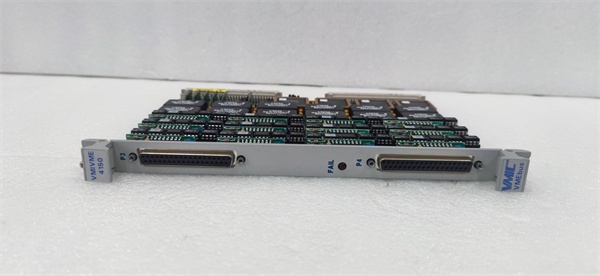
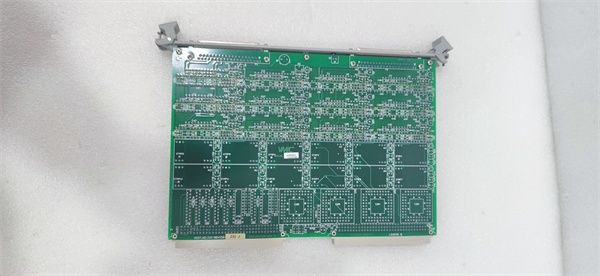
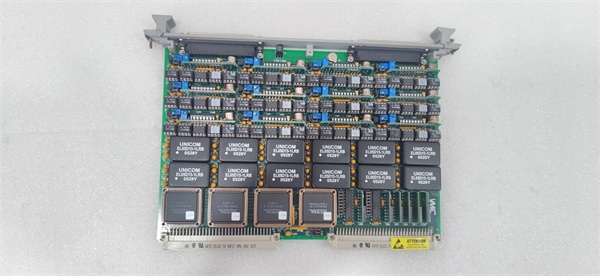
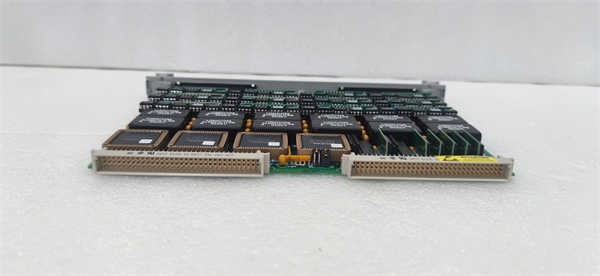
The GE VMIVME-4150 is a 6U VMEbus-compliant analog output module designed to bridge the gap between digital control systems (e.g., VME-based PLCs, DCS) and analog field devices. It is typically mounted in a VME rack (Purdue Level 1–2 boundary) and communicates with the host controller via the VMEbus backplane, which provides power and data transfer.
Core Functional Blocks
The module consists of three main functional blocks:
-
Digital-to-Analog Converters (DACs): 12 independent 12-bit DACs convert digital control signals from the host controller into analog voltages/currents.
-
Isolation Stage: Each channel is optically isolated (1000 VDC) from the VMEbus and other channels using optocouplers, preventing ground loops and protecting the controller from field-side transients.
-
Output Drivers: High-current drivers support both voltage outputs (±2.5V/±5V/±10V) and current loops (4-20mA/0-20mA/5-25mA), with load capacities up to 10mA for voltage outputs.
Operational Workflow
-
Command Reception: The host controller sends a digital command (e.g., “set valve to 50% open”) via the VMEbus backplane.
-
Signal Conversion: The DAC converts the digital command into an analog voltage/current.
-
Isolation: The optocoupler isolates the analog signal from the VMEbus, ensuring no electrical interference propagates back to the controller.
-
Output Delivery: The output driver sends the analog signal to the field device (e.g., a control valve), which adjusts its position based on the signal.
Key Architectural Advantages
-
Hot-Swappable: The module can be replaced without shutting down the VME rack, minimizing downtime in 24/7 industrial applications.
-
Static Readback Registers: Allow the host controller to read back the current output value, simplifying program control and diagnostics.
-
Front-Panel Fail LED: Indicates faults (e.g., overvoltage, open circuit) and helps technicians quickly identify issues.

VMIVME-4150
Core Technical Specifications
|
Parameter
|
Specification
|
|---|---|
|
Model
|
VMIVME-4150
|
|
Manufacturer
|
GE (General Electric) / VMIC
|
|
Form Factor
|
6U VMEbus (160 mm × 233.5 mm)
|
|
Channels
|
4/8/12 isolated analog outputs (configurable)
|
|
Resolution
|
12-bit (some variants offer 16-bit)
|
|
Voltage Ranges
|
±2.5V, ±5V, ±10V (bipolar); 0-2.5V, 0-5V, 0-10V (unipolar)
|
|
Current Ranges
|
4-20mA, 0-20mA, 5-25mA (optional)
|
|
Isolation
|
1000 VDC channel-to-channel (1500 VDC optional)
|
|
Accuracy
|
±0.05% (voltage outputs); ±0.08% (current loops)
|
|
Load Capacity
|
10mA (voltage outputs over full ±10V range)
|
|
Power Supply
|
+5V DC (from VMEbus); ≤25W max power consumption
|
|
Operating Temperature
|
-40°C to +70°C (-40°F to +158°F)
|
|
Compliance
|
VMEbus standard; MIL-STD-810F (vibration); MIL-STD-883H (shock)
|
|
Certifications
|
CE, UL, RoHS
|
Customer Value & Operational Benefits
1. High Precision for Critical Control
The 12-bit resolution and ±0.05% voltage accuracy ensure that analog outputs (e.g., valve positions, motor speeds) are adjusted with minimal error. This is critical for applications like nuclear facility instrumentation or pharmaceutical process control, where even small deviations can lead to safety risks or product defects.
2. Robust Isolation for Harsh Environments
The 1000 VDC channel-to-channel isolation prevents ground loops and protects the VMEbus from field-side transients (e.g., lightning strikes, motor startups). This is essential in steel mills or oil refineries, where electrical noise is prevalent and can corrupt digital signals.
3. Flexible Output Options for Diverse Applications
Support for both voltage outputs (±10V) and current loops (4-20mA) allows the module to interface with a wide range of field devices, from control valves to variable-speed drives. This flexibility reduces the need for multiple I/O modules, simplifying system design and lowering costs.
4. Minimized Downtime with Hot-Swap Design
The ability to replace the module without shutting down the VME rack is invaluable for 24/7 power generation or continuous manufacturing processes. Technicians can perform maintenance during scheduled outages, avoiding costly unplanned shutdowns.
5. Easy Diagnostics with Visual Indicators
The front-panel Fail LED and static readback registers allow technicians to quickly identify faults (e.g., a stuck relay, open circuit) without needing specialized tools. This reduces mean time to repair (MTTR) and keeps systems operational.
VMIVME-4150
Field Engineer’s Notes (From the Trenches)
When installing the VMIVME-4150, always use shielded twisted-pair (STP) cable for field wiring—unshielded cable can pick up electromagnetic interference (EMI) from nearby equipment, leading to erratic output signals. I once spent hours troubleshooting a control valve that “hunted” (oscillated between positions) until I realized the cable was unshielded and running parallel to a variable frequency drive (VFD).Verify the isolation voltage (1000 VDC standard) matches your system’s requirements—if you’re working in a high-voltage environment (e.g., a substation), consider upgrading to the 1500 VDC isolation option.Use GE’s configuration tools (e.g., ToolboxST) to set the output range (voltage/current) and test the module’s response. For example, if you’re using a 4-20mA current loop, set the range to 4-20mA and verify the output with a multimeter.Check the backplane connections—loose pins or bent contacts are a common cause of communication failures. Use a multimeter to test continuity between the VMEbus connector and the module’s pins.
Real-World Applications
1. Nuclear Facility Instrumentation (United States)
A nuclear power plant uses the VMIVME-4150 to control the reactor coolant pumps. The module’s 1000 VDC isolation protects the VMEbus from the high voltages generated by the pumps, while the 12-bit resolution ensures precise speed control. The hot-swap design allows technicians to replace the module during refueling outages without shutting down the reactor.
2. Oil Refinery Process Control (Texas, USA)
An oil refinery uses the VMIVME-4150 to drive control valves on a distillation column. The module’s 4-20mA current loops provide accurate flow control, while the ±0.05% voltage accuracy ensures that the column’s temperature is maintained within strict limits. The Fail LED helps technicians quickly identify faults (e.g., a broken valve stem) during routine inspections.
3. Steel Mill Rolling Mill Control (Indiana, USA)
A steel mill uses the VMIVME-4150 to control the rolling mill stands. The module’s 10mA load capacity and 1000 VDC isolation handle the high currents and electrical noise from the rolling mills, while the 12-bit resolution ensures precise thickness control of the steel sheets. The hot-swap design minimizes downtime during maintenance, keeping the mill operational.