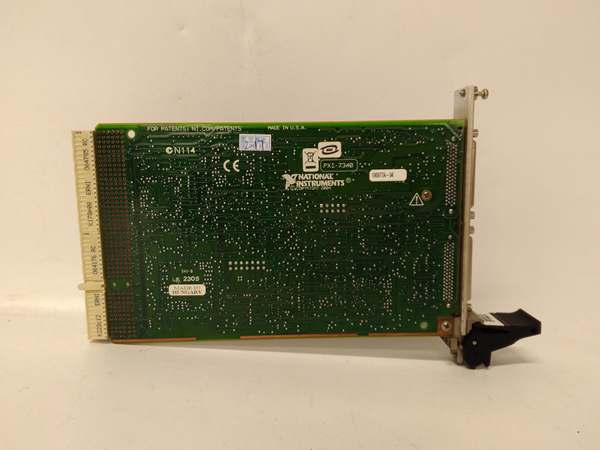
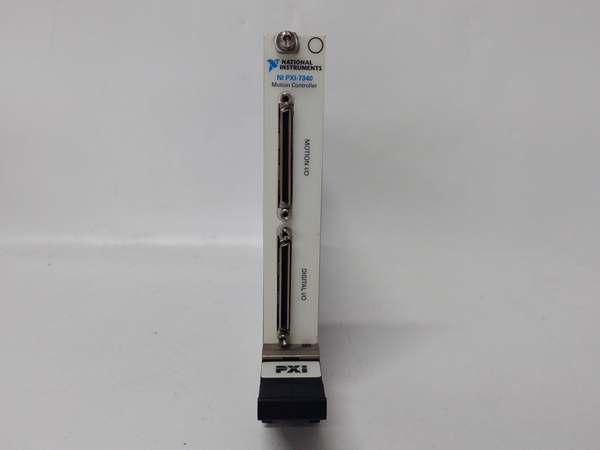
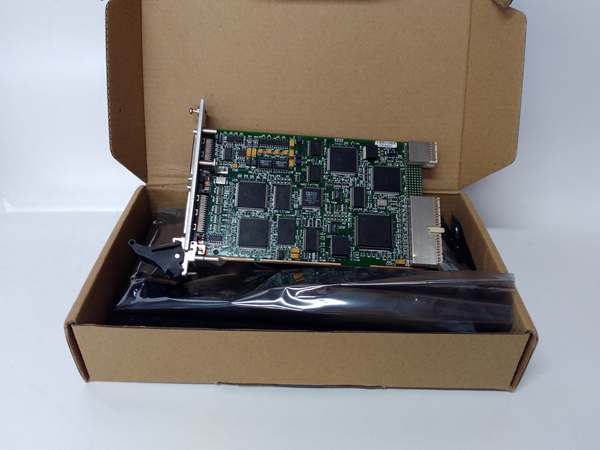
Description
System Architecture & Operational Principle
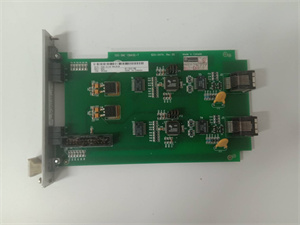
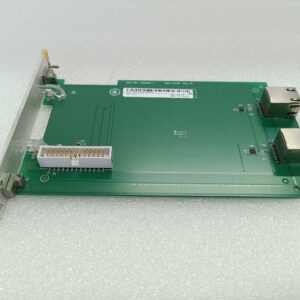
The NI PXI-7344 is a 4-axis stepper/servo PXI motion controller designed for Purdue Model Level 1 (Process Control) in industrial automation and robotics. It serves as the critical interface between host computers (e.g., PXI controllers, industrial PCs) and servo/stepper motors (e.g., DC servo motors, stepper motors with encoders), enabling precise motion control for applications like robotic arm positioning, CNC machining, and automated assembly.
Core Functional Blocks
-
Motion Control Processor: A high-performance CPU (e.g., Motorola MC68331) combined with a digital signal processor (DSP) executes motion control algorithms (e.g., PID, field-oriented control) in real time. The processor supports multi-axis interpolation (linear, circular, spherical) for complex motion trajectories.
-
I/O Interface:
-
Digital I/O: 32 lines (TTL/CMOS compatible) for connecting limit switches, home sensors, and other discrete devices.
-
Analog Input: 4 channels (12-bit resolution) for feedback from analog sensors (e.g., potentiometers, load cells).
-
Encoder Input: 4 channels (20 MHz maximum input rate) for reading position feedback from motor encoders (e.g., quadrature encoders).
-
-
Communication Interface: Connects to the PXI chassis via a PXI bus (32-bit, 33 MHz), providing high-speed data transfer (up to 132 MB/s) to the host computer. Compatible with NI-Motion driver software for configuration and control.
-
Motor Drive Interface: Supports both stepper motors (up to 4 MHz step output rate) and servo motors (via analog command output or pulse/direction signals). Includes patented step generation technology for smooth stepper motion.
Operational Workflow
-
Host Command Reception: The PXI-7344 receives motion commands (e.g., target position, speed) from the host computer via the PXI bus. Commands are sent using NI-Motion API (e.g., LabVIEW, C/C++).
-
Trajectory Planning: The motion control processor plans the motion trajectory (e.g., linear interpolation between two points) based on the received commands. For servo motors, it calculates the required voltage/current output using PID algorithms.
-
Motor Control: The processor sends signals to the motor drive (e.g., step pulses for stepper motors, analog voltage for servo motors) to execute the motion. Encoder feedback is read in real time to adjust the output and maintain precision.
-
Status Feedback: The PXI-7344 sends status information (e.g., current position, speed, fault codes) back to the host computer via the PXI bus. This allows the host to monitor the motion and make adjustments if necessary.

NI PXI-7344
Core Technical Specifications
|
Parameter
|
Specification
|
|---|---|
|
Number of Axes
|
4 (independent or coordinated control)
|
|
Control Modes
|
Position, speed, torque (servo); step/direction (stepper)
|
|
PID Update Rate
|
62.5 µs per axis (closed-loop control)
|
|
Stepper Output Rate
|
Up to 4 MHz (step pulses)
|
|
Encoder Input Rate
|
Up to 20 MHz (quadrature signals)
|
|
Digital I/O
|
32 lines (TTL/CMOS, 5 V)
|
|
Analog Input
|
4 channels (12-bit resolution, ±10 V range)
|
|
Motor Compatibility
|
Stepper motors (2-phase, 4-phase); servo motors (brushless, brushed)
|
|
Communication
|
PXI bus (32-bit, 33 MHz)
|
|
Driver Software
|
NI-Motion (compatible with LabVIEW, C/C++, Visual Basic)
|
|
Operating Temperature
|
0°C to +55°C (ambient, non-condensing)
|
|
Power Consumption
|
≤5 W (from PXI bus)
|
Customer Value & Operational Benefits
1. High Precision for Critical Applications
The PXI-7344’s 62.5 µs PID update rate and 20 MHz encoder input rate enable micrometer-level positioning accuracy, critical for applications like semiconductor manufacturing (e.g., wafer stage positioning) and robotics (e.g., robotic arm pick-and-place). This precision reduces defect rates and improves product quality.
2. Flexible Integration with Existing Systems
The PXI-7344’s PXI bus compatibility allows seamless integration with existing PXI-based systems (e.g., PXI controllers, PXI data acquisition modules). The NI-Motion driver software supports LabVIEW, C/C++, and Visual Basic, enabling users to leverage existing code and development environments.
3. Reduced Downtime with Reliable Design
The PXI-7344’s onboard motion control processor reduces the load on the host computer, allowing it to perform other tasks (e.g., data analysis, user interface) while the motion controller handles real-time control. This reduces downtime in industrial applications where every minute counts.
4. Cost-Effective Motion Control
The PXI-7344 supports both stepper and servo motors, eliminating the need for separate controllers for different motor types. This reduces system costs and simplifies maintenance.
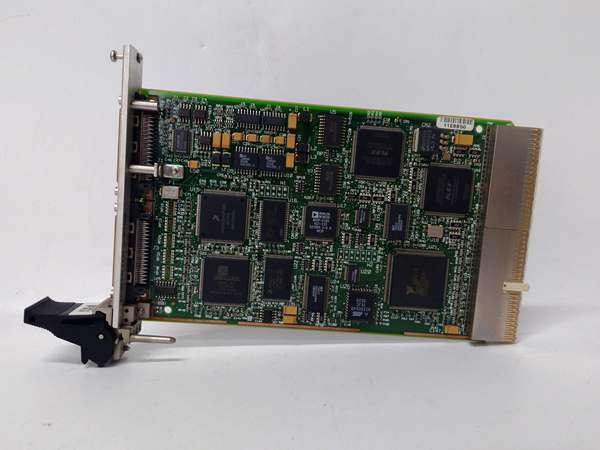
NI PXI-7344
Field Engineer’s Notes (From the Trenches)
When installing the PXI-7344, always use shielded cables (e.g., Belden 9841) for encoder and motor connections—unshielded cables can pick up EMI from nearby equipment (e.g., motors, power supplies), leading to noisy feedback and position errors. I once saw a site lose 8 hours of production because they used unshielded cables, resulting in invalid robotic arm positioning.Verify the PID parameters (e.g., proportional gain, integral gain) for your motor—using default parameters can cause oscillations or slow response. Use NI-Motion’s auto-tuning feature to optimize the PID parameters for your specific motor and load.Check the encoder wiring—quadrature encoders require 4 wires (A+, A-, B+, B-) for direction and position feedback. A miswired encoder can cause the motor to move in the wrong direction or not move at all.Update the NI-Motion driver annually (via NI’s website) to fix bugs and improve compatibility with new operating systems. A 2023 driver update resolved a “motor stall” issue that affected 10% of PXI-7344 systems.
Real-World Applications
1. Robotic Arm Positioning
A automotive manufacturing plant uses the PXI-7344 to control a 6-axis robotic arm for welding. The controller receives position commands from a host computer (via PXI bus) and sends step pulses to the stepper motors driving the arm. The encoder feedback ensures that the arm moves to the correct position with ±0.1 mm accuracy, critical for consistent weld quality.
2. CNC Machining
A job shop uses the PXI-7344 to control a CNC milling machine’s spindle and axis motors. The controller uses circular interpolation to mill complex shapes (e.g., circles, arcs) with high precision. The 62.5 µs PID update rate ensures that the spindle speed remains constant, even under varying loads, improving surface finish quality.
3. Automated Assembly
A electronics manufacturer uses the PXI-7344 to control a pick-and-place machine for assembling circuit boards. The controller coordinates the motion of 4 stepper motors (for X, Y, Z axes and rotation) to pick components from a feeder and place them on the board with ±0.05 mm accuracy. The digital I/O lines are used to trigger the feeder and check for component presence.