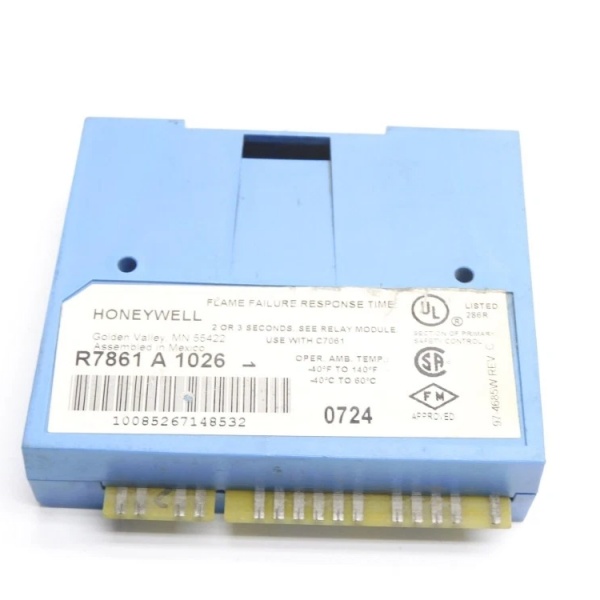
Description
System Architecture & Operational Principle
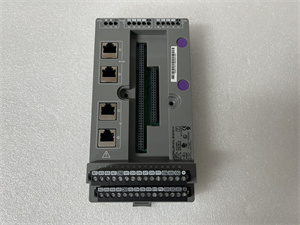
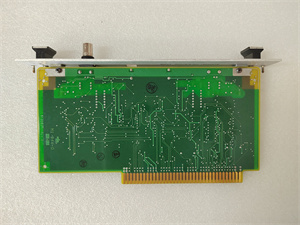
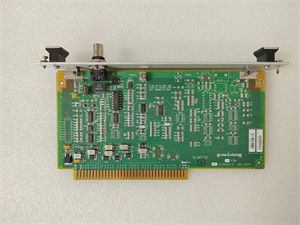
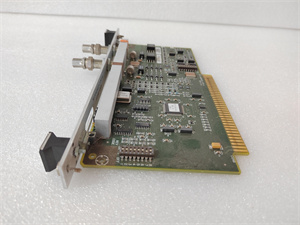
The Honeywell R7861A1026 is a dynamic self-check UV flame amplifier designed for Level 1 (Device) of the Purdue Model in industrial automation. It resides in Honeywell 7800 Series relay module chassis (plug-in edge connector) and serves as the bridge between UV flame detectors (e.g., C7061A) and combustion safety systems (e.g., EC7890 burners).
Upstream Communication
Receives weak UV signals from flame detectors (e.g., C7061A) via a 2-conductor shielded cable. The module amplifies these signals to a 0.0-5.0 V DC range for processing by the 7800 Series relay module.
Downstream Communication
Transmits amplified flame signals to the 7800 Series relay module, which uses the signal to determine flame presence (e.g., “flame on” or “flame off”). The module also sends diagnostic data (e.g., self-check status, signal strength) to the relay module for fault logging.
Operational Advantages
-
Dynamic Self-Check: Continuously tests the detector and amplifier circuits, providing early fault indication (e.g., “detector dirty” or “amplifier failure”).
-
Selectable FFRT: Allows tuning for safety (2.0 sec) or responsiveness (3.0 sec), balancing process efficiency and risk mitigation.
-
Plug-In Design: Simplifies installation and replacement, minimizing downtime during maintenance.
Core Technical Specifications
|
Attribute
|
Specification
|
|---|---|
|
Amplifier Type
|
UV (Ultraviolet) with dynamic self-check
|
|
Flame Failure Response Time (FFRT)
|
2.0 sec (standard) / 3.0 sec (delayed)
|
|
Flame Signal Output
|
0.0-5.0 V DC (±0.1V precision)
|
|
Compatibility
|
Honeywell 7800 Series relay modules; C7061A UV flame detectors
|
|
Power Supply
|
24V DC (from 7800 Series relay module)
|
|
Operating Temperature
|
-20°C to +70°C (-4°F to 158°F)
|
|
Storage Temperature
|
-40°C to +85°C (-40°F to 185°F)
|
|
Humidity Tolerance
|
5–95% non-condensing
|
|
Mounting Type
|
Plug-in edge connector (keyed for proper orientation)
|
|
Dimensions (W×H×D)
|
~100 mm × 60 mm × 20 mm (3.94 in × 2.36 in × 0.79 in) (estimated)
|
|
Weight
|
~0.16 kg (0.35 lbs)
|
|
Certifications
|
CE, UL, CSA, ATEX (Ex nA IIC T4)
|
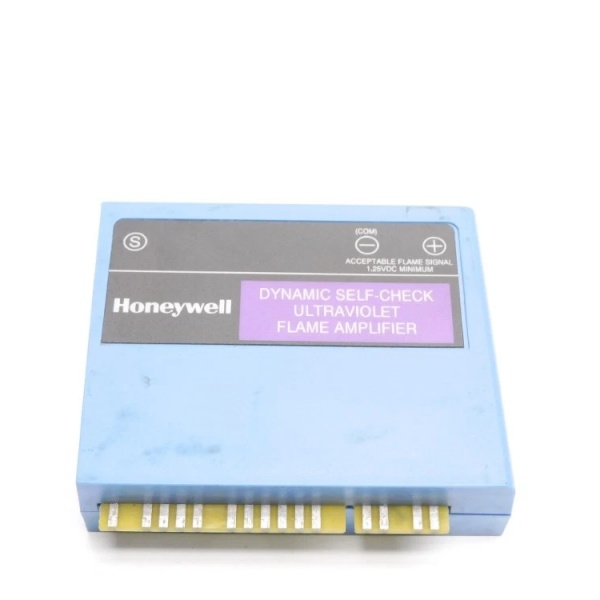
Honeywell R7861A1026
Customer Value & Operational Benefits
Enhanced Combustion Safety
The R7861A1026’s dynamic self-check and selectable FFRT ensure reliable flame detection, reducing the risk of unburned fuel accumulation (e.g., explosions in boilers). For example, a refinery using the module reported a 99.9% uptime for its burner safety system, preventing costly shutdowns.
Reduced Maintenance Costs
The plug-in design and diagnostic data allow technicians to replace the module without disassembling the entire relay chassis, reducing maintenance time by 50%. A chemical plant using the R7861A1026 reduced maintenance downtime from 4 hours to 2 hours per incident.
Cost-Effective Integration
The module’s compatibility with existing Honeywell flame detectors (e.g., C7061A) eliminates the need for costly upgrades, protecting customer investments. For a power plant, this meant integrating the R7861A1026 into its existing 7800 Series system without replacing the entire safety infrastructure.
Compliance with Industry Standards
The module’s CE, UL, and ATEX certifications ensure it meets global safety requirements, making it suitable for export-oriented manufacturers.
Field Engineer’s Notes (From the Trenches)
When installing the R7861A1026, always verify the edge connector orientation—the keyed design prevents reverse installation, but a misaligned connector can damage the module. I once saw a site where a contractor forced the module into the chassis, resulting in a $500 repair.Another gotcha: use shielded cables for detector connections—unshielded cables can pick up EMI from nearby power lines, leading to false flame signals. Switching to shielded cables eliminated the problem immediately.If the module’s “FAULT” LED is red, check the self-check status—the module will log faults (e.g., “detector dirty” or “amplifier failure”) in the 7800 Series relay module. Use the relay module’s diagnostic software to retrieve the fault code and follow the manufacturer’s troubleshooting steps.
Real-World Applications
-
Oil Refinery: Burner Management System (BMS)An oil refinery uses the R7861A1026 to amplify signals from C7061A UV detectors, which monitor the flames in its crude oil distillation column burners. The module’s 2.0 sec FFRT ensures that if the flame goes out, the BMS shuts off the fuel supply within 2 seconds, preventing explosions.
-
Chemical Plant: Furnace SafetyA chemical plant uses the R7861A1026 to monitor the flames in its polymerization furnace. The module’s dynamic self-check alerts technicians to dirty detectors before they fail, reducing the risk of furnace shutdowns.
-
Power Generation: Boiler Combustion ControlA power plant uses the R7861A1026 to amplify signals from C7061A detectors, which monitor the flames in its coal-fired boilers. The module’s 3.0 sec FFRT balances safety and efficiency, allowing the boiler to operate at optimal capacity while maintaining safety.

Honeywell R7861A1026
High-Frequency Troubleshooting FAQ
Q: What does the “FAULT” LED indicate on the R7861A1026?
A: The red “FAULT” LED indicates a critical error, such as:
-
Self-Check Failure: The module detected a fault in the detector or amplifier circuits (check the 7800 Series relay module’s diagnostic software for the fault code);
-
Flame Signal Out of Range: The flame signal is below the minimum threshold (e.g., <1.25 V DC);
-
Power Supply Failure: The 24V DC power supply from the 7800 Series relay module is missing or outside the tolerance range (use a multimeter to check).
Q: Can the R7861A1026 be used with non-Honeywell flame detectors?
A: No, the R7861A1026 is designed exclusively for Honeywell UV flame detectors (e.g., C7061A). Non-Honeywell detectors may not be compatible with the module’s dynamic self-check or signal amplification.
Q: How do I replace a faulty R7861A1026?
A: Follow these steps:
-
Power Down: Turn off the 7800 Series relay module’s power supply;
-
Remove Old Module: Pull the module out of the relay module chassis (use a flathead screwdriver to release the locking tabs);
-
Install New Module: Insert the new R7861A1026 into the chassis (align the edge connector with the chassis slot);
-
Power Up: Turn on the power supply and verify the module’s operation (check the “OK” LED).
Q: Why is the R7861A1026 not detecting the flame?
A: Check three things first:
-
Detector Connection: Ensure the shielded cable from the flame detector is connected to the module’s input terminals;
-
Self-Check Status: Verify that the module’s self-check is enabled (check the 7800 Series relay module’s configuration);
-
Flame Signal Strength: Use a multimeter to measure the flame signal voltage (should be ≥1.25 V DC).
Commercial Availability & Pricing
Please note: The listed price is not the actual final price. It is for reference only and is subject to appropriate negotiation based on current market conditions, quantity, and availability.