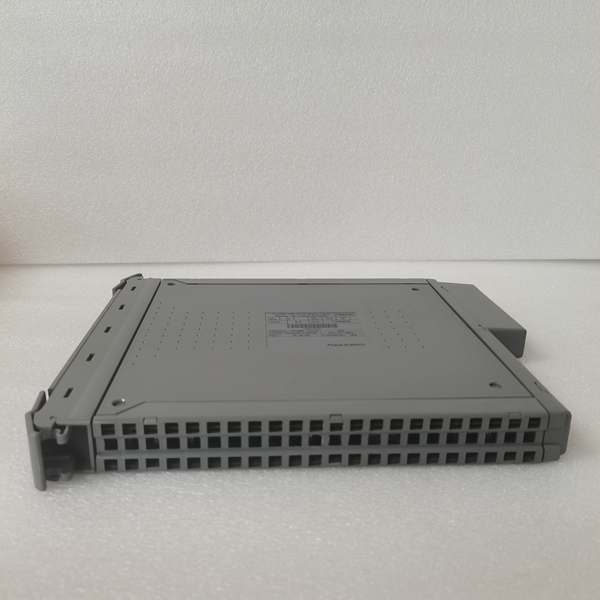
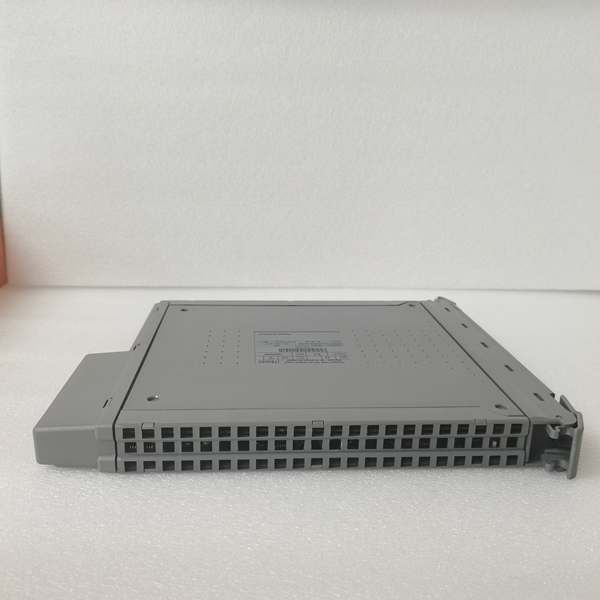
Description
System Architecture & Operational Principle
The ICS TRIPLEX T8403C is a core component of the ICS TRIPLEX Trusted 8000 Series safety instrumented system (SIS), deployed at Purdue Model Level 1 (Basic Control) or Level 2 (Supervisory Control) depending on the application. It acts as the primary interface between field-mounted digital devices (e.g., emergency stop buttons, fire detectors, pressure switches) and the Trusted safety controller (e.g., T8100, T9400).
Upstream/Downstream Interaction
-
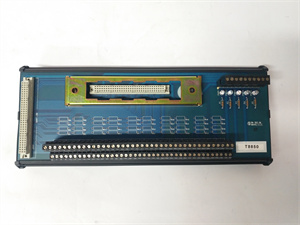
Upstream: Receives 24VDC digital signals from field devices (dry/wet contacts) via compatible terminal blocks (e.g., T8800 FTA).
-
Downstream: Transmits processed digital data to the Trusted controller via the Trusted I/O bus (a proprietary high-speed serial link). The controller uses this data to execute safety logic (e.g., emergency shutdown, interlock activation).
Key Architectural Advantages
The T8403C leverages Triple Modular Redundancy (TMR)—three independent input channels per signal—with a 2-out-of-3 voting mechanism. This ensures that a single channel failure (e.g., due to EMI, wiring issues) does not compromise system integrity. The Trusted I/O bus provides deterministic communication (≤1ms latency) and hot-swappable module replacement, minimizing downtime during maintenance.
Operational Principle
Each input channel uses a sigma-delta input circuit to measure field voltage, comparing it to user-configurable thresholds to determine signal state (ON/OFF). The module performs continuous self-tests (e.g., channel-to-channel comparison, power supply monitoring) and reports faults to the controller via the I/O bus. For critical applications, the Sequence of Events (SOE) feature captures signal changes with 1ms resolution, enabling precise root-cause analysis of safety incidents.

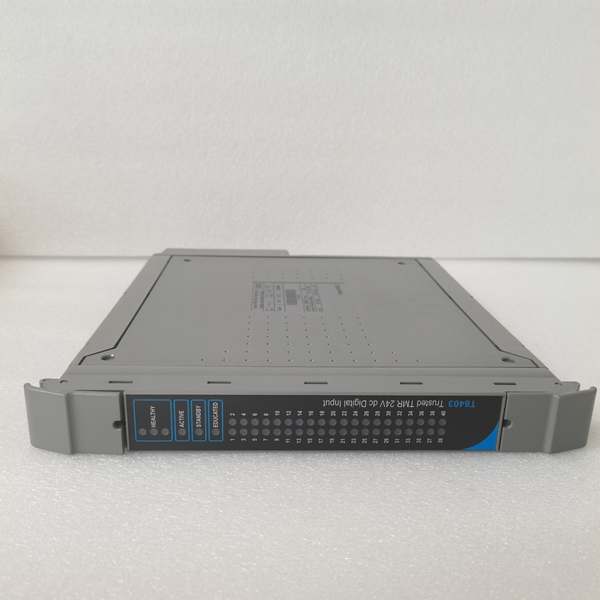
ICS TRIPLEX T8403C
Core Technical Specifications
-
Input Type: Discrete digital (dry contact/wet contact compatible)
-
Input Voltage Range: 24VDC nominal (18–30VDC operating)
-
Number of Channels: 32–40 (varies by configuration)
-
Channel Isolation: 2500V impulse-resistant optoelectronic isolation (channel-to-backplane)
-
Response Time: <5ms typical (configurable filtering for noise reduction)
-
Communication Bus: Trusted I/O bus (proprietary; supports hot-swap)
-
Power Consumption: ≤8W maximum (from backplane)
-
Operating Temperature: -40°C to +70°C (-40°F to +158°F)
-
Environmental Rating: IP20 (dust-protected; suitable for control cabinets)
-
Safety Certification: SIL 3 (IEC 61508), Class 1 Div 2, CE, UL/cUL
-
Dimensions: ~266mm (H) × 31mm (W) × 303mm (D) (10.5in × 1.2in × 12.0in)
-
Weight: ~1.18kg (2.6lb)
Customer Value & Operational Benefits
Uncompromised Safety with TMR Architecture
The T8403C’s triple modular redundancy ensures fault tolerance—even if one channel fails, the other two maintain signal integrity. This is critical for safety-critical applications like emergency shutdown (ESD) systems, where a single point of failure could lead to catastrophic consequences. For example, in an offshore refinery, the T8403C monitors pressure relief valves; if one channel detects a fault, the voting mechanism ignores it, preventing unnecessary shutdowns while alerting maintenance teams.
Reduced Downtime with Hot-Swap Design
The module supports online hot-swapping—technicians can replace a faulty T8403C without shutting down the entire I/O rack. This is a game-changer for continuous process industries (e.g., power generation, petrochemicals), where even a 1-hour outage can cost millions in lost production. The Trusted I/O bus automatically reroutes communication to the replacement module, minimizing disruption.
Simplified Maintenance with Advanced Diagnostics
The T8403C features comprehensive self-diagnostics (e.g., channel fault detection, power supply monitoring) and SOE reporting (1ms resolution). Maintenance teams can quickly identify faulty channels using the controller’s diagnostic interface, reducing mean time to repair (MTTR) from hours to minutes. For instance, if a fire detector’s signal is lost, the SOE log pinpoints the exact time and channel, eliminating guesswork during troubleshooting.
Scalability for Growing Systems
The T8403C’s modular design allows easy expansion—additional modules can be added to the I/O rack to accommodate more field devices. This scalability is ideal for industries like chemical processing, where production lines often expand to meet demand. The Trusted I/O bus supports up to 512 I/O points per rack, making the T8403C a future-proof solution.
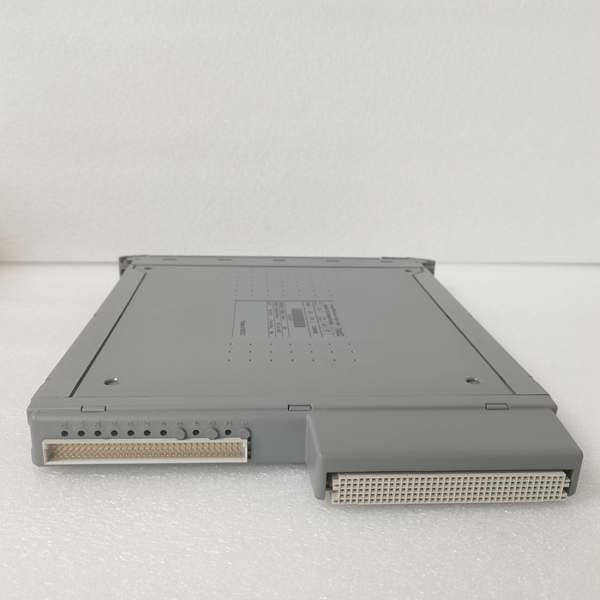
ICS TRIPLEX T8403C
Field Engineer’s Notes (From the Trenches)
When installing the T8403C, always verify the terminal block compatibility—the module uses a 5-pin screw terminal for field wiring, and mismatched blocks can cause intermittent connections. I once saw a technician use a generic terminal block with thinner wires, leading to signal dropouts during high-vibration operations. Stick to ICS TRIPLEX-approved blocks (e.g., T8800 FTA) for reliable performance.Ground the module properly—the T8403C requires a single-point ground (connected to the control cabinet’s ground bus) to avoid ground loops. I’ve encountered cases where multiple grounds caused EMI interference, resulting in false trip signals. Use a multimeter to check the ground resistance (should be ≤1Ω) before powering up the module.Test the SOE feature after installation—use a signal generator to simulate a digital input change and verify that the controller logs the event with 1ms resolution. This ensures that the SOE function is working correctly, which is critical for post-incident analysis.
Real-World Applications
Offshore Oil Platform Emergency Shutdown (ESD)
On an offshore oil platform, the T8403C monitors emergency stop buttons, fire and gas detectors, and pressure relief valves. The TMR architecture ensures that even if one channel fails (e.g., due to saltwater corrosion), the system continues to monitor critical signals. For example, if a fire detector’s signal is lost, the T8403C alerts the controller, which triggers the ESD sequence—shutting down pumps, closing valves, and activating fire suppression systems—within milliseconds.
Chemical Reactor Safety Interlock
In a chemical reactor, the T8403C monitors temperature switches, level sensors, and pressure transmitters. The module’s configurable filtering eliminates noise from nearby motors, ensuring accurate signal detection. If the reactor temperature exceeds the safe limit, the T8403C sends a signal to the controller, which closes the steam valve and opens the cooling water valve—preventing a runaway reaction. The SOE feature logs the exact time of the temperature spike, helping engineers identify the root cause (e.g., a faulty sensor or process deviation).
Power Plant Turbine Protection
In a gas-fired power plant, the T8403C monitors turbine vibration sensors, bearing temperature switches, and overspeed detectors. The TMR architecture ensures that the turbine is protected even if one channel fails. For example, if a vibration sensor’s signal is lost, the T8403C uses the other two channels to continue monitoring—preventing unnecessary turbine shutdowns while alerting maintenance teams to the faulty sensor.