Description
System Architecture & Operational Principle
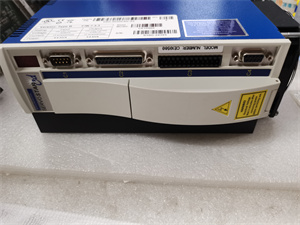
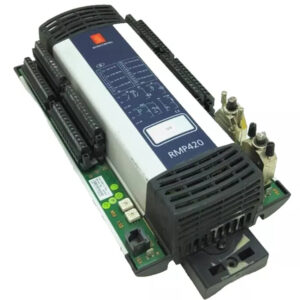
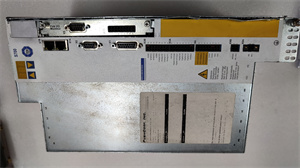
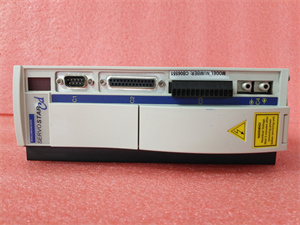
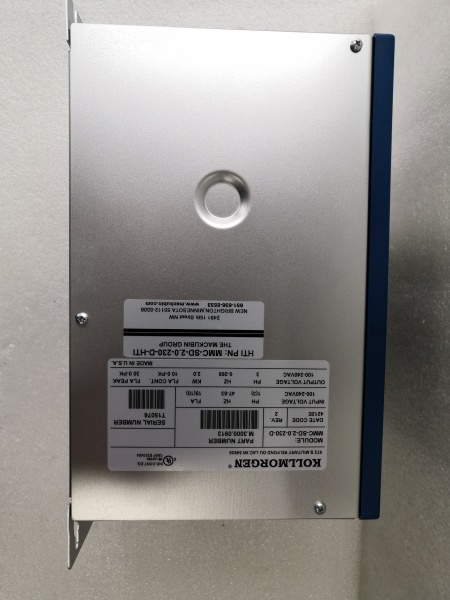
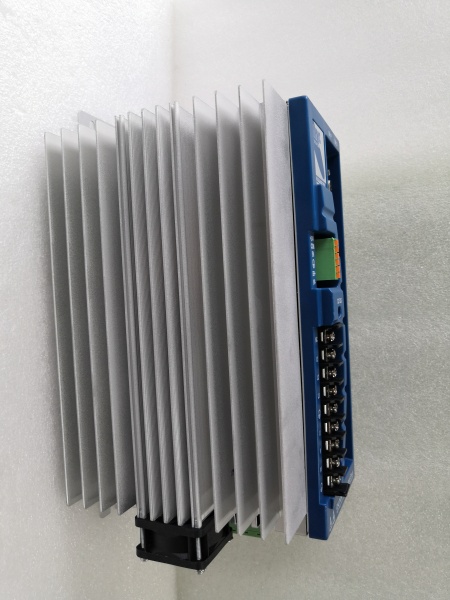
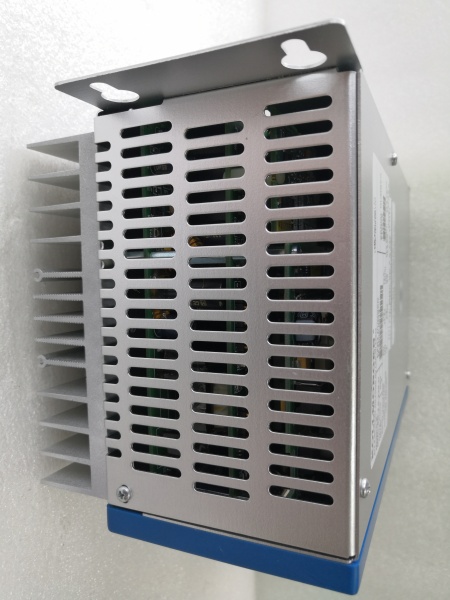
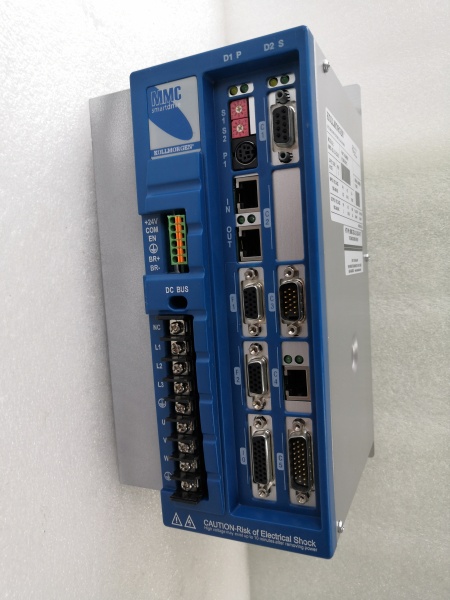
The KOLLMORGEN MMC-SD-2.0-230-D is a high-power servo drive from the MMC (Motion/Motor Control) series, designed for demanding industrial automation applications requiring robust performance and precise control. It acts as the central control unit in a servo system, bridging upstream operator interfaces (HMIs/SCADA) and downstream servo motors/actuators.
Core Functional Blocks
-
Power Conversion Stage: Converts 230V AC input to stabilized DC bus voltage (e.g., 320V DC) via high-efficiency rectifiers and active PFC (Power Factor Correction), minimizing harmonic distortion.
-
Control Circuitry: Employs a dual-core DSP (Digital Signal Processor) for real-time execution of advanced algorithms (e.g., Field-Oriented Control (FOC), PID tuning, S-curve acceleration/deceleration) to optimize torque, speed, and position accuracy.
-
Communication Interface: Supports multi-protocol integration: EtherCAT (real-time Ethernet), CANopen (industrial fieldbus), RS-485 (serial), and analog/digital I/O for legacy systems.
-
Protection Mechanisms: Integrated overcurrent, overvoltage, short-circuit, thermal overload, and feedback loss protection; includes a built-in brake chopper for regenerative energy dissipation.
Operational Workflow
-
Command Input: Receives motion commands (e.g., target position/speed) from HMIs, SCADA, or PLCs via fieldbuses or I/O.
-
Algorithm Execution: The DSP calculates optimal voltage/current outputs using FOC, adjusting for load variations and dynamic conditions (e.g., sudden stops).
-
Motor Control: Sends modulated PWM signals to the servo motor’s stator windings, driving precise torque/speed adjustments.
-
Feedback Loop: Processes real-time data from motor encoders/resolvers to correct deviations (closed-loop control), ensuring micrometer-level positioning.
-
Status Monitoring: Transmits operational data (e.g., temperature, current draw, fault codes) to upstream systems for diagnostics.

KOLLMORGEN MMC-SD-2.0-230-D
Core Technical Specifications
|
Parameter
|
Specification
|
|---|---|
|
Rated Power
|
2.0 kW (continuous)
|
|
Peak Power
|
6.0 kW (short-term, 3 sec)
|
|
Input Voltage
|
230V AC (±10%, 50/60 Hz); 115V AC optional
|
|
Output Current
|
8A continuous (24A peak)
|
|
DC Bus Voltage
|
320V DC (nominal)
|
|
Control Modes
|
Position/Speed/Torque (with S-curve profiling)
|
|
Communication
|
EtherCAT, CANopen, RS-485, Analog (±10V), Pulse/Direction
|
|
Protection Level
|
IP20 (dust-protected, indoor use)
|
|
Operating Temperature
|
-20°C to +60°C (ambient); derate above 40°C
|
|
Cooling Method
|
Natural convection (fanless design for quiet operation)
|
|
Dimensions
|
180mm × 250mm × 80mm (approx.)
|
|
Weight
|
~3.2 kg (7.1 lbs)
|
|
Certifications
|
CE, UL, cUL, RoHS
|
Customer Value & Operational Benefits
1. High Power Density for Medium-Heavy Loads
The MMC-SD-2.0-230-D delivers 2.0 kW continuous power in a compact footprint, ideal for medium-heavy automation (e.g., robotic arms lifting 20–50 kg, CNC spindles cutting hard metals). Its fanless design reduces maintenance needs in dusty environments.
2. Precision Motion Control for Quality Assurance
Advanced FOC algorithms and 16-bit encoder feedback enable ±0.05 mm positioning accuracy, critical for applications like automotive welding (consistent seam placement) or medical device assembly (implant component alignment).
3. Seamless Integration with Mixed-Vendor Systems
Multi-protocol support (EtherCAT/CANopen/RS-485) allows integration with third-party PLCs (e.g., Siemens S7, Allen-Bradley) and legacy sensors, avoiding costly system replacements. Hot-swappable I/O modules minimize downtime during upgrades.
4. Energy Efficiency & Regenerative Braking
Active PFC and regenerative braking (via brake chopper) reduce energy consumption by 15–25% compared to traditional drives. In applications like crane hoisting, regenerated energy lowers utility costs.
KOLLMORGEN MMC-SD-2.0-230-D
Field Engineer’s Notes (From the Trenches)
When installing the MMC-SD-2.0-230-D, verify input voltage with a True-RMS multimeter—non-sinusoidal waveforms (e.g., from generators) can damage the rectifier. I once saw a site use a 240V supply without correction, leading to blown capacitors.Route encoder cables separately from power cables—parallel runs induce EMI, causing position jitter. Use shielded twisted-pair (STP) cables with 360° grounding.Enable regenerative braking in the drive software for vertical axis applications (e.g., elevators, cranes) to prevent overvoltage faults during descent.Update firmware annually—Kollmorgen’s MOTIONLINK software provides bug fixes and enhanced motor compatibility (e.g., new AKM series motors).
Real-World Applications
1. Industrial Robotics: Automotive Welding Arms
A Tier-1 auto supplier uses the MMC-SD-2.0-230-D to control a 6-axis welding robot. The drive’s EtherCAT sync ensures all axes move in unison, achieving ±0.1 mm weld seam accuracy. Energy savings from regenerative braking cut annual electricity costs by $8,000.
2. Machine Tools: CNC Lathe Spindles
A job shop powers a CNC lathe spindle with the drive, leveraging its 24A peak current for rapid acceleration (0–3000 rpm in 0.5 sec). S-curve profiling reduces spindle bearing wear by 30%, extending tool life.
3. Material Handling: Automated Guided Vehicles (AGVs)
An e-commerce warehouse uses the drive in AGV wheel motors. The IP20 rating and wide temp range (-20°C to +60°C) suit cold storage areas, while CANopen communication enables real-time navigation updates.