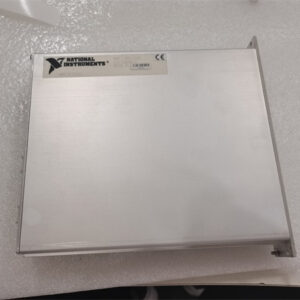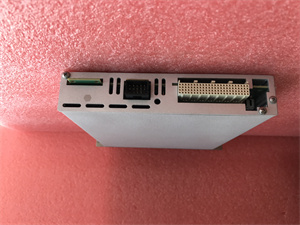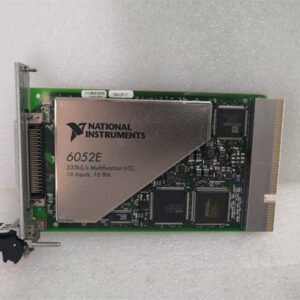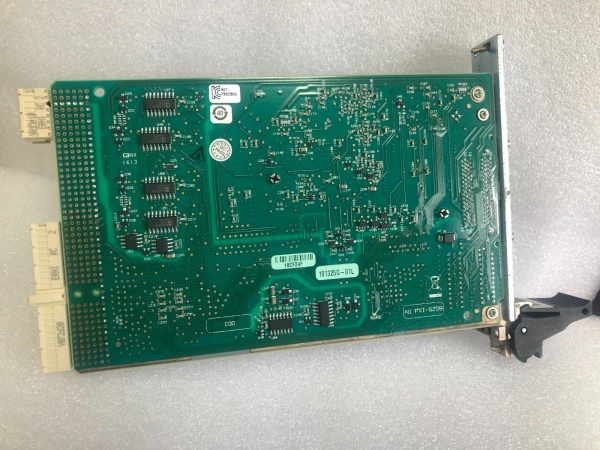
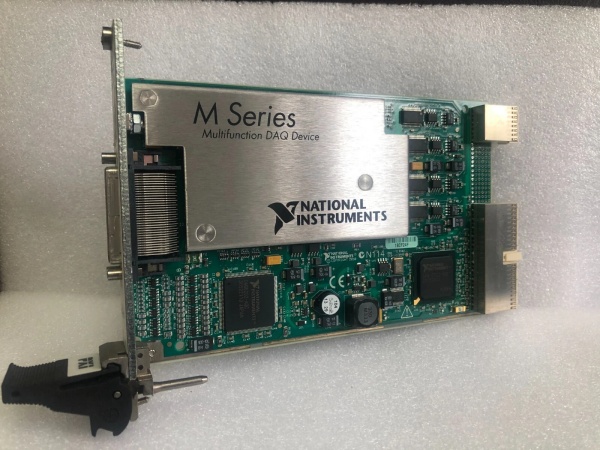
NI PXI-5670 | PXI RF Vector Signal Generator

  • Brand:​ National Instruments

  • Model:​ PXI-5670

  • Product Type:​ PXI RF Vector Signal Generator

  • Series:​ PXI

  • Core Function:​ Generates high-fidelity RF signals for test and measurement applications with wide bandwidth and modulation capabilities.

  • Key Specs:​ 250 kHz to 2.7 GHz frequency range, 100 MHz instantaneous bandwidth, 16-bit resolution.
Manufacturer:
Part number: NI PXI-5670
Our extensive catalogue, including : NI PXI-5670 , is available now for dispatch to the worldwide.

Description

PXI-5670: Product Overview
The National Instruments PXI-5670 is a high-performance RF vector signal generator designed for PXI-based test systems requiring sophisticated signal generation capabilities. This module functions as a programmable RF source capable of producing complex modulated signals for testing wireless communication systems, radar systems, and other RF components. The device covers a frequency range from 250 kHz to 2.7 GHz with an instantaneous bandwidth of 100 MHz, supporting a wide variety of communication standards and custom waveform requirements.
Installed in a PXI chassis, the module operates as a complete signal generation solution, incorporating a vector signal generator, RF local oscillator, and upconversion stages. The architecture supports both standard communication waveforms (such as WLAN, WiMAX, and LTE) and user-defined arbitrary waveforms. The module is designed for integration into automated test systems for research and development, production test, and system validation applications where signal fidelity and flexibility are critical requirements.

NI PXI-5670

NI PXI-5670

PXI-5670: Technical Specifications

  • Model Number:​ PXI-5670

  • Manufacturer:​ National Instruments

  • Product Type:​ PXI RF Vector Signal Generator

  • Frequency Range:​ 250 kHz to 2.7 GHz

  • Instantaneous Bandwidth:​ 100 MHz

  • Output Power Range:​ -140 dBm to +15 dBm

  • Resolution:​ 16 bits

  • Sample Rate:​ 100 MS/s

  • Spurious Emissions:​ < -55 dBc (typical)

  • Phase Noise:​ -110 dBc/Hz at 100 kHz offset (1 GHz carrier)

  • Modulation Formats:​ QPSK, QAM, OFDM, and custom modulations

  • Waveform Memory:​ 512 MB standard

  • I/Q Impairments:​ Programmable I/Q offset, gain, and phase imbalance

  • Interface:​ PXI trigger lines for synchronization

  • Operating Temperature:​ 0°C to 55°C

  • Relative Humidity:​ 10% to 90% non-condensing

    NI PXI-5670
    NI PXI-5670

Core Features & Customer Value
The primary value of the PXI-5670 lies in its combination of wide bandwidth and high signal quality. The 100 MHz instantaneous bandwidth enables generation of complex wideband signals for testing modern communication systems, radar systems, and electronic warfare applications. The 16-bit resolution provides excellent dynamic range and signal fidelity, ensuring that generated signals accurately represent real-world conditions without introducing unnecessary artifacts or distortion.
The module’s software-defined architecture​ allows for flexible signal generation across multiple standards and custom waveforms. This programmability enables test engineers to adapt the instrument to evolving requirements without hardware changes, reducing system lifecycle costs. The comprehensive modulation capabilities​ support both standard communication protocols and specialized modulation schemes, making the module suitable for both commercial wireless testing and specialized defense applications.
Integration with the PXI platform​ provides synchronization capabilities with other instruments in the chassis, enabling multi-instrument test systems for complex RF characterization. The module can be synchronized with signal analyzers, digitizers, and other instruments to create complete transmitter test systems or hardware-in-the-loop simulation environments.
Typical Applications
In wireless communication testing, the module generates standard-compliant signals for receiver testing of devices implementing WLAN, WiMAX, LTE, and other communication standards, including multi-carrier and MIMO signals.
In radar system testing, the instrument creates pulsed RF signals with precise timing and modulation characteristics for evaluating radar receiver performance and signal processing algorithms.
For satellite communication systems, the module generates modulated carriers with specific phase noise characteristics and modulation formats for testing transponders and ground station equipment.