Description
System Architecture & Operational Principle
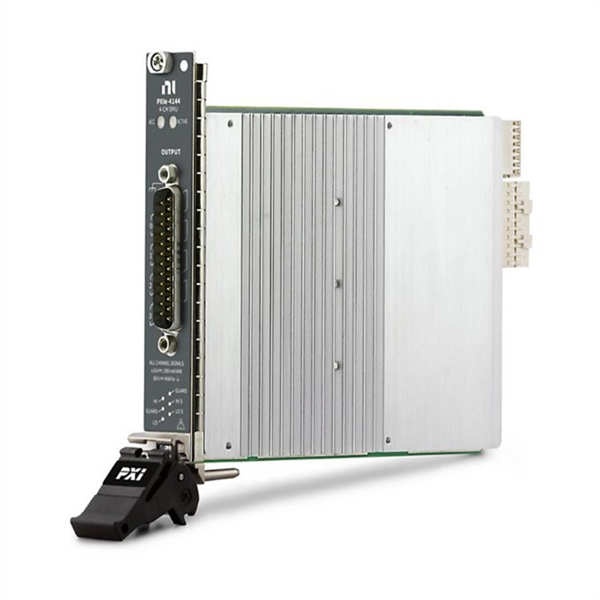
The NI PXIe-4145 is a 4-channel precision Source Measure Unit (SMU) designed for high-performance test and measurement applications. It integrates four independent SMU channels in a single 3U PXIe module, each capable of sourcing and measuring voltage and current with high accuracy. The module connects to a PXIe chassis via a x4 Gen 2 PCIe interface, enabling high-speed communication with the host computer and other PXIe devices.
Core Functional Blocks
-
SMU Channels: Each channel includes a precision voltage/current source, a high-resolution ADC/DAC, and a 4-wire remote sensing circuit. The 4-wire sensing compensates for lead resistance, ensuring accurate measurements even with long cables.
-
SourceAdapt Technology: Adjusts the SMU’s transient response to match the load, minimizing overshoot and settling time. This is critical for testing devices with fast transient behavior (e.g., GaN/SiC semiconductors).
-
High-Speed Sequencer: Allows programming of complex sequences (e.g., voltage sweeps, current ramps) with microsecond-level timing, enabling automated testing of multiple devices in sequence.
-
PXIe Interface: Provides a x4 Gen 2 PCIe connection to the PXIe chassis, supporting data transfer rates up to 4 GB/s. The interface also enables synchronization with other PXIe devices (e.g., oscilloscopes, switches) via PXI trigger lines.
Operational Workflow
-
Configuration: The user configures the SMU channels (voltage/current range, compliance limits) using NI-DCPower software or a programming language (e.g., LabVIEW, Python).
-
Sourcing: The SMU outputs a precise voltage or current to the device under test (DUT). For example, in battery testing, the SMU simulates a charging current while measuring the battery’s voltage.
-
Measurement: The SMU measures the voltage and current from the DUT using the high-resolution ADC. The 4-wire sensing ensures that the measurement is not affected by lead resistance.
-
Data Transfer: The measured data is transferred to the host computer via the PXIe interface, where it is analyzed or stored.
Core Technical Specifications
|
Parameter
|
Specification
|
|---|---|
|
Channels
|
4 independent, isolated channels
|
|
Voltage Range
|
±6 V (programmable)
|
|
Current Range
|
±500 mA (max); down to ±10 μA (with auto-ranging)
|
|
Power per Channel
|
7 W maximum (sinking power derated above 45°C)
|
|
Measurement Resolution
|
Voltage: 100 μV; Current: 1 μA (at low ranges)
|
|
Sampling Rate
|
Up to 200 kS/s (with onboard digitizer)
|
|
Accuracy (Typical)
|
Voltage: 0.03% + 1 mV; Current: 0.05% + 10 μA
|
|
SourceAdapt
|
Adjustable transient response (settling time <100 μs to 0.1%)
|
|
Remote Sensing
|
4-wire (HI/LO sense) for each channel
|
|
Communication
|
PXIe x4 Gen 2 (compatible with PXIe-1085 chassis)
|
|
Operating Temperature
|
0°C to +55°C (ambient)
|
|
Power Requirements
|
2.1 A from 12 V rail; 2.9 A from 3.3 V rail (PXIe chassis)
|
Customer Value & Operational Benefits
1. Precise & Reliable Measurements
The PXIe-4145’s high accuracy (0.03% voltage, 0.05% current) and 4-wire remote sensing ensure that measurements are not affected by lead resistance or noise. This is critical for applications like semiconductor testing, where small variations in voltage/current can affect device performance.
2. Fast Transient Response with SourceAdapt
SourceAdapt technology minimizes overshoot and settling time, allowing the SMU to respond quickly to changes in load. This is essential for testing devices with fast transient behavior (e.g., GaN transistors), where slow settling times can lead to inaccurate results.
3. High Throughput with Multi-Channel Design
The 4 independent channels enable testing of multiple devices simultaneously, increasing throughput in production environments. For example, in battery testing, the PXIe-4145 can test 4 batteries at once, reducing test time by 50%.
4. Flexible Integration with PXIe Systems
The PXIe interface allows seamless integration with other PXIe devices (e.g., oscilloscopes, switches), enabling complex test setups. The module’s synchronization capabilities (via PXI trigger lines) ensure that all devices operate in tandem, improving test accuracy.
Field Engineer’s Notes (From the Trenches)
When installing the PXIe-4145, always verify the PXIe chassis power supply—the module requires 2.1 A from the 12 V rail and 2.9 A from the 3.3 V rail. I once saw a technician install the module in a chassis with insufficient power, leading to intermittent resets. Use a multimeter to measure the rail voltages before installation.Check the PXIe link status (via NI MAX) after installation—if the link is down, re-seat the module and check the chassis fan speed (set to “HIGH” for adequate cooling). I’ve spent hours troubleshooting “no comms” faults only to find the fan was set to “LOW,” causing the module to overheat and shut down.Perform a self-calibration (via NI MAX) after installation—this corrects for variations in the module’s environment (e.g., temperature, humidity) and ensures accurate measurements. I recommend doing this at least once a month, especially in environments with large temperature swings.
Real-World Applications
1. Semiconductor Testing (GaN/SiC Devices)
A semiconductor manufacturer uses the PXIe-4145 to test GaN transistors for electric vehicles. The SMU’s fast transient response (SourceAdapt) and high accuracy allow engineers to characterize the transistors’ switching behavior (e.g., turn-on/turn-off times) with high precision. The 4-channel design enables testing of multiple transistors simultaneously, increasing throughput by 30%.
2. Battery Management System (BMS) Testing
An EV battery manufacturer uses the PXIe-4145 to test BMS modules. The SMU simulates a charging current (e.g., 10 A) while measuring the battery’s voltage and temperature. The 4-wire remote sensing ensures that the measurement is accurate, even with long cables connecting the SMU to the battery. The high sampling rate (200 kS/s) allows engineers to capture transient behavior (e.g., inrush current) during charging.