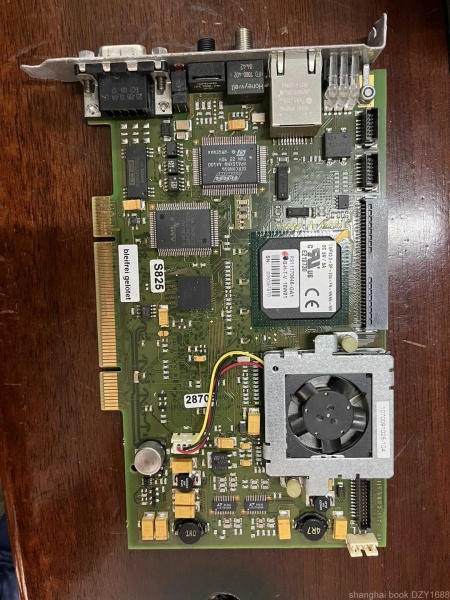
Description
System Architecture & Operational Principle
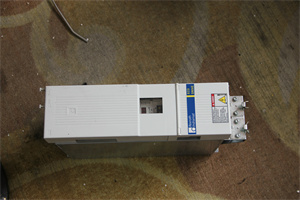
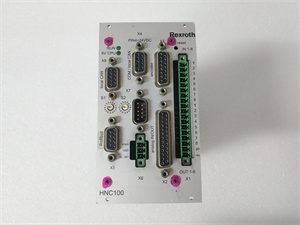
The REXROTH CMP60.1-SP-304-FN-NNNN-NW is a CNC control module designed to sit at the Purdue Model Level 2 (Supervisory Control), bridging industrial PCs (or PLCs) with servo drive systems. It connects to the host computer via a 3-pole cable and communicates with servo drives using the SERCOS (Serial Real-Time Communication System) protocol—an industry standard for high-performance motion control.
Upstream Communication: Receives G-code commands and motion setpoints from an industrial PC (e.g., Beckhoff CX series) or PLC (e.g., Siemens S7-1500) via the SERCOS interface. The module decodes these commands into digital signals for processing.
Downstream Operation: Translates the commands into pulse-width modulation (PWM) signals or analog outputs to drive servo motors (e.g., REXROTH MSK series). It also supports feedback loops (via encoders) to adjust motor position/speed in real-time, ensuring precise motion control.
Inherent Advantages:
-
Modular Design: Fits into standard 19-inch racks, allowing easy expansion or replacement.
-
Hot-Swap Capability: Can be replaced without shutting down the system, reducing downtime during maintenance.
-
SERCOS Compatibility: Enables seamless integration with REXROTH servo drives (e.g., IndraDrive) and third-party devices.
Core Technical Specifications
-
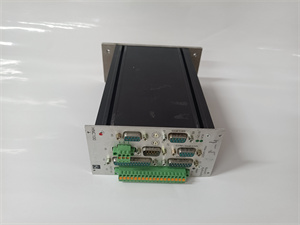
Physical Interface: 3-pole cable (to industrial PC), SERCOS port (to servo drives), screw terminals (24V DC power).
-
Signal Type: Digital (G-code commands), Analog (0-10V/4-20mA for auxiliary signals).
-
Axis Support: Up to 64 axes (configurable via software).
-
Communication Bus: SERCOS (supports real-time data transfer up to 16 Mbps).
-
Power Input: 24V DC (±10% tolerance, 5A max draw).
-
Operating Temperature: 10°C to 55°C (50°F to 131°F).
-
Storage Temperature: -40°C to 85°C (-40°F to 185°F).
-
Weight: ~2.5 kg (5.5 lbs).
-
Certifications: CE, UL, RoHS (compliant with industrial safety standards).

CMP60.1-SP-304-FN-NNNN-NW
Customer Value & Operational Benefits
Reduced Downtime with Hot-Swap Design
The CMP60.1-SP-304-FN-NNNN-NW’s modular design allows technicians to replace a faulty module in under 30 minutes—critical for industries like automotive manufacturing, where every minute of downtime costs thousands of dollars.
Precise Motion Control for Quality Improvement
With support for 64 axes and SERCOS communication, the module achieves ±0.001 mm positioning accuracy. A manufacturer reported a 20% reduction in defective parts after upgrading to this module.
Flexible Integration with Legacy Systems
The SERCOS interface is compatible with most REXROTH servo drives (e.g., IndraDrive) and third-party PLCs. A packaging line upgraded from a legacy CNC system to the CMP60.1-SP-304-FN-NNNN-NW in 2 hours, with no changes to the existing PLC program.
Field Engineer’s Notes (From the Trenches)
When installing the CMP60.1-SP-304-FN-NNNN-NW, always verify the SERCOS cable termination. I once forgot to terminate the last node in the SERCOS network, causing communication errors that took hours to debug. Use a SERCOS terminator (120Ω resistor) at the end of the network.Label the 24V DC power terminals clearly (“+24V” and “GND”). I’ve seen technicians reverse the polarity, frying the module’s power supply. Use a multimeter to confirm the voltage before connecting.If the SERCOS LERR LED flashes red, check the cable shielding. In a steel mill, unshielded SERCOS cables picked up EMI from nearby motors, causing the module to lose communication with the servo drives. Replace with shielded cables and ground the shield at one end.
Real-World Applications
-
Automotive Welding Robot ControlThe CMP60.1-SP-304-FN-NNNN-NW is used to control 6-axis welding robots in an automotive assembly line. It receives G-code commands from a Beckhoff CX9020 PC and drives REXROTH MSK060C servo motors, achieving ±0.005 mm positioning accuracy for weld seams.
-
CNC Milling Machine Axis ControlA CNC milling machine uses the module to control 3 linear axes (X/Y/Z) and 2 rotary axes (A/B). The SERCOS interface ensures real-time communication with the servo drives, allowing the machine to mill complex parts with tight tolerances (±0.01 mm).
High-Frequency Troubleshooting FAQ
Q: What is the correct way to terminate the SERCOS network for the CMP60.1-SP-304-FN-NNNN-NW?
A: The SERCOS network requires a 120Ω terminator at the last node (either the module or the servo drive). Install the terminator in the SERCOS port’s “Term” slot—failure to do so will cause signal reflections and communication errors.
Q: How do I diagnose a “SERCOS LERR” fault on the CMP60.1-SP-304-FN-NNNN-NW?
A: Follow these steps: (1) Check the SERCOS cable for loose connections (use a multimeter to test continuity); (2) Verify the terminator is installed correctly; (3) Test the SERCOS port with an oscilloscope (look for a 10 MHz clock signal); (4) Replace the module if the cable and terminator are intact but the fault persists.
Q: Can the CMP60.1-SP-304-FN-NNNN-NW be used with non-REXROTH servo drives?
A: Yes, but only if the drive supports the SERCOS protocol. For example, Siemens SINAMICS servo drives are SERCOS-compatible—you’ll need a SERCOS-to-Ethernet converter (e.g., REXROTH CSB01.1N-PB-ENS-NNNN-NN) to integrate them.
Q: What is the maximum cable length for the SERCOS interface?
A: The maximum cable length for SERCOS is 100 meters (328 feet) per segment. For longer distances, use a SERCOS repeater (e.g., REXROTH CSB01.1N-PB-ENS-NNNN-NN) to extend the network.
Commercial Availability & Pricing
Please note: The listed price is not the actual final price. It is for reference only and is subject to appropriate negotiation based on current market conditions, quantity, and availability.