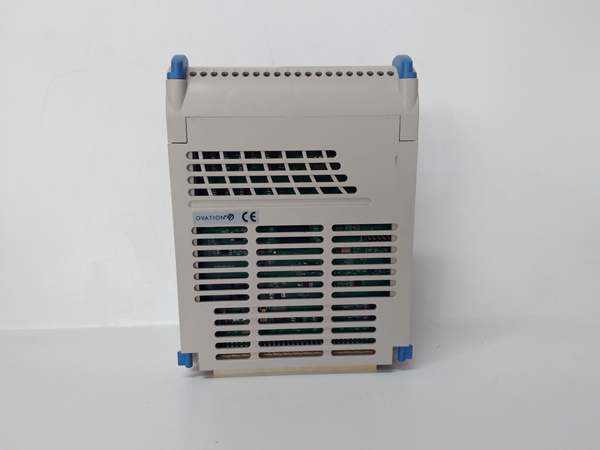
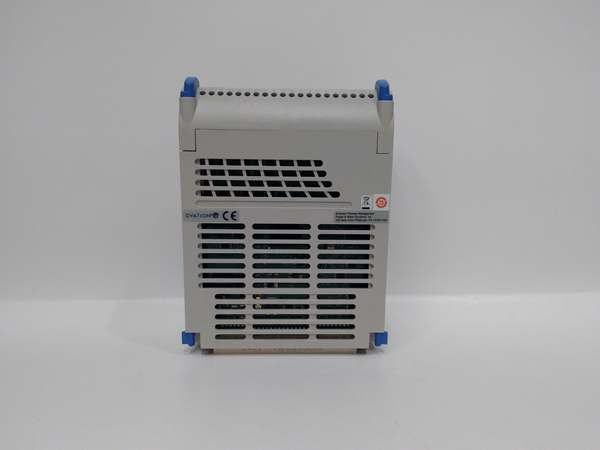
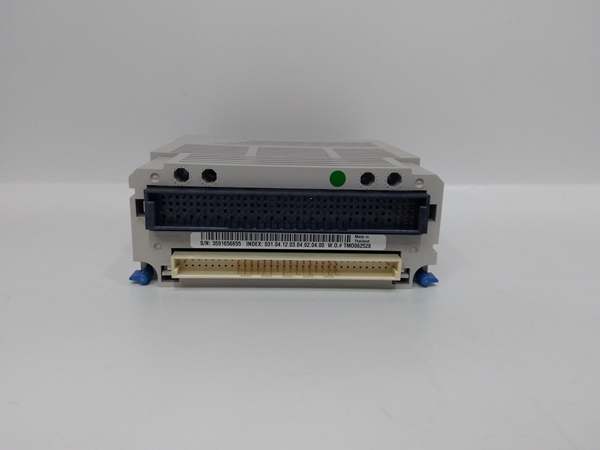
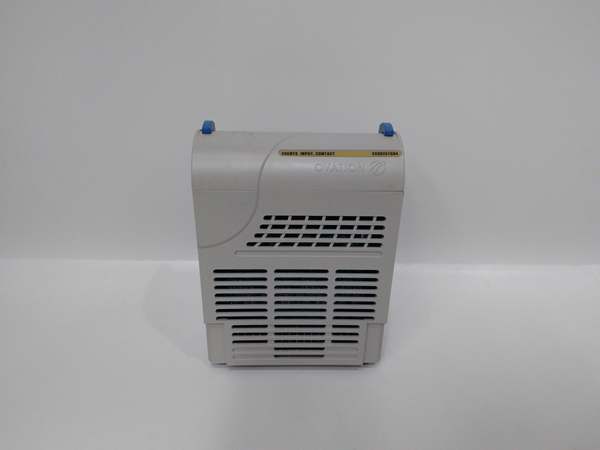
Description
Key Technical Specifications
-
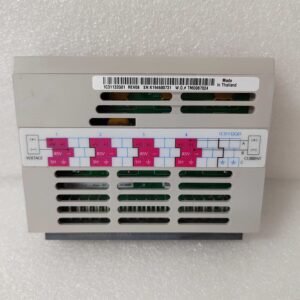
Model Number: 5X00357G04
-
Manufacturer: Emerson (formerly Westinghouse)
-
Number of Channels: 16 independent optically isolated event input channels
-
Input Voltage: 48V DC (nominal)
-
Input Signal Type: Digital (dry contact, NO/NC configurable)
-
Input Current: 5mA per channel (typical)
-
Isolation: Optical isolation (channel-to-channel and channel-to-backplane) for noise immunity
-
Time Resolution: Millisecond-level time-stamping (critical for SOE accuracy)
-
Response Time: ≤10ms (On/Off transitions, typical)
-
Operating Temperature: –40°C to +70°C (IEC 60068-2 compliant)
-
Storage Temperature: –40°C to +85°C
-
Humidity Range: 0–95% RH (non-condensing)
-
Dimensions: ~121mm × 52mm × 165mm (single-slot Ovation chassis)
-
Weight: ~0.32kg (0.71 lbs)
-
Certifications: CE, RoHS, UL 508 (industrial safety)

WESTINGHOUSE 5X00357G04
Field Application & Problem Solved
In industrial automation—from power plants to chemical refineries—critical event monitoring is essential for fault detection, safety interlocks, and process optimization. The biggest challenge with legacy event input modules is finding a solution that balances high-speed time-stamping (for accurate Sequence of Events (SOE) recording) with reliable signal integrity (to withstand harsh environments). Solid-state modules often fall short: they lack sufficient isolation, leading to noise-induced false triggers, or they cannot capture events with the precision required for root cause analysis.
The 5X00357G04 solves this by providing 16 optically isolated event input channels with millisecond-level time-stamping. You’ll find it in:
-
Power generation: Monitoring circuit breaker trips, turbine shutdown signals, and generator fault conditions (e.g., over-speed, over-temperature).
-
Chemical/petrochemical: Detecting emergency stop button presses, pressure switch activations, and valve position changes (e.g., in distillation columns).
-
Manufacturing: Reading limit switch statuses, machine guard positions, and robotic safety fence inputs (e.g., in automotive assembly lines).
Its core value is precision and reliability in mission-critical applications. The optical isolation prevents cross-talk and surge damage, ensuring stable operation in high-EMI environments like power plants. The millisecond-level time-stamping allows engineers to reconstruct event sequences with accuracy, which is essential for diagnosing faults (e.g., identifying the root cause of a turbine trip).
Installation & Maintenance Pitfalls (Expert Tips)
1. Ignoring Optical Isolation Requirements
A common rookie mistake is assuming all event input modules have adequate isolation. The 5X00357G04’s optical isolation is critical for preventing noise from nearby devices (e.g., motors, relays) from corrupting event signals. Always verify isolation with a megger (insulation tester) before installation—we once had a client skip this step, and a surge from a nearby motor damaged the module’s input channels, causing a 4-hour downtime in a power plant.
2. Incorrect Wiring of Dry Contacts
Dry contacts (passive devices like switches) require proper wiring to avoid floating inputs. Always connect the contact’s common terminal to the module’s COM pin and the NO (normally open) or NC (normally closed) terminal to the input channel. Floating inputs can cause false triggers—we fixed a recurring alarm in a paper mill by properly wiring dry contacts.
3. Overlooking Time-Stamping Configuration
The 5X00357G04’s time-stamping is millisecond-level, but you must configure the module to capture events with the correct timestamp format (e.g., UTC vs. local time). Incorrect configuration can lead to inaccurate event logs—we once had a client misconfigure the timestamp, which made it impossible to correlate events with other system data.
4. Forgetting Hot-Swap Procedure
The 5X00357G04 supports hot-swapping, but you must follow the correct procedure:
-
Remove the module from the chassis.
-
Wait 5 seconds (to allow the backplane to discharge).
-
Insert the new module.If you skip the 5-second wait, you risk damaging the backplane’s connector pins. We had a junior engineer yank a module out mid-operation—this fried the backplane connector, requiring a $500 repair and 8 hours of downtime.
WESTINGHOUSE 5X00357G04
Technical Deep Dive & Overview
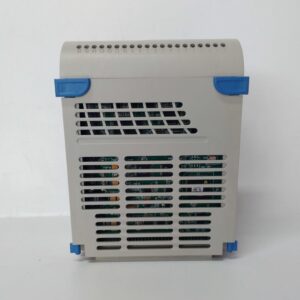
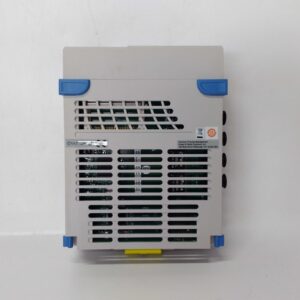
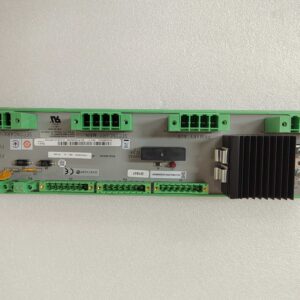
The 5X00357G04 is a 16-channel events input contact module designed exclusively for Emerson’s Ovation Distributed Control System (DCS). It acts as a bridge between the DCS’s backplane (which carries power and data) and the field devices (which provide event signals). Here’s how it works:
-
Signal Reception: The module receives 48V DC signals from field devices (e.g., switches, relays) via dry contacts.
-
Optical Isolation: Each channel uses an optocoupler to isolate the field wiring from the DCS backplane, preventing surge damage and cross-talk.
-
Signal Conditioning: The module’s internal circuitry filters out noise and converts the analog signal to a digital value.
-
Time-Stamping: A built-in real-time clock (RTC) assigns a millisecond-level timestamp to each event (e.g., a switch activation).
-
Digital Conversion: The module converts the conditioned signal to a digital bit (0 or 1) and sends it to the Ovation controller via the backplane, along with the timestamp.
-
Status Indication: Front-panel LEDs provide real-time feedback for each channel (ON/OFF), aiding in troubleshooting.
What sets the 5X00357G04 apart is its integration with Ovation DCS. The module works seamlessly with Ovation’s SOE software, which allows engineers to view event sequences in chronological order. This is critical for diagnosing faults—for example, if a turbine trips, the SOE log can show exactly when the circuit breaker opened, when the turbine shutdown signal was sent, and when the generator fault was detected.
Another key feature is hot-swapping. The module can be replaced without shutting down the system, which is critical for 24/7 operations like power plants. The built-in diagnostics (e.g., wire break detection, overcurrent protection) also help identify issues before they cause process upsets.
Final Notes
The 5X00357G04 is a workhorse module for critical event monitoring in industrial automation. Its combination of 16 optically isolated channels, millisecond-level time-stamping, and Ovation DCS integration makes it ideal for mission-critical applications where reliability is non-negotiable. Whether you’re upgrading a legacy system or building a new one, this module will handle the tough jobs—just remember to follow the installation tips to avoid common pitfalls.