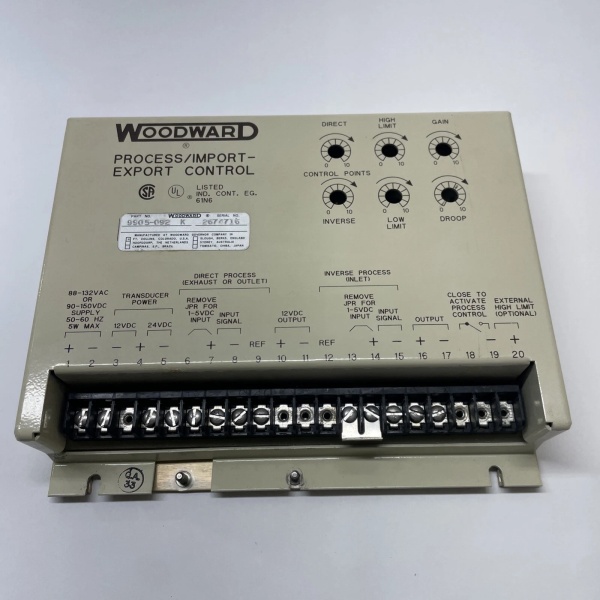
Description
1326-183: Product Overview
The Woodward 1326-183 is a load sharing module designed for engine-driven generator sets in industrial and power generation applications. It serves as a critical component in parallel power systems, enabling precise load distribution across multiple generators to ensure stable power output, optimize fuel efficiency, and comply with grid requirements. As part of Woodward’s 1326 series, the 1326-183 is engineered to work seamlessly with Woodward’s ecosystem of synchronizers (e.g., SPM-A), governors, and automatic voltage regulators (AVRs), providing a unified solution for generator control.
The 1326-183’s primary function is to orchestrate load sharing between generators by adjusting their output based on real-time load demand. It supports two key control modes:
-
Isochronous Mode: Maintains constant generator speed (±0.1% tolerance) for standalone operation, ensuring frequency stability in isolated grids.
-
Droop Mode: Adjusts generator speed based on load (adjustable droop percentage, 0–10%), allowing multiple generators to share load evenly in parallel with the utility grid or other generators.
The module’s design emphasizes reliability and flexibility, with features tailored to harsh industrial environments (e.g., extended temperature range, salt fog resistance). It is widely used in applications where generator sets must operate in parallel, such as power plants, marine propulsion systems, and industrial cogeneration facilities.

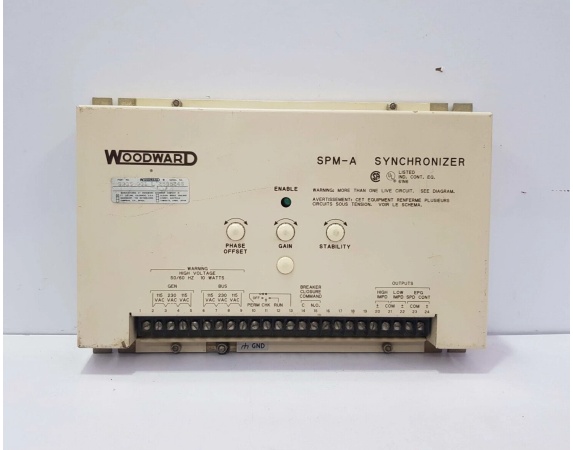
Woodward 9905-001-L
1326-183: Technical Specifications
-
Model Number: 1326-183
-
Manufacturer: Woodward (USA)
-
Product Type: Load Sharing Module
-
Power Supply: 18–32 VDC (nominal 24 VDC) or 95–260 VAC (jumper-selectable, 50–400 Hz)
-
Inputs:
-
3-phase PT Inputs: 95–130 VAC or 190–260 VAC line-to-line (50–400 Hz), 1.6 W/phase burden at 240 VAC.
-
3-phase CT Inputs: 3–7 Arms at full load, 0.1 VA/phase burden.
-
Load Sharing Input: 0–3 VDC into 25 kΩ impedance (isochronous mode), open circuit (droop mode).
-
-
Outputs:
-
Load Signal: DC signal proportional to total real current (used to adjust load gain).
-
Output to Speed Control: 0.5–4.5 VDC analog, 3 VDC analog, or PWM (depends on model).
-
-
Control Modes: Isochronous (constant speed), Droop (load-dependent speed).
-
Adjustments:
-
Droop: Adjustable from 0–10% (output reduction between no-load and full-load).
-
Load Gain: Adjusts specified full load condition from 3–7 Arms.
-
-
Environmental Ratings:
-
Operating Temperature: -40°C to +70°C (-40°F to +158°F).
-
Humidity: 95% RH (non-condensing) at 65°C.
-
Vibration: 4 G (5–2000 Hz, 3 hr/min/axis).
-
Salt Fog: Tested at 5% NaCl (35°C, 47 hrs wet/dry).
-
-
Dimensions: ~280 mm × 210 mm × 90 mm (11 in × 8.3 in × 3.5 in).
-
Weight: ~4.0 kg (8.8 lbs).
-
Certifications: CE, UL, cUL.
Core Features & Customer Value
The 1326-183’s design focuses on precision, flexibility, and ruggedness, delivering tangible benefits to engineers and operators:
-
Dual Control Modes (Isochronous/Droop):
-
Isochronous Mode: Ideal for standalone generator sets (e.g., remote power plants), where maintaining constant frequency (50/60 Hz) is critical. The module uses a phase-locked loop (PLL) to lock onto the grid frequency and adjust the generator’s speed accordingly.
-
Droop Mode: Enables parallel operation with other generators or the utility grid. The module adjusts the generator’s speed based on load, ensuring even load distribution (±1% accuracy) and preventing overloading.
-
Customer Value: Reduces the need for multiple controllers (one for each mode), simplifying system design and lowering costs.
-
-
Flexible Input/Output (I/O) Options:
-
The module accepts 3-phase PT/CT inputs, making it compatible with most generator sets. It also supports multiple output types (analog/PWM), allowing integration with various speed controls (e.g., Woodward 2301 series governors).
-
Customer Value: Eliminates the need for signal converters, reducing installation time and potential points of failure.
-
-
Rugged Environmental Design:
-
The 1326-183 is built to withstand harsh industrial environments, with an extended temperature range (-40°C to +70°C) and salt fog resistance. It is also vibration-tested to ensure reliable operation in mobile or marine applications.
-
Customer Value: Minimizes downtime and maintenance costs, especially in remote or offshore sites where repairs are costly.
-
-
Integration with Woodward Ecosystem:
-
The module works seamlessly with Woodward’s synchronizers (e.g., SPM-A) and governors, providing a complete solution for generator control. It can also be networked with up to 8 modules for unmanned generator sets.
-
Customer Value: Simplifies system integration and ensures compatibility with existing Woodward equipment.

Woodward 9905-092K
-
Typical Applications
The 1326-183 is designed for industrial and power generation applications where generator sets must operate in parallel. Typical use cases include:
-
Power Plants:
-
In coal-fired or gas-fired power plants, the 1326-183 controls generator sets that provide baseload or peak shaving power. It synchronizes the generators with the grid and distributes load evenly, ensuring compliance with grid codes (e.g., NERC PRC-002).
-
-
Marine Propulsion:
-
On commercial vessels, the 1326-183 controls auxiliary generator sets that provide power to onboard systems (e.g., lighting, HVAC). It works with the ship’s synchronizers to ensure stable power for navigation and communication systems.
-
-
Industrial Cogeneration:
-
In refineries or chemical plants, the 1326-183 balances electrical and thermal loads by controlling generator sets that drive compressors or pumps. It adjusts the generator’s output based on process demand, optimizing energy efficiency.
-
-
Remote Power Systems:
-
In remote mines or oil/gas sites, the 1326-183 controls generator sets that provide power to remote equipment (e.g., drilling rigs, pumps). It can be networked with other modules for unmanned operation, reducing the need for on-site staff.
-