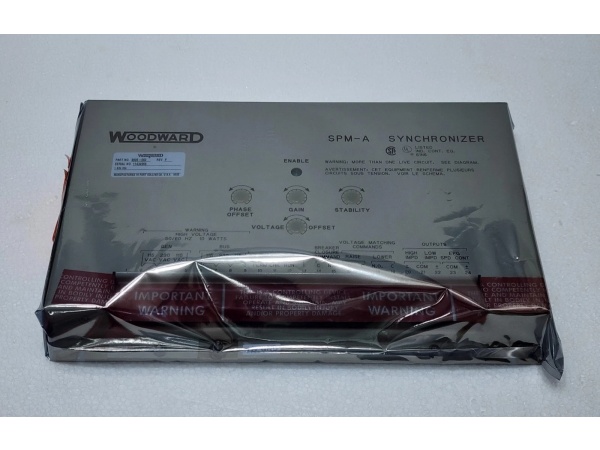
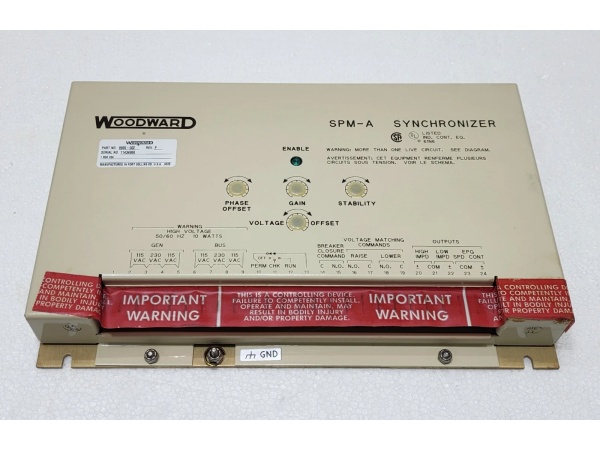
Description
Product Overview
The Woodward 9905-002 is a SPM-A series base-model synchronization module designed for industrial generator and turbine control systems. It serves as a critical interface for synchronizing offline generators/turbines with an online system (e.g., utility grid or another generator) before paralleling. As part of Woodward’s SPM-A ecosystem—renowned for precision synchronization—the 9905-002 is optimized for standard industrial environments (e.g., power plants, cogeneration facilities, marine engine rooms) where reliable grid compliance and uptime are essential.
Its core function is to match the offline unit’s frequency, phase, and voltage to the online system within strict tolerances, then send a contact closure signal to close the circuit breaker—enabling smooth power transfer without electrical faults (e.g., phase mismatch, frequency surges). The 9905-002 is the predecessor to revised versions like the 9905-002N (Rev. N, with updated firmware/hardware), retaining the foundational synchronization capabilities of the SPM-A platform.
Key Technical Specifications
Insights from Woodward SPM-A series documentation and industrial supplier listings reveal the following parameters for the 9905-002 (base version):
-
Input Voltage: 115 VAC RMS or 230 VAC RMS (supports both European and North American power standards).
-
Frequency Range: 50 to 60 Hz (compatible with global grid frequencies).
-
Synchronization Tolerances:
-
Frequency: ±0.1 Hz (matches online system frequency).
-
Phase Angle: ±10° (aligns generator phase with the online system).
-
Voltage: 1–5% (adjusts generator voltage to match the online system).
-
-
Output Options:
-
High impedance (for 2301 load sharing systems).
-
Low impedance (for 2301A, EPG, and 2500 load sharing systems).
-
EPG output (for EPG controls without load sharing).
-
Breaker closure signal (dry contact, 24 Vdc/2A).
-
-
Power Consumption: ≤10 W (low-power design for continuous operation).
-
Operating Temperature: -20°C to +70°C (-4°F to +158°F) (suitable for indoor industrial environments).
-
Mounting: Panel-mounted (fits standard industrial control cabinets).
-
Certifications: CE, UL (compliant with international industrial safety standards).
-
Dimensions: ~250 mm × 180 mm × 80 mm (9.8in × 7.1in × 3.1in) – compact for space-constrained panels.
-
Weight: ~3.5 kg (7.7 lbs) – lightweight for easy handling.

Woodward 9905-002
Field Application & Problem Solved
In industrial power systems, improper generator synchronization (e.g., frequency mismatch, phase misalignment) can lead to:
-
Electrical Faults: Short circuits, voltage spikes, or equipment damage (e.g., generator windings).
-
Grid Penalties: Fines for frequency deviations (e.g., >±0.5 Hz from 50/60 Hz).
-
Downtime: Generator tripping, process interruptions, or delayed grid connection.
The 9905-002 addresses these challenges by:
-
Automated Synchronization: Continuously monitors the online system’s frequency/phase and adjusts the offline generator’s speed via a control signal (e.g., to a Woodward 2301A governor).
-
Tight Tolerance Control: Ensures frequency (±0.1 Hz) and phase (±10°) alignment, meeting basic grid code requirements.
-
Seamless Breaker Closure: Sends a dry contact signal only when synchronization is achieved, preventing premature breaker closure.
Typical Applications:
-
Power Generation: Synchronizing standby diesel/gas generators to the utility grid during peak demand or outages.
-
Industrial Cogeneration: Paralleling turbine-driven generators with grid power to balance electrical/thermal loads.
-
Marine Propulsion: Synchronizing shipboard generators for auxiliary power.
Installation & Maintenance Pitfalls (Expert Tips)
To ensure reliable synchronization with the 9905-002:
-
Verify Voltage Compatibility:
-
Confirm the input voltage (115/230V AC) matches the module’s rating. Use a multimeter to check for voltage drops, which can disrupt synchronization.
-
-
Check Phase Angle Settings:
-
Adjust the phase angle matching range (±10°) per application needs. For example, power plants may require a tighter tolerance (±5°) for grid compliance.
-
-
Test Synchronization Logic:
-
After installation, simulate synchronization using a variable frequency drive (VFD) to adjust the generator’s speed. Verify the module sends a breaker closure signal only when all parameters are aligned.
-
-
Perform Regular Maintenance:
-
Inspect annually for loose connections, cracked casings, or corroded terminals. Clean connectors with isopropyl alcohol to remove debris.
Woodward 9905-002
-
Technical Deep Dive & Overview
The 9905-002 operates on Woodward’s SPM-A base synchronization algorithm, a proven method for generator paralleling:
-
Signal Reception: Measures the online system’s frequency, phase, and voltage via potential transformers (PTs) and current transformers (CTs).
-
Comparison & Adjustment: Compares the offline generator’s parameters to the online system. If mismatched, it sends a control signal to the generator’s governor (e.g., 2301A) to adjust speed (frequency) or excitation (voltage).
-
Phase Locking: Uses a phase-locked loop (PLL) circuit to align the generator’s phase with the online system once frequency/voltage are matched.
-
Breaker Closure: When all parameters are within tolerance, the module energizes a dry contact to close the circuit breaker, paralleling the generator.
Distinction from Revised Versions:
-
Unlike the 9905-002N (Rev. N, with updated firmware for better frequency stability and modern system compatibility), the 9905-002 is the base model with original SPM-A algorithm and hardware.
Final Notes
The Woodward 9905-002 is a foundational SPM-A series synchronizer for industrial generator/turbine control in standard environments. Its automated synchronization, tight tolerance alignment, and seamless integration with Woodward’s ecosystem make it ideal for basic grid-connection applications.
-
Upgrade Consideration: For enhanced performance (e.g., improved firmware, modern system compatibility), use the 9905-002N (Rev. N).
-
Maintenance: Follow Woodward’s SPM-A Series Synchronizer Manual (Document # SPM-A-OM-001) and consult certified technicians.