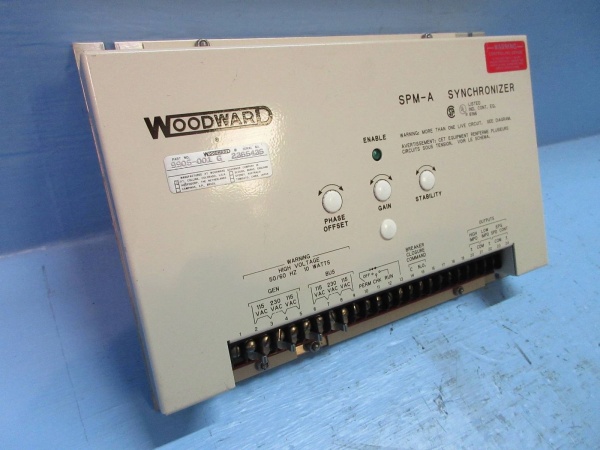
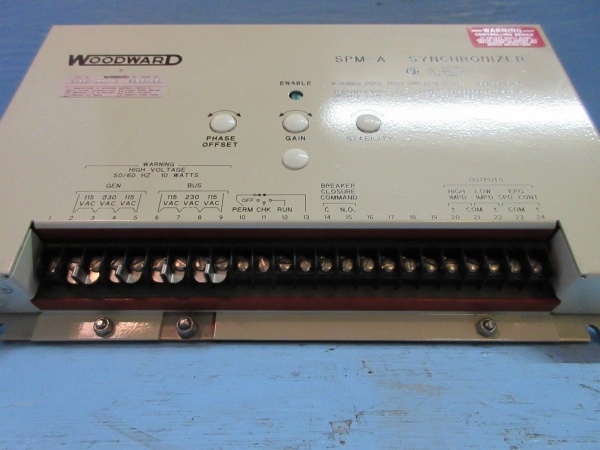
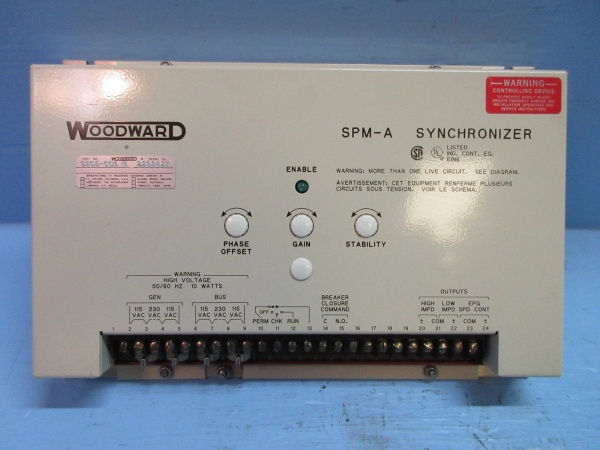
Description
Product Overview
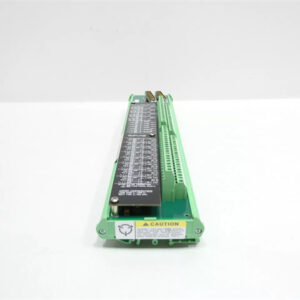
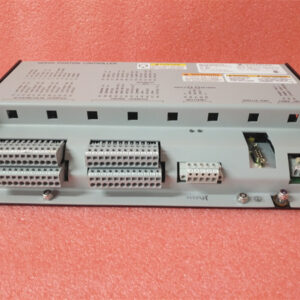
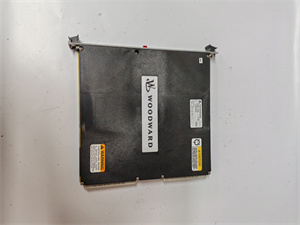
The Woodward 9905-798 is a 2301A series electronic load sharing and speed controller designed for industrial generator sets and prime movers (e.g., diesel engines, gas turbines, steam turbines). It serves as the “brain” of the control system, responsible for maintaining precise speed stability (critical for grid compliance) and distributing load evenly among parallel generator sets (to maximize efficiency and prevent overloads).
As part of Woodward’s 2301A ecosystem, the 9905-798 is widely used in applications where reliable power generation and optimal load management are paramount—such as power plants, cogeneration facilities, marine propulsion systems, and oil & gas installations. Its menu-driven programming interface allows engineers to customize settings (e.g., speed setpoints, load sharing ratios) for specific applications, making it a versatile solution for diverse industrial needs.
Key Technical Specifications
Insights from Woodward 2301A series documentation and industrial supplier listings reveal the following key parameters for the 9905-798:
-
Power Supply:
-
Low-voltage model: 20–40 VDC (for smaller prime movers).
-
High-voltage model: 88–132 VAC (50/60 Hz) or 90–152 VDC (for larger turbines/generators).
-
-
Input Signals:
-
Accepts 4–20 mA current signals (from CTs/scalar sensors) and 0–10 VDC voltage signals (from PTs/potentiometers).
-
Supports up to 12 programmable digital inputs (e.g., start/stop commands, fault signals).
-
-
Output Signals:
-
4–20 mA analog output (for driving actuators/valves).
-
Up to 6 programmable relay outputs (for alarms, breaker control, or load shedding).
-
-
Speed Control Range: 500–12,000 RPM (configurable via software).
-
Load Sharing Accuracy: ±1% (ensures balanced load distribution among parallel generators).
-
Protection Functions:
-
Overspeed protection (independent of main control system).
-
Reverse power protection (prevents generator from motoring).
-
Loss-of-speed-signal protection (triggers alarm/shutdown if speed sensor fails).
-
-
Operating Temperature: -20°C to +70°C (-4°F to +158°F) (suitable for indoor/outdoor industrial environments).
-
Certifications: CE, UL (compliant with international industrial safety standards).

WOODWARD 9905-001-G
Field Application & Problem Solved
In industrial generator operations, poor speed control (e.g., frequency drift) or unbalanced load distribution (e.g., one generator overloaded while others idle) can lead to:
-
Grid penalties (e.g., fines for frequency deviations).
-
Equipment damage (e.g., generator overheating, turbine blade fatigue).
-
Downtime (e.g., generator tripping, process interruptions).
The 9905-798 addresses these challenges by:
-
Precision Speed Regulation: Using a PID (Proportional-Integral-Derivative) control algorithm, it maintains the prime mover’s speed within ±0.1% of the setpoint—critical for grid compliance (e.g., 50/60 Hz frequency stability).
-
Intelligent Load Sharing: It communicates with other 2301A series controllers (via a shared bus) to distribute load evenly among parallel generator sets. For example, if one generator’s load exceeds 80%, the 9905-798 automatically shifts load to idle generators—maximizing efficiency and preventing overloads.
-
Fault Tolerance: Built-in protection functions (e.g., overspeed, reverse power) trigger immediate alarms or shutdowns if abnormal conditions are detected—minimizing downtime and equipment damage.
Typical Applications:
-
Power Generation: Controlling standby generators during peak demand or grid outages.
-
Cogeneration: Balancing electrical and thermal loads by paralleling turbines with driven equipment (e.g., compressors).
-
Marine Propulsion: Synchronizing shipboard generators for auxiliary power generation.
Installation & Maintenance Pitfalls (Expert Tips)
To ensure optimal performance of the 9905-798, follow these best practices:
-
Power Supply Compatibility:
-
Verify that the input voltage (20–40 VDC or 88–152 VDC/VAC) matches the model’s rating. Mismatched voltage can damage the internal circuitry—use a multimeter to check the power supply before installation.
-
-
Signal Wiring Best Practices:
-
Use shielded cables for all input/output signals (to reduce electromagnetic interference).
-
Separate power cables from signal cables (to prevent noise coupling).
-
Ensure proper grounding (all shields should be connected to a single-point ground).
-
-
Programming & Calibration:
-
Use Woodward’s menu-driven software (via a PC or handheld programmer) to configure settings (e.g., speed setpoints, load sharing ratios).
-
Calibrate the controller using a precision frequency meter (to ensure speed accuracy).
-
-
Regular Maintenance:
-
Inspect the 9905-798 annually for signs of wear (e.g., cracked casings, loose connections).
-
Clean the controller’s connectors with isopropyl alcohol (to remove dirt/debris that can cause communication failures).
-
Test protection functions (e.g., overspeed trip) quarterly to ensure they work properly.
WOODWARD 9905-001-G
-
Technical Deep Dive & Overview
The 9905-798 operates on Woodward’s 2301A control algorithm, which integrates three key functions:
-
Speed Sensing: The controller receives speed signals from a magnetic pickup (MPU) or encoder (mounted on the prime mover’s shaft). These signals are converted to a digital format for processing.
-
PID Control: The digital signal is compared to the desired speed setpoint. The PID algorithm calculates the error (difference between actual and setpoint speed) and adjusts the output signal to the actuator (e.g., fuel valve)—bringing the prime mover’s speed back to the setpoint.
-
Load Sharing: For parallel generator sets, the 9905-798 communicates with other controllers via a shared bus. It exchanges load data and adjusts each generator’s output to ensure balanced distribution.
What sets the 9905-798 apart is its flexibility—it can be configured for a wide range of prime movers (diesel, gas, steam) and applications (power generation, marine, industrial). Additionally, its menu-driven interface makes it easy to program and troubleshoot—reducing setup time and maintenance costs.
Final Notes
The Woodward 9905-798 is a critical component for ensuring reliable speed control and load management in industrial generator systems. Its precision, flexibility, and built-in protection functions make it an essential tool for maintaining grid compliance and maximizing operational efficiency.
When installing or maintaining the 9905-798, always adhere to Woodward’s guidelines (e.g., Manual 82389) and consult with a certified technician. For more detailed information, refer to Woodward’s official 2301A Series Technical Manual or contact Woodward’s customer support for application-specific advice.