Description
Product Overview
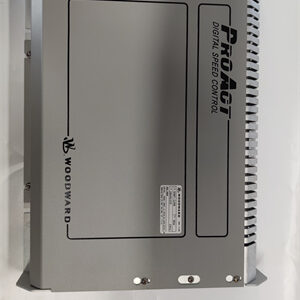
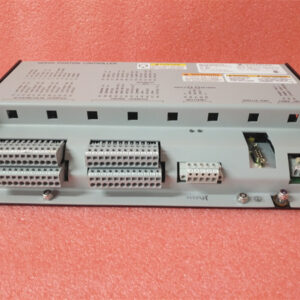
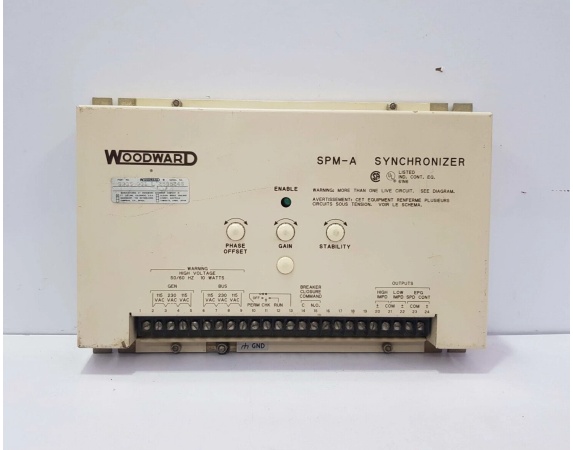
The Woodward 9905-930 is a first-generation digital governor from Woodward’s 505 series, developed in the 1980s–1990s for small-scale industrial turbine control. It served as an early solution for precise speed regulation and load sharing in applications like power generation (small hydro/turbine generators), mechanical drive (pumps/compressors), and process control (chemical/refinery turbines).
As a legacy product, the 9905-930 is now discontinued and has been replaced by Woodward’s newer 505D (for single-actuator turbines) and 505XT (for dual-actuator/turboexpanders) series, which offer enhanced features (e.g., graphic HMI, Modbus TCP communication, advanced diagnostics). However, it remains relevant for understanding the evolution of Woodward’s turbine control technology.
Key Technical Specifications
While detailed specs for the 9905-930 are limited due to its age, insights from Woodward 505 series documentation and industry archives suggest the following key parameters:
-
Input Signals:
-
1–2 magnetic pickup (MPU) inputs (for speed sensing, 1–10 Vrms).
-
4–20 mA analog inputs (for process variables like pressure/temperature).
-
-
Output Signals:
-
4–20 mA analog output (for actuator control, e.g., fuel valves/steam inlet).
-
Relay outputs (for alarms, e.g., overspeed/low oil pressure).
-
-
Control Modes:
-
Isochronous Mode: Maintains constant turbine speed (±0.5% tolerance) for standalone operation.
-
Droop Mode: Adjusts speed based on load (adjustable droop percentage) for parallel operation.
-
-
Actuator Compatibility: Works with Woodward proportional actuators (e.g., EG-3P) for fuel/steam valve positioning.
-
Operating Temperature: –20°C to +60°C (–4°F to +140°F) (suitable for indoor industrial environments).
-
Power Supply: 24 V DC (nominal, ±10% tolerance).
-
Dimensions: ~15 cm × 10 cm × 5 cm (6 in × 4 in × 2 in) (compact for panel mounting).
Field Application & Problem Solved
The 9905-930 was designed to address basic turbine control needs in small industrial settings, where precise speed regulation and load sharing were critical but advanced features (e.g., touchscreen HMIs, network communication) were not yet required. Typical applications included:
-
Power Generation: Controlling small hydro turbines or waste-heat recovery turbines in remote areas.
-
Mechanical Drive: Regulating pumps/compressors in chemical plants or refineries.
-
Process Control: Maintaining stable speed for turbines driving distillation columns or compressors.
Its primary value was simplicity and reliability—it provided accurate speed control without the complexity of modern digital systems, making it easy to install and maintain in resource-constrained environments.
Installation & Maintenance Pitfalls (Expert Tips)
Since the 9905-930 is a legacy product, installation and maintenance require specialized expertise (familiarity with 505 series hardware/software). Key considerations include:
-
Compatibility Checks:
-
Ensure that the turbine’s actuators (e.g., fuel valves) are compatible with the 9905-930’s 4–20 mA output. Mismatched signals can lead to erratic control—consult Woodward’s legacy actuator compatibility charts.
-
-
Sensor Calibration:
-
Use a precision tachometer to calibrate the magnetic pickup (MPU) sensors before installation. Incorrect sensor alignment can cause speed deviations—verify with a multimeter.
-
-
Software Configuration:
-
The 9905-930 uses a menu-driven interface for programming (via front-panel keys). Save configuration settings to a non-volatile memory module (NVM) to prevent data loss during power outages.
-
-
Spare Parts:
-
Since the 9905-930 is discontinued, source spare parts (e.g., circuit boards, potentiometers) from authorized Woodward distributors or third-party suppliers specializing in legacy industrial components.
-
Technical Deep Dive & Overview
The 9905-930 operates on Woodward’s first-generation digital control algorithm, which combines:
-
Speed Sensing: Magnetic pickup (MPU) sensors detect turbine shaft rotation, generating a frequency signal proportional to speed.
-
Signal Processing: The module’s analog-to-digital converter (ADC) converts the MPU signal to a digital value, which is compared to the speed setpoint.
-
Control Action: A proportional-integral (PI) controller adjusts the actuator output (4–20 mA) to minimize the error between the actual speed and setpoint.
-
Load Sharing: In parallel operation (droop mode), the 9905-930 communicates with other governors via a shared bus to distribute load evenly across turbines.
What set the 9905-930 apart from earlier mechanical governors was its digital precision—it eliminated drift and provided more accurate speed control than analog counterparts. However, it lacked the advanced features (e.g., Modbus communication, graphic HMIs) of modern Woodward governors like the 505D/XT.
Final Notes
The Woodward 9905-930 is a legacy digital governor that played a key role in the evolution of industrial turbine control. While it is no longer in production, its design principles (e.g., digital speed regulation, load sharing) remain foundational to modern Woodward products.
For current applications, Woodward recommends upgrading to the 505D/XT series, which offers enhanced features (e.g., touchscreen HMIs, Modbus TCP communication, advanced diagnostics) and better compatibility with modern industrial networks. If you are maintaining a system with a 9905-930, consult Woodward’s legacy support team for assistance with spare parts and technical guidance.