Description
System Architecture & Operational Principle
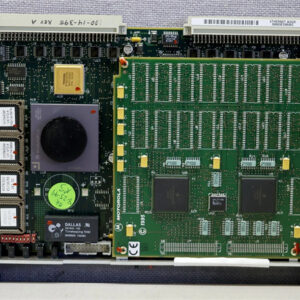
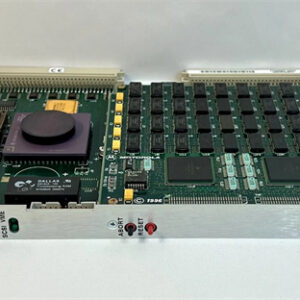
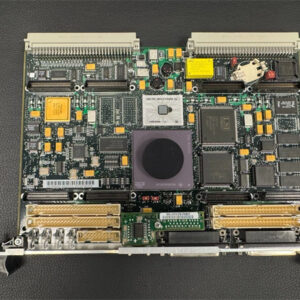
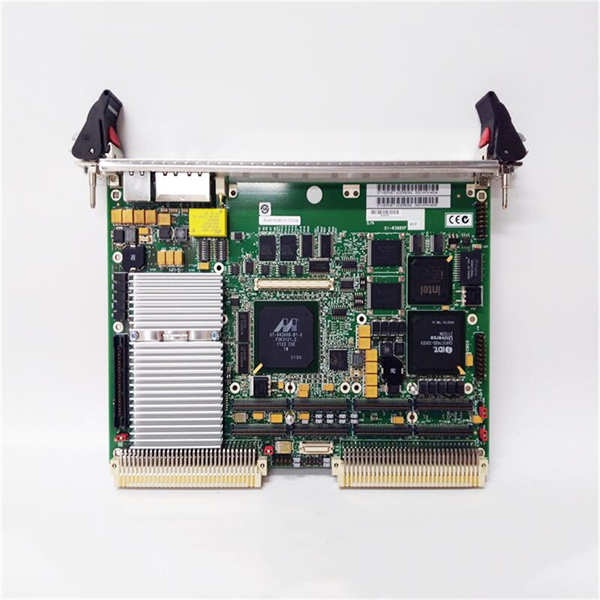
The MOTOROLA MVME55006E-0163R is a rugged, mid-range single board computer (SBC) designed for mission-critical industrial applications (e.g., power generation, infrastructure monitoring, aerospace test systems). It combines a high-performance PowerPC processor, ECC-protected memory, and multi-protocol communication interfaces to deliver reliable real-time computing in harsh environments.
Core Functional Blocks
The SBC is organized into four primary functional blocks, optimized for industrial embedded use:
-
Processing Unit:
-
CPU: Freescale PowerPC P2020 dual-core processor (1.0 GHz per core), featuring a 32 KB L1 instruction cache, 32 KB L1 data cache, and 512 KB L2 cache (shared between cores). The P2020 is optimized for real-time computing with a low-latency memory architecture, making it suitable for control algorithms (e.g., PID loops, turbine speed regulation).
-
Memory: 4 GB DDR3 SDRAM (ECC, 1600 MHz) for error-free data storage and retrieval, plus 512 MB NAND flash (SLC, error-corrected) for firmware and application storage. The ECC memory prevents data corruption in high-reliability applications (e.g., power grid monitoring).
-
-
Bus Interface:
-
CompactPCI: 3U form factor (160 mm × 100 mm × 12.7 mm) compliant with CompactPCI standards, supporting 32-bit/66 MHz operation. This allows the SBC to integrate with legacy CompactPCI systems while providing backward compatibility with VMEbus (via adapter cards).
-
PMC/XMC Slot: One 64-bit PMC/XMC slot supporting PCI Express x4 or PCI bus, enabling expansion with specialized modules (e.g., A/D converters, communication cards).
-
-
I/O Subsystem:
-
Ethernet: Two Gigabit Ethernet ports (RJ45, IEEE 802.3) with VLAN and LACP support, enabling high-speed data transfer to SCADA systems or enterprise networks.
-
Serial: Two RS-232/422/485 serial ports (isolated, 15 kV ESD protection) for legacy device integration (e.g., sensors, actuators).
-
USB: Two USB 2.0 ports (Type A, industrial-grade) for connecting peripheral devices (e.g., keyboards, mice, storage devices).
-
Digital I/O: 16x digital input/output lines (isolated, 24 VDC) for direct control of field devices (e.g., relays, solenoids).
-
-
Power & Cooling:
-
Power Supply: 5 VDC ±5% (from CompactPCI backplane), with a maximum power consumption of 14 W (full load) and 9 W (typical, idle).
-
Cooling: Conduction-cooled (no fans) for reliable operation in harsh environments (-40°C to +70°C). The rugged design resists shock (50 g peak acceleration) and vibration (8 g random vibration), making it suitable for industrial sites (e.g., power plants, factories).
-
Operational Workflow
-
Power-Up: The SBC draws power from the CompactPCI backplane (5 VDC) and initializes the firmware (stored in NAND flash).
-
Boot Process: The firmware configures the PowerPC P2020 processor, memory, and I/O interfaces, then boots the operating system (e.g., VxWorks 7, Linux).
-
Task Execution: The dual-core processor executes real-time control programs (e.g., turbine speed regulation, data acquisition) and communicates with field devices via the I/O subsystem.
-
Data Transfer: High-speed Ethernet ports handle network communication (e.g., uploading data to SCADA systems), while the CompactPCI interface enables expansion with additional modules for specialized tasks.

MOTOROLA MVME55006E-0163R
Core Technical Specifications
|
Parameter
|
Specification
|
|---|---|
|
Processor
|
Freescale PowerPC P2020 dual-core (1.0 GHz per core)
|
|
Cache
|
32 KB L1 I-cache/32 KB L1 D-cache (per core), 512 KB shared L2 cache
|
|
Memory
|
4 GB DDR3 SDRAM (ECC, 1600 MHz); 512 MB NAND flash (SLC, error-corrected)
|
|
CompactPCI Interface
|
3U form factor, 32-bit/66 MHz, compliant with CompactPCI standards
|
|
Expansion Slots
|
1x PMC/XMC slot (PCI Express x4/PCI); 1x CompactPCI interface
|
|
I/O Ports
|
2x Gigabit Ethernet (RJ45); 2x RS-232/422/485 serial; 2x USB 2.0; 16x digital I/O
|
|
Operating Temperature
|
-40°C to +70°C (industrial-grade)
|
|
Power Consumption
|
14 W max (full load); 9 W typical (idle)
|
|
Shock Resistance
|
50 g peak acceleration (11 ms duration, half-sine wave)
|
|
Vibration Resistance
|
8 g (10 Hz – 2000 Hz, random vibration, 1 hour per axis)
|
|
Certifications
|
UL 61010-1, CSA C22.2 No. 61010-1, IEC 61010-1; ATEX II 3G Ex nA IIC T4 Ga
|
Customer Value & Operational Benefits
1. Reliable Real-Time Processing
The PowerPC P2020 dual-core processor and 4 GB ECC DDR3 SDRAM enable the MVME55006E-0163R to handle complex control algorithms (e.g., PID loops for turbine speed regulation) and large datasets (e.g., from 100+ sensors) with low latency. This is critical for applications like power generation (maintaining grid frequency) and infrastructure monitoring (detecting anomalies in real time).
2. Rugged Durability for Harsh Environments
The -40°C to +70°C operating temperature range and shock/vibration resistance (50 g shock, 8 g vibration) make the SBC suitable for:
-
Power Plants: Turbine control systems, where high temperatures and vibration are common.
-
Factories: Automated production lines, where dust and moisture are present.
-
Aerospace: Test benches for aircraft components, where reliability is critical.
3. Flexible Expansion for Custom Applications
The PMC/XMC slot and CompactPCI interface allow users to add custom functionality (e.g., A/D conversion modules for sensor data acquisition, communication cards for legacy device integration) without modifying the core SBC. This flexibility is ideal for prototype development and system upgrades.
4. Long-Term Availability & Lifecycle Support
Emerson Automation Solutions provides long-term support for the MVME55006E-0163R, including spare parts and firmware updates. This reduces the risk of obsolescence for critical infrastructure (e.g., power grids, transportation systems), where replacing the entire system is not feasible.
Field Engineer’s Notes (From the Trenches)
When installing the MVME55006E-0163R, always verify the CompactPCI backplane voltage (5 VDC ±5%) with a multimeter before powering up—incorrect voltage can damage the SBC. I once saw a technician fry a board because he used a non-regulated power supply.Check the PMC/XMC slot alignment before inserting expansion cards—misalignment can damage the slot pins. Use the guide rails on the chassis to ensure proper alignment.Test the Ethernet ports (ping the device’s IP address) after installation—use a crossover cable if connecting directly to a laptop. I’ve spent hours troubleshooting “no comms” faults only to find a bad Ethernet cable.
Real-World Applications
1. Power Generation: Turbine Speed Regulation
A U.S. power plant uses the MVME55006E-0163R to control a 500 MW gas turbine. The SBC’s PowerPC P2020 processor executes PID loops to adjust fuel flow and turbine speed, maintaining grid frequency (50/60 Hz) within strict limits. The dual Gigabit Ethernet ports enable remote monitoring via the plant’s SCADA system, while the digital I/O lines control the turbine’s actuators (e.g., fuel valves).
2. Infrastructure Monitoring: Power Grid Data Acquisition
A utility company uses the MVME55006E-0163R to collect data from 100+ sensors (e.g., voltage, current, temperature) in a power distribution network. The SBC’s 4 GB ECC DDR3 SDRAM stores the data temporarily before uploading it to the company’s enterprise network via the Ethernet ports. The rugged design ensures reliable operation in outdoor substations, where temperature extremes and vibration are common.
3. Aerospace: Test Bench Data Acquisition
An aerospace manufacturer uses the MVME55006E-0163R to collect data from a jet engine test bench. The SBC’s PMC/XMC slot adds an A/D conversion module for high-precision sensor data acquisition (e.g., pressure, temperature), while the PowerPC P2020 processor analyzes the data in real time. The -40°C to +70°C operating temperature range ensures reliable operation in the test bench’s harsh environment.