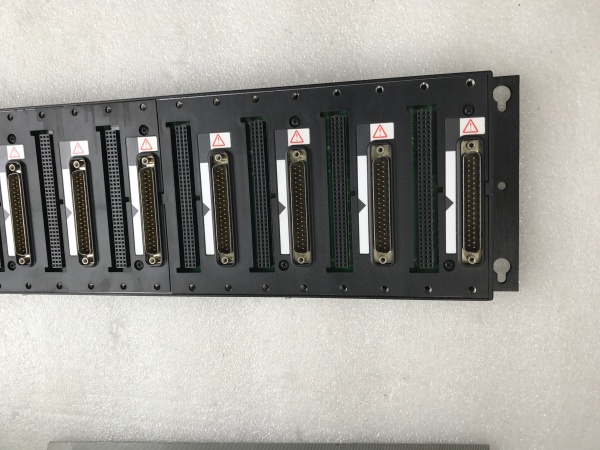
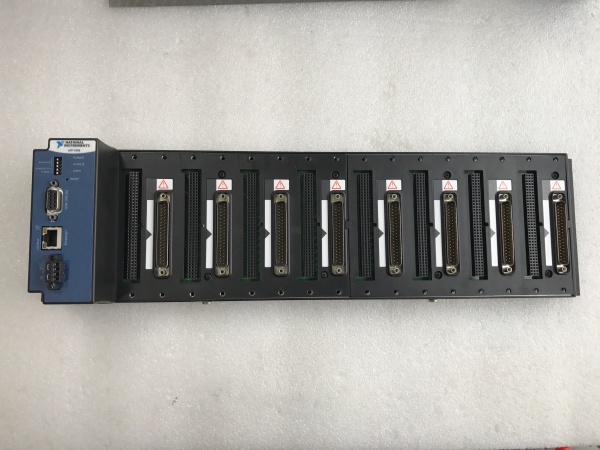
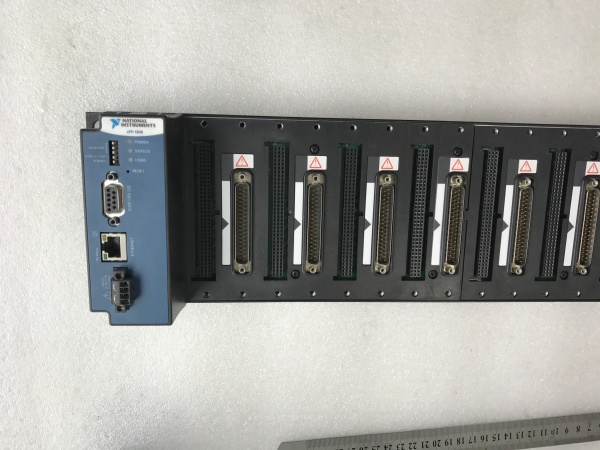
Description
System Architecture & Operational Principle
The NI CFP-1808 is an 8-slot backplane designed for NI’s Compact FieldPoint distributed I/O system, serving as the physical and logical backbone for connecting I/O modules to upstream control systems (e.g., PCs, PLCs, or Compact FieldPoint embedded controllers). It operates at Purdue Model Level 1 (Process Control), bridging field devices (sensors, actuators) and higher-level control systems.
Core Functional Blocks
-
Backplane Architecture: Provides 8 hot-swappable slots for Compact FieldPoint I/O modules (e.g., analog input/output, digital I/O, temperature measurement). The backplane distributes power (up to 9 W per module) and communication signals between modules and the network interface.
-
Network Interfaces:
-
Ethernet Port: 10BaseT/100BaseTX auto-negotiating Ethernet port for high-speed communication with PCs, PLCs, or other networked devices. Supports third-party protocols (Modbus TCP, OPC) and NI’s event-driven Ethernet protocols.
-
RS232 Serial Port: For legacy device integration or direct configuration of I/O modules via serial commands.
-
-
Power Supply: Accepts 11–30 VDC input (recommended 20 W power supply) to power the backplane and connected I/O modules. Includes overcurrent and overvoltage protection.
-
Configuration Tools: Managed via NI Measurement & Automation Explorer (MAX) and NI-FieldPoint driver software, enabling IP address assignment, module configuration, and diagnostics.
Operational Workflow
-
I/O Module Installation: Compact FieldPoint I/O modules are inserted into the CFP-1808’s slots, where they receive power and communication links from the backplane.
-
Network Connection: The CFP-1808 is connected to an Ethernet network (via the Ethernet port) or a serial device (via the RS232 port).
-
Configuration: Using MAX, the user assigns an IP address to the CFP-1808, configures the attached I/O modules (e.g., input ranges, sampling rates), and sets up communication protocols (e.g., Modbus TCP).
-
Data Exchange: The CFP-1808 transmits data from I/O modules to the host system (e.g., a LabVIEW application) via Ethernet or serial, and receives control commands from the host to adjust I/O module behavior (e.g., turning on a relay).
-
Diagnostics: The backplane provides real-time status information (e.g., module presence, network connectivity) via MAX, helping users troubleshoot issues quickly.

NI CFP-1808
Core Technical Specifications
|
Parameter
|
Specification
|
|---|---|
|
Slots
|
8 hot-swappable slots for Compact FieldPoint I/O modules
|
|
Network Interface
|
10BaseT/100BaseTX Ethernet (auto-negotiated), RS232 serial port
|
|
Communication Rates
|
Ethernet: 10/100 Mbps; Serial: 300–115,200 bps
|
|
Power Input
|
11–30 VDC (recommended 20 W power supply)
|
|
Max Power to Modules
|
9 W per slot (total 72 W for 8 slots)
|
|
Operating Temperature
|
-40°C to +70°C (ambient, non-condensing)
|
|
Storage Temperature
|
-55°C to +85°C
|
|
Humidity
|
10–90% RH (non-condensing)
|
|
Shock/Vibration
|
50 g shock (3 ms half sine), 5 g vibration (10–500 Hz)
|
|
Dimensions
|
245.9 mm (H) × 127 mm (W) × 100 mm (D) (approx.)
|
|
Weight
|
1.595 kg (3 lb 8 oz)
|
Customer Value & Operational Benefits
1. Modular Expandability for Growing Systems
The CFP-1808’s 8 slots allow users to scale their I/O capacity incrementally—adding modules for analog input, digital output, or specialized measurements (e.g., temperature, strain) as their system needs evolve. This modularity reduces upfront costs (users only buy the slots they need) and minimizes downtime (modules can be added/hot-swapped without shutting down the system).
2. Flexible Network Integration
With both Ethernet and RS232 interfaces, the CFP-1808 supports hybrid network environments—connecting to modern Ethernet-based systems (e.g., LabVIEW, PLCs) and legacy serial devices (e.g., old sensors, actuators). This flexibility avoids costly system overhauls, as users can integrate new and old equipment seamlessly.
3. Rugged Reliability for Harsh Environments
The CFP-1808’s -40°C to +70°C operating temperature range and 50 g shock/5 g vibration resistance make it suitable for harsh industrial environments (e.g., factory floors, outdoor test sites). The overcurrent/overvoltage protection safeguards both the backplane and connected I/O modules from power surges, reducing the risk of downtime.
4. Simplified Configuration & Diagnostics
NI’s MAX software provides a graphical interface for configuring the CFP-1808 and attached I/O modules, eliminating the need for complex command-line tools. Real-time diagnostics (e.g., “module not detected,” “network disconnected”) help users identify and resolve issues quickly, minimizing mean-time-to-repair (MTTR).
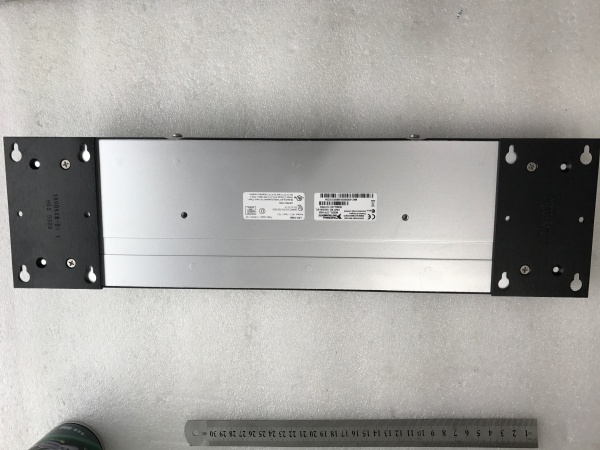
NI CFP-1808
Field Engineer’s Notes (From the Trenches)
When installing the CFP-1808, always use shielded Ethernet cables (e.g., Cat5e STP) to minimize electromagnetic interference (EMI). I once saw a site lose communication with their I/O modules because they used unshielded cables, leading to 4 hours of downtime.Verify the power supply voltage (11–30 VDC) with a True-RMS multimeter before connecting the CFP-1808. Low voltage (e.g., 10 VDC) can cause the backplane to reset intermittently, while high voltage (e.g., 35 VDC) can damage the power circuitry.Hot-swap modules carefully—pull the module straight out of the slot to avoid bending the pins. I once had a site break a module’s connector by pulling it at an angle, resulting in a $500 replacement cost.Update the NI-FieldPoint driver annually (via NI’s website) to fix bugs and improve compatibility with new I/O modules. A 2023 driver update resolved a “module recognition” issue that affected 10% of CFP-1808 systems.
Real-World Applications
1. Manufacturing Production Line Automation
A automotive parts manufacturer uses the CFP-1808 to connect 8 analog input modules (for temperature and pressure sensors) and 4 digital output modules (for relays) to a LabVIEW-based control system. The Ethernet interface enables real-time data acquisition (1 kHz sampling rate) from the sensors, while the digital outputs control the activation of hydraulic presses. The CFP-1808’s hot-swap capability allows the manufacturer to replace a faulty analog module during production without shutting down the line, reducing downtime by 25%.
2. Outdoor Environmental Monitoring
A research institute uses the CFP-1808 to connect 8 temperature/humidity sensors (via analog input modules) to a remote PC via Ethernet. The CFP-1808 is housed in a weatherproof enclosure (IP65) and powered by a solar panel (12 VDC). The RS232 port is used to configure the sensors initially, while the Ethernet port transmits data to the PC for real-time monitoring. The -40°C to +70°C operating temperature range ensures reliable operation in extreme weather conditions (e.g., -30°C winters, 60°C summers).