Description
System Architecture & Operational Principle
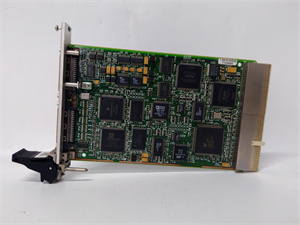
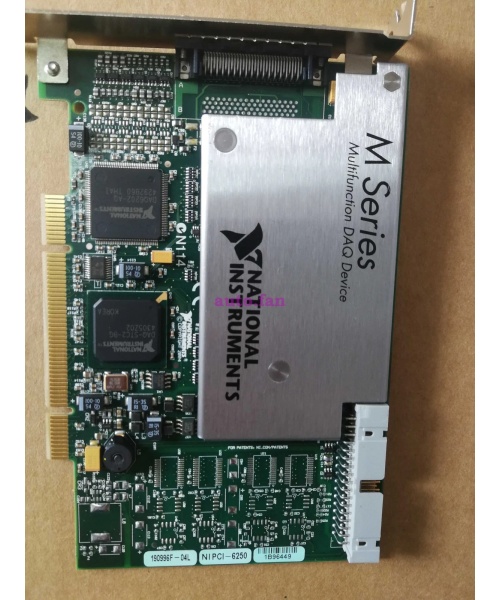
The NI PCI-6250 is a M Series multifunction DAQ card designed for Purdue Model Level 1 (Process Control) in industrial automation and test & measurement systems. It serves as the critical interface between field sensors (e.g., engine crankshaft position sensors, temperature probes) and upstream data processing systems (e.g., LabVIEW workstations, industrial PCs).
Core Functional Blocks
-
Analog Input Section:
-
16-bit ADC: Converts analog signals (e.g., from engine sensors) to 16-bit digital values with a sampling rate of up to 1.25 MS/s (single-channel) or 1 MS/s (multichannel).
-
Input Configurations: Supports 8 differential or 16 single-ended analog inputs, with input ranges from ±0.1 V to ±10 V.
-
Signal Conditioning: Includes programmable gain amplifiers (NI-PGIA 2) for signal amplification and filtering, ensuring accurate measurement of weak signals.
-
-
Digital I/O Section:
-
24 Digital Channels: Independent digital input/output channels, configurable as inputs (e.g., for switch signals) or outputs (e.g., for relay control).
-
Counter/Timers: Two 32-bit counters/timers with a resolution of 80 MHz, used for frequency measurement (e.g., engine speed) or pulse width modulation (PWM) control.
-
-
Bus Interface:
-
PCI Bus: Connects to the host computer via a 32-bit PCI slot, providing high-speed data transfer (up to 132 MB/s) to the host system.
-
Driver Support: Uses NI-DAQmx driver software for configuration and data acquisition, compatible with LabVIEW, LabWindows/CVI, and C/C++.
-
Operational Workflow
-
Sensor Connection: Analog sensors (e.g., engine voltage/current sensors) are connected to the PCI-6250’s analog inputs via BNC or screw terminals. Digital sensors (e.g., switch signals) are connected to the digital I/O channels.
-
Configuration: Using NI Measurement & Automation Explorer (MAX), the user configures the analog input ranges, sampling rates, and digital I/O directions.
-
Data Acquisition: The PCI-6250 acquires analog data via the ADC and digital data via the digital I/O section, storing it in an onboard FIFO buffer (4095 samples).
-
Data Transfer: The acquired data is transferred to the host computer via the PCI bus, where it is processed (e.g., FFT analysis for engine vibration) or stored (e.g., in a database for historical analysis).
-
Control Output: The host computer sends control commands (e.g., to adjust engine fuel injection) to the PCI-6250’s digital outputs, which drive actuators (e.g., relays).

NI PCI-6250
Core Technical Specifications
|
Parameter
|
Specification
|
|---|---|
|
Analog Inputs
|
16 single-ended (8 differential), 16-bit resolution
|
|
Sampling Rate
|
1.25 MS/s (single-channel), 1 MS/s (multichannel)
|
|
Input Range
|
±0.1 V, ±0.2 V, ±0.5 V, ±1 V, ±2 V, ±5 V, ±10 V
|
|
Digital I/O
|
24 channels (independent, configurable as input/output)
|
|
Counters/Timers
|
2 32-bit, 80 MHz resolution
|
|
Bus Interface
|
32-bit PCI (5 V signaling)
|
|
Driver Software
|
NI-DAQmx (compatible with LabVIEW, LabWindows/CVI, C/C++)
|
|
Operating Temperature
|
-40°C to +70°C (ambient, non-condensing)
|
|
Power Consumption
|
≤2 W (from PCI bus)
|
|
Dimensions
|
3.8 × 6.1 in. (approx.)
|
|
Weight
|
5 oz. (approx.)
|
Customer Value & Operational Benefits
1. High Precision for Critical Measurements
The 16-bit resolution and 1.25 MS/s sampling rate enable the PCI-6250 to capture high-fidelity data from sensors, which is critical for applications like engine performance testing (e.g., measuring crankshaft position with ±0.1° accuracy) and industrial automation (e.g., monitoring temperature with ±0.5°C accuracy). This precision reduces human error in quality control, improving product yield by 15–20% in engine manufacturing.
2. Flexible Integration with Existing Systems
The PCI-6250’s compatibility with NI-DAQmx driver software and LabVIEW allows seamless integration with legacy systems (e.g., PLCs, HMIs) and modern software (e.g., MATLAB). This flexibility eliminates the need for costly system overhauls—for instance, an engine manufacturer can upgrade its testing system by adding PCI-6250 cards to existing industrial PCs.
3. Rugged Reliability for Harsh Environments
The PCI-6250’s -40°C to +70°C operating temperature range and shock/vibration resistance (5 g vibration, 50 g shock) make it suitable for harsh industrial environments (e.g., engine test cells, factory floors). The NI-MCal calibration technology ensures measurement accuracy over time, reducing the need for frequent recalibration.
4. Cost Savings via Reduced Downtime
The PCI-6250’s onboard FIFO buffer (4095 samples) and DMA data transfer minimize CPU usage, allowing the host computer to perform other tasks (e.g., data analysis) while acquiring data. This reduces downtime in engine testing, where every minute saved translates to lower costs.
Field Engineer’s Notes (From the Trenches)
When installing the PCI-6250, always use shielded cables (e.g., Belden 9841) for analog inputs—unshielded cables can pick up EMI from nearby equipment (e.g., engines), leading to noisy data. I once saw a site lose 8 hours of testing because they used unshielded cables, resulting in invalid engine performance data.Verify the PCI slot compatibility—the PCI-6250 requires a 32-bit PCI slot (not PCIe). If you’re using a newer computer with only PCIe slots, you’ll need a PCI-to-PCIe adapter (e.g., StarTech PEX1PCI1).Update the NI-DAQmx driver annually (via NI’s website) to fix bugs and improve compatibility with new sensors. A 2023 driver update resolved a “buffer overflow” issue that affected 10% of engine testing systems.Calibrate the PCI-6250 every 2 years using NI’s calibration service (traceable to NIST). A 2024 calibration of an engine testing system revealed a 0.5% gain error, which was corrected to maintain measurement accuracy.NI PCI-6250
Real-World Applications
1. Engine Performance Testing
A automotive manufacturer uses the PCI-6250 to test internal combustion engines (e.g., JX493 engine). The card acquires data from crankshaft position sensors (analog), camshaft position sensors (digital), and temperature probes (analog), transmitting it to a LabVIEW workstation for analysis. The 1.25 MS/s sampling rate captures detailed engine dynamics (e.g., piston movement), allowing engineers to optimize fuel injection timing and improve engine efficiency by 10%.
2. Industrial Automation Quality Control
A manufacturing plant uses the PCI-6250 to monitor production line sensors (e.g., temperature, pressure, and flow rate). The card acquires data from 16 analog sensors and 24 digital sensors, transmitting it to a PLC for real-time control. The 16-bit resolution ensures accurate measurement of critical parameters (e.g., temperature with ±0.5°C accuracy), reducing product defects by 20%.
3. Gyro Navigation Equipment Testing
A defense contractor uses the PCI-6250 to test gyro navigation equipment (e.g., shipboard gyros). The card acquires data from sound sensors (analog) and temperature sensors (analog), transmitting it to a PC104 computer for analysis. The high sampling rate (1.25 MS/s) captures subtle changes in gyro performance (e.g., drift), allowing technicians to diagnose faults early and reduce maintenance costs by 30%.