Description
System Architecture & Operational Principle
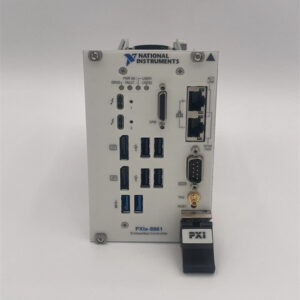
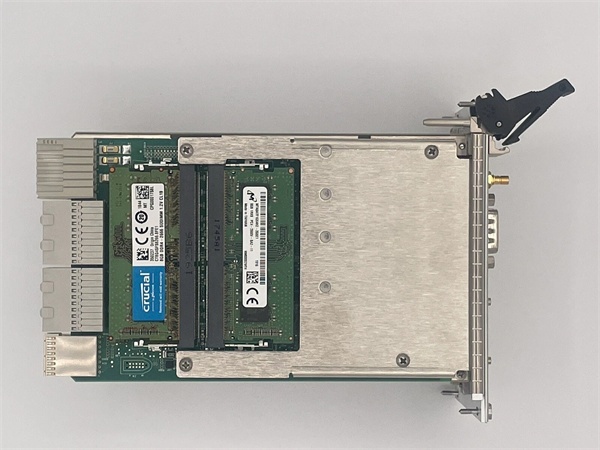
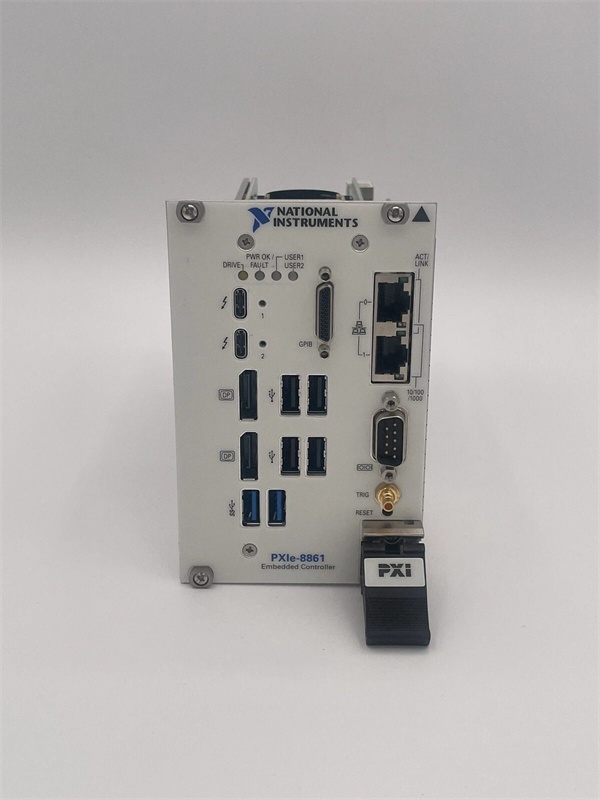
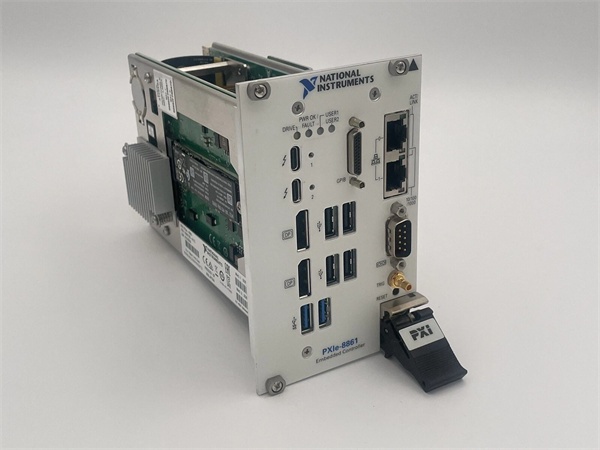
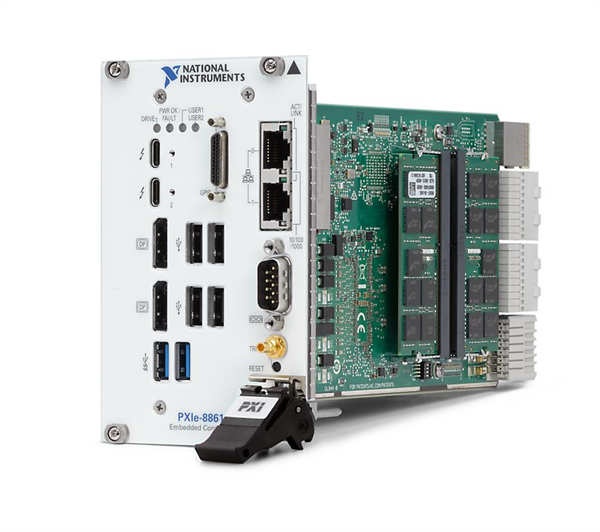
The NI PXIe-8861 is a 6U PXIe embedded controller designed to serve as the central processing unit for PXIe-based test, measurement, and automation systems. It integrates a high-performance Intel Xeon processor, ECC-protected memory, and high-speed I/O interfaces into a compact form factor, enabling seamless integration with PXIe I/O modules (e.g., data acquisition cards, signal generators) and external networks.
Core Functional Blocks
-
Processing Unit:
-
CPU: Intel Xeon E3-1515M v5 quad-core processor (2.8 GHz base, 3.7 GHz turbo) with 8 MB SmartCache. The Xeon architecture provides enhanced reliability and performance for compute-intensive tasks (e.g., real-time data processing, HIL simulation).
-
Memory: 32 GB DDR4 ECC SDRAM (expandable) for error-free data storage and retrieval, critical for applications like semiconductor testing where data integrity is paramount.
-
-
Bus Interface:
-
PXIe Backplane: Connects to the PXIe chassis via a x16 Gen 3 PCIe interface, supporting data transfer rates up to 16 GB/s. The backplane provides power, timing, and synchronization signals to the controller and I/O modules.
-
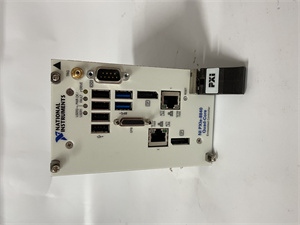
I/O Ports: Dual 10/100/1000Base-T Ethernet ports (for network communication), 2x Thunderbolt 3 ports (for high-speed peripheral connectivity), 4x USB 3.0 ports (for external devices), and 1x RS-232 serial port (for legacy equipment).
-
-
Storage:
-
NVMe SSD: 512 GB onboard NVMe solid-state drive for fast boot times and high-speed data storage, ideal for applications like RF signal recording or large-scale data acquisition.
-
Operational Workflow
-
Power-Up: The controller draws power from the PXIe chassis (via the backplane) and initializes the BIOS/UEFI firmware.
-
Boot Process: The firmware configures the processor, memory, and I/O interfaces, then boots the operating system (Windows 10 IoT Enterprise or NI Linux Real-Time).
-
Task Execution: The Xeon processor executes real-time control programs (e.g., HIL simulation, data acquisition) and communicates with I/O modules via the PXIe backplane.
-
Data Transfer: High-speed data from I/O modules is transferred to the controller’s memory or NVMe SSD for processing, then sent to external networks (e.g., SCADA systems) via Ethernet.

NI PXIe-8861
Core Technical Specifications
|
Parameter
|
Specification
|
|---|---|
|
Processor
|
Intel Xeon E3-1515M v5 quad-core (2.8 GHz base, 3.7 GHz turbo)
|
|
Memory
|
32 GB DDR4 ECC SDRAM (expandable to 64 GB)
|
|
Storage
|
512 GB NVMe SSD (onboard)
|
|
PXIe Interface
|
x16 Gen 3 PCIe (16 GB/s data transfer rate)
|
|
I/O Ports
|
2x 10/100/1000Base-T Ethernet, 2x Thunderbolt 3, 4x USB 3.0, 1x RS-232
|
|
Operating System
|
Windows 10 IoT Enterprise, NI Linux Real-Time
|
|
Power Consumption
|
~65 W typical (idle), 100 W max (full load)
|
|
Form Factor
|
6U PXIe (233.35 mm × 160 mm × 41 mm)
|
|
Weight
|
~2.6 kg (5.7 lbs)
|
|
Certifications
|
CE, UL, RoHS, MIL-STD-810F (vibration/shock)
|
Customer Value & Operational Benefits
1. High Performance for Compute-Intensive Applications
The Xeon E3-1515M v5 processor and 32 GB DDR4 ECC memory enable the PXIe-8861 to handle complex real-time tasks (e.g., HIL simulation for aerospace systems, RF signal processing for 5G testing) with low latency. The NVMe SSD ensures fast data access, reducing bottlenecks in high-throughput applications.
2. Reliable Data Integrity with ECC Memory
The ECC SDRAM prevents data corruption from single-bit errors, critical for applications like semiconductor testing (where a single bit flip can invalidate test results) or medical device validation (where data accuracy is regulated).
3. Flexible I/O for Diverse Applications
The dual Thunderbolt 3 ports and Gigabit Ethernet ports allow seamless integration with external devices (e.g., high-speed cameras, spectrum analyzers) and networks (e.g., enterprise SCADA systems). The RS-232 port supports legacy equipment, ensuring backward compatibility.
4. Real-Time Capabilities with NI Linux RT
The NI Linux Real-Time operating system provides deterministic execution for time-critical tasks (e.g., closed-loop control in industrial automation), with sub-microsecond latency for I/O operations. This is essential for applications like motor control or power grid monitoring.

NI PXIe-8861
Field Engineer’s Notes (From the Trenches)
When installing the PXIe-8861, always verify the PXIe chassis power supply—the controller requires a minimum of 500 W from the chassis (check the chassis manual for exact requirements). I once saw a technician install the controller in a 300 W chassis, leading to intermittent resets. Use a multimeter to measure the chassis’s +12 V rail voltage (should be 11.4–12.6 V DC) before installation.Check the PXIe link status (via NI MAX) after installation—if the link is down, re-seat the controller and ensure the chassis fans are set to “HIGH” (adequate cooling is critical for the Xeon processor). I’ve spent hours troubleshooting “no comms” faults only to find the fans were set to “LOW,” causing the controller to overheat and shut down.Perform a self-calibration (via NI MAX) after installation—this corrects for variations in the controller’s environment (e.g., temperature, humidity) and ensures accurate measurements. I recommend doing this at least once a month, especially in environments with large temperature swings.
Real-World Applications
1. Hardware-in-the-Loop (HIL) Simulation for Aerospace
A defense contractor uses the PXIe-8861 to run HIL simulations for unmanned aerial vehicles (UAVs). The controller processes real-time data from simulated sensors (e.g., GPS, gyroscopes) and sends commands to the UAV’s flight control system, enabling testing of navigation algorithms without physical prototypes.
2. Automated Test Systems (ATE) for Semiconductors
A semiconductor manufacturer uses the PXIe-8861 as the core of its ATE for testing 5G RF chips. The controller coordinates multiple I/O modules (e.g., PXIe-5840 vector signal transceiver) to acquire and analyze RF signals, reducing test time by 40% compared to previous systems.
3. Industrial Automation for Power Grid Monitoring
A utility company uses the PXIe-8861 to monitor power grid substations. The controller collects data from 100+ sensors (e.g., voltage, current, temperature) via PXIe I/O modules and sends it to the company’s SCADA system in real time, enabling early detection of faults (e.g., transformer overheating).