Description
Product Overview
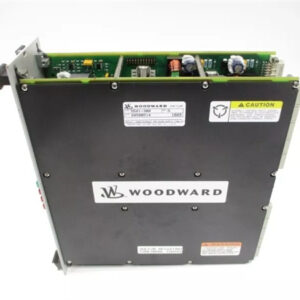
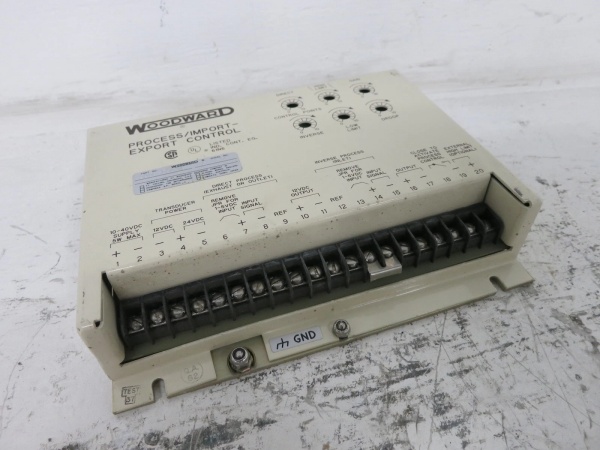
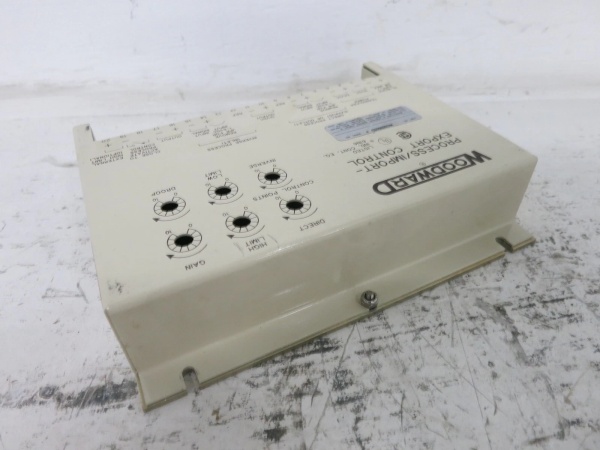
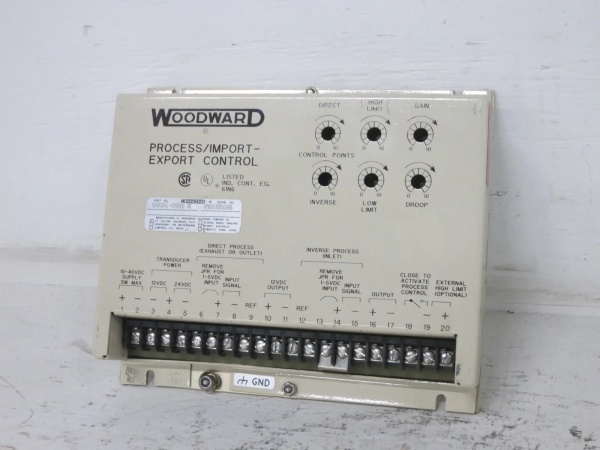
The Woodward 9905-131 is a reverse-acting variant of the 2301A series electronic load sharing and speed control module, engineered for industrial prime movers (e.g., diesel engines, gas turbines, generators) that require inverse control signal response from their actuators. Unlike standard 2301A modules (forward-acting, where output increases with input), the 9905-131’s reverse-acting design outputs a decreasing current signal (0–200 mA sink) as the input signal (e.g., speed error) increases—critical for actuators that close valves with increasing current or require negative feedback loops.
As part of Woodward’s 2301A ecosystem, the 9905-131 retains core functionalities: precision speed regulation (isochronous/droop modes) and automatic load sharing for parallel generator sets. Its unique value lies in compatibility with specialized equipment where forward-acting signals would cause instability (e.g., legacy hydraulic governors, certain fuel metering systems).
Key Technical Specifications
Insights from Woodward 2301A series documentation and industrial supplier listings (e.g., Emerson legacy catalogs, TurboSeek) reveal the following parameters for the 9905-131 (reverse-acting version):
-
Input Voltage: 20–40 Vdc (nominal 24 Vdc) – compatible with standard industrial DC power systems.
-
Control Modes:
-
Isochronous Mode: Maintains constant prime mover speed (±0.1% tolerance) for standalone/isolated bus operation.
-
Droop Mode: Adjusts speed based on load (adjustable droop percentage, 0–10%) for parallel operation.
-
-
Actuator Compatibility: Works with reverse-acting actuators (e.g., Woodward legacy EG-3R, third-party hydraulic valves requiring 0–200 mA sink signals that decrease with increased input).
-
Output Signal: Reverse-acting 0–200 mA sink (output current decreases as input error increases; e.g., 200 mA at zero error, 0 mA at maximum error).
-
Operating Temperature: -25°C to +60°C (-13°F to +140°F) – suitable for indoor industrial environments.
-
Certifications: CE, UL – compliant with international industrial safety standards.
-
Dimensions: Compact form factor (~280 mm × 210 mm × 90 mm) – fits standard industrial cabinets.
-
Weight: ~4.0 kg (8.8 lbs) – lightweight for easy handling.
-
Diagnostic Features: 4x LED indicators (power, run, fault, mode) – basic status monitoring.

Woodward 9905-090
Field Application & Problem Solved
In industrial systems with specialized reverse-acting actuators, standard 2301A modules (forward-acting) cause:
-
Actuator Instability: Forward signals (increasing current) may open valves instead of closing them, leading to overspeed or fuel starvation.
-
Control Loop Mismatch: Legacy systems designed for inverse signals fail to respond correctly to standard outputs.
The 9905-131 solves these by:
-
Reverse-Acting Output: Delivers a 0–200 mA sink signal that decreases as the prime mover deviates from the setpoint (e.g., 200 mA at perfect speed, 0 mA at maximum overspeed). This matches actuators that require less current to close valves or increase fuel flow.
-
Precision Speed/Load Control: Maintains ±0.1% speed accuracy (isochronous mode) and ±1% load sharing (droop mode), ensuring stability even with inverse actuation.
-
Legacy System Integration: Enables modernization of older plants with reverse-acting actuators without replacing the entire control infrastructure.
Typical Applications:
-
Legacy Power Plants: Upgrading diesel generator controls paired with reverse-acting hydraulic governors.
-
Marine Auxiliary Systems: Controlling older shipboard turbines with specialized fuel valves.
-
Industrial Cogeneration: Integrating with reverse-acting steam control valves in paper mills/refineries.
Installation & Maintenance Pitfalls (Expert Tips)
To ensure reliable operation with reverse-acting actuators:
-
Confirm Actuator Compatibility:
-
Verify the actuator requires a decreasing current signal (0–200 mA sink) for correct response. Use a multimeter to test the actuator’s reaction to varying currents.
-
-
Calibrate Reverse-Acting Output:
-
In isochronous mode, set the speed setpoint and adjust the output offset so 200 mA corresponds to the actuator’s “neutral” position. Use Woodward’s handheld programmer (Model 8923-xxxx) for fine-tuning.
-
-
Avoid Signal Conflicts:
-
Ensure no other control devices (e.g., PLCs) are sending conflicting signals to the actuator. Isolate the 9905-131’s output with a relay if needed.
-
-
Annual Actuator-Controller Sync Check:
-
Test the system at minimum/maximum load to confirm the actuator responds correctly to the reverse-acting output (e.g., 0 mA = full fuel cut, 200 mA = full fuel).
Woodward 9905-090
-
Technical Deep Dive & Overview
The 9905-131 operates on Woodward’s 2301A analog control platform with a reverse-acting output stage:
-
Signal Reception:
-
Accepts inputs from:
-
Speed sensor (magnetic pickup) for prime mover RPM.
-
Load sensor (current transformer) for generator output current.
-
Operator inputs (front-panel potentiometers) for speed setpoint/droop adjustment.
-
-
-
Processing & Control:
-
Analog circuitry with PID algorithms calculates the speed/load error. In standard 2301A modules, this error drives a forward-acting output; in the 9905-131, the error is inverted to produce a reverse-acting signal.
-
-
Reverse-Acting Output Stage:
-
A transistor array converts the PID output to a 0–200 mA sink signal, where higher error = lower current. For example:
-
Zero error (perfect speed): 200 mA output (actuator neutral/fully open, depending on design).
-
Maximum error (overspeed/underspeed): 0 mA output (actuator fully closed/restricted).
-
-
-
Monitoring:
-
Tracks overspeed, low oil pressure, and actuator faults via 4x LEDs. Triggers a relay alarm for critical errors.
-
Distinction from Forward-Acting 2301A Variants:
-
Output Polarity: Reverse-acting (0–200 mA sink decreases with error) vs. forward-acting (0–200 mA sink increases with error, e.g., 9905-068).
-
Actuator Pairing: Exclusively for reverse-acting actuators; incompatible with standard forward-acting valves.
Final Notes
The Woodward 9905-131 is a specialized reverse-acting 2301A series module designed for industrial prime mover control with legacy or specialized reverse-acting actuators. Its inverse output signal ensures compatibility with systems where standard forward-acting controllers would cause instability, making it a critical component for modernizing older facilities without full actuator replacement.
-
Choose 9905-131 if: Your system uses reverse-acting actuators (0–200 mA sink, decreasing with input) and requires 2301A-level precision.
-
Consider Alternatives: For standard forward-acting actuators, use 9905-068 (24 Vdc) or 9905-796 (enhanced actuator support).
Always refer to Woodward’s 2301A Series Reverse-Acting Module Manual (Document # 2301A-RA-001) for installation guidelines. For actuator calibration, consult the actuator manufacturer’s specifications.